Fiction
Fletcher on “Laughing Whitefish” and Tribal Customary Law
Matthew Fletcher posted “Laughing Whitefish: A Tale of Justice and Anishinaabe Custom” on SSRN. Here is the abstract:
Laughing Whitefish, a novel by Robert Traver, the pen name of former Michigan Supreme Court Justice John Voelker, is the fictionalized story of a case that reached the Michigan Supreme Court three times, culminating in Kobogum v. Jackson Iron Co., 43 N.W. 602 (Mich. 1889). The petitioner, Charlotte Kobogum, an Ojibwe Indian from the Upper Peninsula of Michigan, brought suit to recover under a note issued to her father, Marji Gesick, by the mining company in the 1840s. The company had promised a share in the company because he had led them to one of the largest iron ore deposits in the country, the famed Jackson Mine. Despite the company’s defense that Mr. Gesick was a polygamist and therefore Ms. Kobogum could not be his legitimate heir, the Michigan Supreme Court held that state courts had no right to interfere with internal, domestic relations of reservation Indians, and upheld the claim. Justice Voelker’s tale is a powerful defense of the decision, and offers insights into why state courts should recognize the judgments of tribal courts even today.

Sherman Alexie in The Stranger
An interview with Sherman Alexie, by Paul Constant in The Stranger:
H/T Indianz.com
It’s difficult to imagine Sherman Alexie as a tiny infant, fragile and vulnerable on the operating table in the shadow of a dire prognosis, although that’s where his life story began. He was born with hydrocephalus—water on the brain—and after a complex and risky brain operation at 6 months old, doctors believed he wouldn’t survive. Four decades later, nothing about him seems weak. He is tall and broad and seems made of denser material than everybody else. And he’s loud. When he laughs, he throws his head back and you can almost see the happy noise emanating outward in concentric circles. Continue reading
“American Indian Education” Profiled by ICT
From ICT:
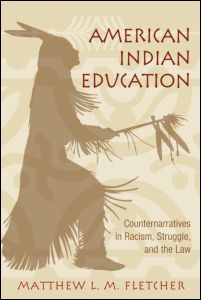
TEMPE, Ariz. – Matthew L.M. Fletcher is an associate professor at Michigan State University College of Law and he is the director of the Indigenous Law and Policy Center. He recently published, ”American Indian Education: Counternarrative in Racism, Struggle, and the Law” through Routledge. He graduated from University of Michigan Law School.
Indian Country Today: Why did you choose to pursue a career in law?
Matthew L.M. Fletcher: I just want to be able to contribute something to the community and I also was thinking in different ways, even before I started college, what I could do. I had talks with people who are from my community and elders from Michigan who talked a lot about how in the ’70s and ’80s, the big treaty fishing cases were going on and people were really happy with the outcomes with those cases but they were sad to see all the litigation conducted and organized and control by people that were not from the community.
ICT: Do you feel like you have helped your tribe?
Fletcher: I feel like I’ve contributed something and I continue to contribute something. My whole life will be a process of contributing. I think it has been real good.
ICT: What is the future of Indian law?
Fletcher: It’s interesting. The ’70s and ’80s were about litigating treaty rights. The key for Indian lawyers is not so much about going to court but it’s about developing governmental structures within the tribe which is what lawyers do. It’s actually a folly to go to federal courts now. All you have to do is ask anyone who does any kind of litigation in federal court if you’re representing a tribe or tribal interest you can’t expect to win. It’s going to be that way for a long time. The thing that you see is institution building within Indian country. There are some incredible things going on that are not getting a lot of attention. There is a lot of creativity with people bringing back indigenous culture and tradition.
ICT: How would you define sovereignty?
Fletcher: My view of sovereignty is that it is the right to make your own mistakes and to decide things for yourselves. That is really what it is about. Tribes have the wherewithal, the ability and the legal authority to pursue different avenues of governance. They are going to do something where everyone shakes their heads, and then they are going to do other things where people are going to just say, ”Wow.” There is an incredible amount of diversity and creativity going on right now.
Book Reading at Everybody Reads (Lansing) — October 25
I’ll be reading from my book “American Indian Education: Counternarratives in Racism, Struggle, and the Law” at Everybody Reads, located at 2019 E. Michigan, Lansing, Michigan. The reading and book signing will take place at October 25, 2008, from 1-3 PM.
More details here.
John Hughes, “Vacation,” and Indian Country
In the most recent issue of Zoetrope: All-Story, John Hughes, the screenwriter for the Chevy Chase movie “Vacation,” publishes the short story “Vacation ’58,” from which the movie eventually derived. It is one of the funnier short stories I’ve ever read, and it includes a set piece in Indian Country that was radically altered in the film. The entire text can be read here.
The set piece in the film is the scene that takes place in St. Louis, where the Griswold family gets lost in an inner-city area, and where the urban inhabitants (primarily Black) strip the Griswold’s car of valuable parts right under their noses. It’s not the most racially enlightened parts of the movie, nor one of the funnier.
But the version in the short story takes place at the Fort Yuma Indian Reservation. It’s even less racially sensitive, with repeated notes that the Indians there are drunk or drinking. But with a little amendment to exclude the racist descriptions, it could be pretty funny.
Consider this one-liner:
As we passed a driveway, a truck pulled out and followed us. Every driveway had a pick-up truck and every pickup truck pulled out and followed us. The lead truck pulled out and passed us. He slowed to a crawl as the other trucks came alongside.
“Lock your doors!” Mom ordered.
Dad honked the horn and waved for the Indians to let us pass. They responded with a shower of beer cans and liquor bottles.
“Indian attack!” I shouted.
“But they’re Yuma Indians. The guidebook says that they are primarily agrarian people with no tradition of warfare!” Mom said.
It devolves from there, but it has potential.
Jim Harrison to Speak at MSU on Thursday
From WKAR:
Authors With MSU Roots Return To East Lansing
This week, three literary giants…all Michigan State University graduates…will appear together on campus. Thomas McGuane, Jim Harrison and Richard Ford will speak at what’s being called a Michigan Author Homecoming Thursday evening. Presented by the Michigan Humanities Council, the event is the culmination of The Great Michigan Read. For a year, the Council has encouraged the people of Michigan to read Ernest Hemingway’s “Nick Adams Stories”. All three authors have lengthy lists of published works, with too many awards and film adaptations to mention. WKAR’S Scott Pohl recently spoke with McGuane and Harrison, both on the phone from their homes in Montana…about their current projects and their motivation for agreeing to appear in public together. The Michigan Author Homecoming is Thursday at 7:30 p.m. in the Pasant Theatre in the Wharton Center at Michigan State University. A book-signing will follow the program.
aired Jul. 8, 2008 | length: 11:43 Extended Version
You can hear the whole interview at the WKAR link.
Heid Erdrich Contributes to “Riding Shotgun”
From The Twin Cities Daily Planet:
Literary Collaborations
By Aimee Loiselle, The Circle
June 28, 2008
Renowned author Heid Erdrich (Turtle Mountain Band of Ojibwe) currently shares her strong voice and unique perspective with two local literary collaborations. Erdrich recently wrote an essay for the anthology Riding Shotgun: Women Write About Their Mothers, published by Borealis/Minnesota Historical Society Press. In addition, she is working with emerging prose and poetry writers as a mentor in The Loft Literary Center’s Mentor Series.
Graphic Novel: Trickster
From ICT:
‘Trickster’ – a Native anthology of tales in graphic novel form
Posted: June 25, 2008 by: Robert Schmidt / Pechanga.net
| Click to Enlarge | ||
 |
||
| Images courtesy Matt Dembicki |
”Trickster” is a graphic novel-style anthology of Native trickster tales created primarily by Native writers and artists. In a Q&A interview conducted by e-mail, writer/artist Matt Dembicki shared the inside story on his project.
Rob Schmidt: Let’s start with a brief description: What is ”Trickster”?
Matt Dembicki: ”Trickster” is a comics anthology, comprising more than 20 Native American trickster stories. Each story is written by a Native American storyteller and illustrated by a comics artist of the writer’s choosing. The stories cover a range of trickster types – from the more well-known creatures, such as the rabbit and coyote, to less-known characters, such as raccoons and personified spirits such as Moshup – as well as types of American Indian tribes and geographic area.
“American Indian Education” Published TODAY
My book, “American Indian Education: Counternarratives in Racism, Struggle, and the Law,” is being published today by Routledge (if the website is to be believed). You can download the introduction and table of contents on SSRN (here).
 Turtle Talk
You must be logged in to post a comment.