On This Day in History: 1924 Citizenship Act

Here.

Be it enacted by the Senate and House of Representatives of the United States of America in Congress assembled, That all noncitizen Indians born within the territorial limits of the United States be, and they are hereby, declared to be citizens of the United States: Provided, That the granting of such citizenship shall not in any manner impair or otherwise affect the right of any Indian to tribal or other property.

Racialized Ivory Soap Ad from 1889

I came across this very offensive ad yesterday in the course of microfilm research.  It’s from the Daily Argus Leader and was published in 1889. 

ivory ad

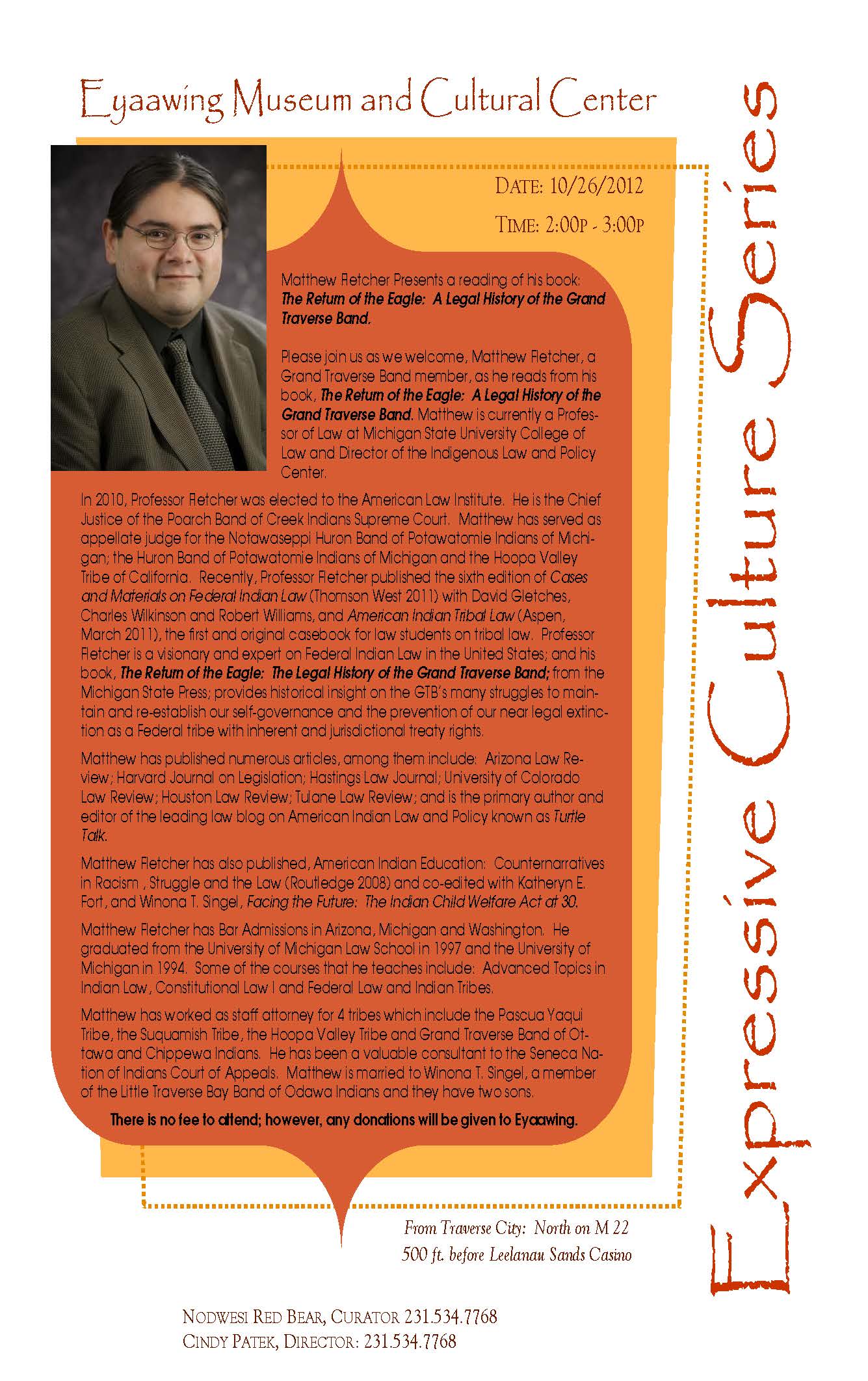
ICT Profile of Fletcher’s New Book: “The Eagle Returns”

Here. An excerpt:

The Eagle Returns: The Legal History of the Grand Traverse Band of Ottawa  and Chippewa Indians (Michigan State University Press, 2012) is a  governmental, legal and political history of the tribe. The volume focuses on  their status as a treaty tribe and as the first tribe to be recognized—or,  perhaps more accurately, re-recognized—by the federal government under the  Bureau of Indian Affairs’s administrative recognition process.

“It is the story of survival against the arrival and savage intervention of  several European nations—and the United States—in the affairs and property of  the Anishinaabek of the Grand Traverse Bay region,” Fletcher writes in his  introduction. Professor of law and director of the Indigenous Law & Policy  Center at Michigan State University College of Law, Fletcher also runs Turtle  Talk, the Indigenous Law & Policy Center’s legal blog and an unrivaled  source of court documents pertaining to Indian casework and law.

In The Eagle Returns, Fletcher takes on the guise of storyteller,  and that role is reflected in the chapter headings: “The Story of the 1836  Treaty of Washington,” “The Story of the 1855 Treaty of Detroit” and “The Story  of the Dispossession of the Grand Traverse Band Land Base” are just some of the  entries.

Although the chapter titles are specific to the Grand Traverse Band, in a  more general sense they could serve as a template for any number of indigenous  nations. The book is a reminder that so many of them have followed the same  post-European settlement trajectory of cultural and economic erosion, genocide,  dispossession and poverty, up to the brink of legal extinction—only to survive  through resilience and resourcefulness to emerge strong and prosperous in the  latter part of the 20th century.

The Eagle Returns is not just a legal history. It is also filled  with details about the material lives of the pre-treaty Anishinaabek peoples. At  one point Fletcher writes deftly of their renowned birchbark canoes: They were “the finest canoes in the northern hemisphere, capable of carrying over a ton of  people and equipment for two-year treks, creating an ability to travel over all  of the Great Lakes and their major tributaries.”

Other compelling passages detail episodes like the negotiations between the  Anishinaabek leaders, who were called ogemuk, and Henry Schoolcraft,  the Indian Commissioner for the United States and “an ardent land speculator  prone to fits of deep ethnocentrism.” On March 28, 1836, Schoolcraft signed off  on the Treaty of Washington, whereby the tribes ceded an area of 13,837,207  acres—more than one-third of Michigan’s land area. The treaty provided for  permanent reservations and prohibited the ethnic cleansing of Michigan Indians.  But within months the Senate rewrote it to limit the reservations to five years  and provide an option to remove Indian communities to the south and west.

“The Senate added the carrot of $200,000 to the bands that chose to remove to  these lands in exchange for their reservations lands,” Fletcher writes. The  president agreed to the amended treaty on May 27, 1836, but the Anishinaabek  were not notified of the changes until July.

Still other chapters detail the further dispossession of the Grand Traverse  Band and its “administrative termination” beginning in the 1870s. The story  brightens with the band’s re–recognition on May 27, 1980; its famous victorious  battle for treaty rights to hunt, fish and gather on public lands; its  successful gaming enter-prises; and the modernization of the tribe’s ancient law  and justice systems.

Fletcher says that he intends The Eagle Returns to serve as a  reference for policymakers, lawyers and Indian people and for an educated  general audience. But for the author, the book is also a considerable labor of  love.

“It is written for the people of the Grand Traverse Band,” writes the author, “who have not had the benefit of drawing upon one source for the bulk of their  legal and political history.”

Read more: http://indiancountrytodaymedianetwork.com/2012/05/06/a-history-of-the-chippewa-and-ottawa-by-one-of-their-own-111388#ixzz1uHEDbdZr

Coverage of the 44th Annual Dakota Conference in the Argus Leader

Here are some links to articles on, and photos of, the 44th Annual Dakota Conference that was held this weekend at Augustana College.  The theme was Wounded Knee 1973.  Unsurprisingly, Russell Means’ comments and keynote address got the most coverage.  The highlight for me was a panel on Native Women’s role in Wounded Knee, which included presentations by Professor Elizabeth Castle, Marcella Gilbert, and Danyelle Means.  I also really enoyed a talk by Professor Emerita Elizabeth Cook-Lynn and a talk and poetry reading by Allison Hedge Coke and Renee Sans Souci.  Finally, a panel discussion by Dennis Banks, Clyde Bellecourt, and Senator James Abourezk was very illuminating, as was a talk by journalist Kevin McKiernan, who covered the occupation from the inside for NPR. 

Articles

http://www.argusleader.com/apps/pbcs.dll/article?AID=2012304280008

http://www.argusleader.com/viewart/20120429/NEWS/304290038/Means-lashes-out-during-look-back-AIM

http://www.argusleader.com/apps/pbcs.dll/article?AID=2012304280010

Photos
http://www.argusleader.com/apps/pbcs.dll/gallery?Site=df&Date=20120427&Category=news&ArtNo=204270804&Ref=ph&Item=0&odyssey=mod|mostpopphotos

Image


Thelda Perdue to Lecture on Indian Lands and the SCT at the Supreme Court Historical Society

Here.

Details from the site:

November 14, 2012 | 6:00 PM
The History of Native American Lands
and the Supreme Court
Professor Theda Perdue
University of North Carolina, Chapel Hill

Kirsten Carlson on “Priceless Property” (Black Hills)

Kirsten Matoy Carlson has posted “Priceless Property,” forthcoming from the Georgia State University Law Review, on SSRN. Highly recommended!

Here is the abstract:

In 2011, the poorest Indians in the United States refused to accept over $1 billion dollars from the United States government. They reiterated their long held belief that money – even $1.3 billion dollars – could not compensate them for the taking of their beloved Black Hills. A closer look at the formation of the Sioux claim to the Black Hills helps us to understand why the Sioux Nation has repeatedly rejected over $1 billion dollars in compensation for land taken by the United States over 100 years ago. This article seeks to understand why the Sioux view the Black Hills as priceless by studying the formation of the Black Hills claim. It constructs a new, richer approach to understanding dispute formation by combining narrative analysis with the sociolegal framework for explaining dispute formation. The article argues that narratives enrich the naming, claiming, and blaming stages of dispute creation and illustrates the usefulness of this new approach through a case study of the Black Hills claim. It uses the autobiographical work of an ordinary Sioux woman to provide a narrative lens to the creation of the Sioux claim to the Black Hills. American Indian Stories by Zitkala-Sa presents a narrative of Sioux life around the time of the claims emergence. By contextualizing and humanizing the claim, my analysis provides insights into why the Sioux claim to the Black Hills emerged into a legal dispute and helps to explain why the Black Hills remain priceless property to the Sioux Nation today.

44th Annual Dakota Conference Happening April 27 & 28

The theme is Wounded Knee 1973: 40 years later. The conference will be April 27-28 and is a project of the Center for Western Studies at Augustana College in Sioux Falls, SD. The program is here. Here’s the link for registration.

Ted White on Indians in American History

From the Faculty Lounge:

Here’s a link to a panel discussion of G. Edward White’s Law in American History: From the Colonial Era Through the Civil War, which was held at UVA Law School back on February 22. The speakers are Tomiko Brown-Nagin, Fred Konefsky, and John Witt. Tomiko and Fred have a number of observations about White’s methodology (in particular his contrast with Lawrence Friedman’s law and society approach and Tomiko is particularly interested in Native American ideas about law and their contact with European Americans and also the role of the law in the development of capitalism) and John asks some meta questions about why we do legal history (and he hypothesizes what White might be doing here). All of this reminds me that I want to talk soon about what why I write legal history and also about what we’re increasingly calling applied legal history. And also what role law has as a form of technology that’s used to implement basic desires and why others see law as more of an independent variable that controls us and what we do. There’s a lot to talk about here and I hope that at some point Tomiko’s, Fred’s, and John’s papers appear somewhere, to extend the conversation.

Lewis & Clark Law Review Indian Law Symposium

Here:

SYMPOSIUM
 The Future of International Law in Indigenous Affairs:The Doctrine of Discovery, the United Nations, and the Organization of American States

THE INTERNATIONAL LAW OF COLONIALISM: A COMPARATIVE ANALYSIS

Robert J. Miller

15 Lewis & Clark L. Rev. 847 (2011)

The majority of the non-European world was colonized under an international law that is known as the Doctrine of Discovery. Under this legal principle, European countries claimed superior rights over Indigenous nations. When European explorers planted flags and religious symbols in the lands of native peoples, they were making legal claims of ownership and domination over the lands, assets, and peoples they had “discovered.” These claims were justified by racial, ethnocentric, and religious ideas of the alleged superiority of European Christians. This Article examines the application of Discovery by Spain, Portugal, and England in the settler societies of Australia, Brazil, Canada, Chile, New Zealand, and the United States. The comparative law analysis used in this Article demonstrates that these three colonizing countries applied the elements of the Doctrine in nearly identical ways against Indigenous peoples. Furthermore, the six settler societies analyzed here continue to apply this law today to restrict the human, property, and sovereign rights of Indigenous nations and peoples. This Article concludes that basic fairness and a restoration of the self-determination rights of Indigenous peoples mandates that these countries work to remove the vestiges of the Doctrine of Discovery from their modern day laws and policies.

RECONCEPTUALIZING TRIBAL RIGHTS: CAN SELF-DETERMINATION BE ACTUALIZED WITHIN THE U.S. CONSTITUTIONAL STRUCTURE?

Rebecca Tsosie

15 Lewis & Clark L. Rev. 923 (2011) Continue reading

Ann Tweedy on Unjustifiable Expectations

Highly recommended!!!!

Ann Tweedy has posted her paper, “Unjustifiable Expectations,” on SSRN. Here is the abstract:

When the Supreme Court decides whether a tribe has jurisdiction over non-members on its reservation or addresses the related issue of reservation diminishment, it sometimes refers implicitly or explicitly to the non-Indians’ justifiable expectations, and Philip Frickey has argued that a concern with non-Indians’ justifiable expectations drives Court decisions about tribal jurisdiction even when the Court does not express that concern directly. The non-Indians’ assumed expectations arise from the fact that, when Congress opened up reservations to non-Indians during the allotment era, its assumption, and presumably that of non-Indians who purchased lands on reservations during that period, was that the reservations would disappear due to the federal government’s assimilationist policies, along with the tribes who governed them. To refute the idea that such non-Indian expectations were justifiable, I examine historical newspaper articles and other historical sources regarding the opening up of reservations to non-Indian purchasers, specifically focusing on articles relating to cessions by the Sioux Nation and especially the Cheyenne River Sioux Tribe. Such sources suggest that non-Indian purchasers were on notice, in at least some cases, of a potential violation of tribal rights in the opening of portions of reservations to non-Indian settlement. Based on my argument that “justifiability” encompasses both reasonableness and a notion of justice, this information is used to show that the non-Indian purchasers’ presumed expectations about the disappearance of reservations were not justifiable because the purchasers had notice in many cases that lands were unjustly being taken from the Sioux Nation and other tribes. If, as I will argue, non-Indian expectations of tribal disappearance were unjustifiable, such expectations should not be given weight in determinations of tribal jurisdiction today.