Important New Scholarship on the Originalist Foundations of the Indian Canons and Tribal Sovereignty

Seth Davis, Eric Biber & Elena Kempf have posted “Persisting Sovereignties,” forthcoming in the University of Pennsylvania Law Review, on SSRN. Here is the abstract:

From the first days of the United States, the story of sovereignty has not been one of a simple division between the federal government and the states of the Union. Then, as today, American Indian tribes persisted as self-governing peoples with ongoing and important political relationships with the United States. And then, as today, there was debate about the proper legal characterization of those relationships. The United States Supreme Court confronted that debate in McGirt v. Oklahoma when, in an opinion by Justice Neil Gorsuch, it held that the reservation of the Muscogee (Creek) Nation “persists today.” The Court’s recognition of the persistence of Tribal sovereignty triggered a flurry of critical commentary, including from federal lawmakers who share Justice Gorsuch’s commitment to originalism. But the original story of federal Indian law supports the persistence of tribal sovereignty.

Through its treaty practice, and opinions of its Supreme Court, the United States recognized Indian tribes as political communities whose preconstitutional sovereignty persisted despite their incorporation within U.S. territory. According to the Marshall Court, tribes were “states” and “nations” with whom the United States had formed political relationships. These terms, the Court explained, had a “well-understood meaning” under the law of nations and applied to tribes as they applied “to the other nations of the earth.” This Article explores the original public meaning of those terms as they applied to Indian tribes through the first comprehensive analysis of the international law commentary cited by the Marshall Court as well as historical examples of shared sovereignty that were familiar to lawyers during the early Republic.

In particular, this Article explores two consequences of tribes’ status as “states” and “nations” under international law during the early Republic. First, it provides an originalist foundation for the Indian canon of construction’s rule that tribal sovereignty is preserved unless expressly surrendered. Like states under international law, tribes retained whatever measure of sovereignty they did not expressly surrender by agreement. Accordingly, a court interpreting an Indian treaty must construe ambiguous terms to retain tribal sovereignty. Today, this rule of interpretation is known as the Indian canon of construction and is thought to be peculiar to federal Indian law. To the contrary, however, the Indian canon’s foundations include generally accepted principles of the law of nations at the time of the Founding. Second, this understanding of Indian tribes as “states” implies that the sovereignty of tribes is not divested by their incorporation within the United States and persists despite periods in which federal and state governments have prevented its exercise. This principle, which has important implications for contemporary debates in federal Indian law, not only justifies the Court’s recognition of tribal persistence in McGirt, but also offers a way for thinking about the future story of divided sovereignty in the United States.
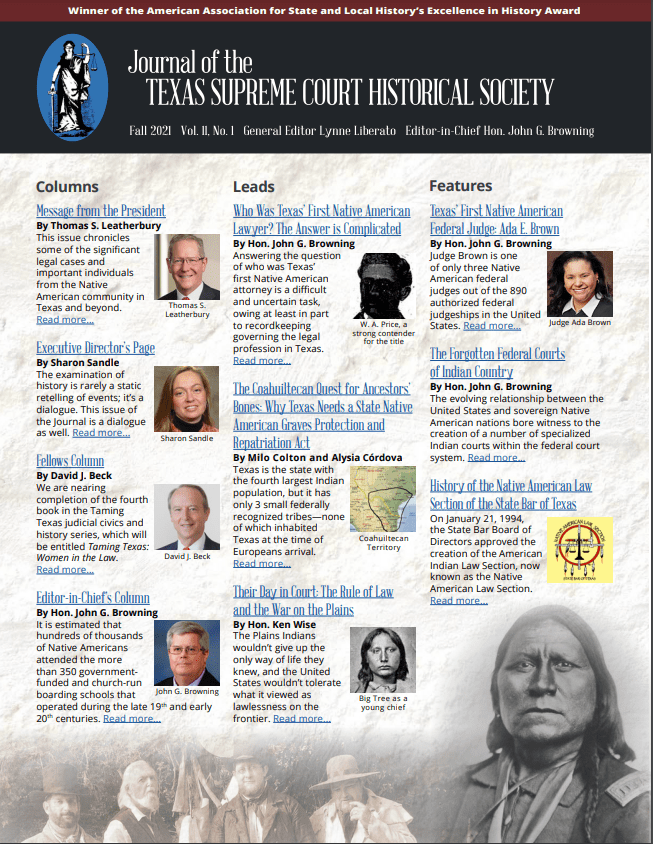
Texas Supreme Court Historical Society Journal Publishes Special Issue on Native Issues

Here. And a link to other issues here. John Browning masterminded this effort and he writes about this issue, “Among other features, it showcases scholarly work on NAGPRA in Texas, an 1871 trial of Native American combatants in a Texas criminal court, a dive into the historical mystery of Texas’ first Native American lawyer, a profile of Texas’ first Native American federal judge, reviews of legal-themed books by Native American authors, and more. “

Tiya Miles Wins National Book Award!

Here.

One of our favorite people!

Order the book here.

McSweeney’s on the Founders (they’re dead)

Here.

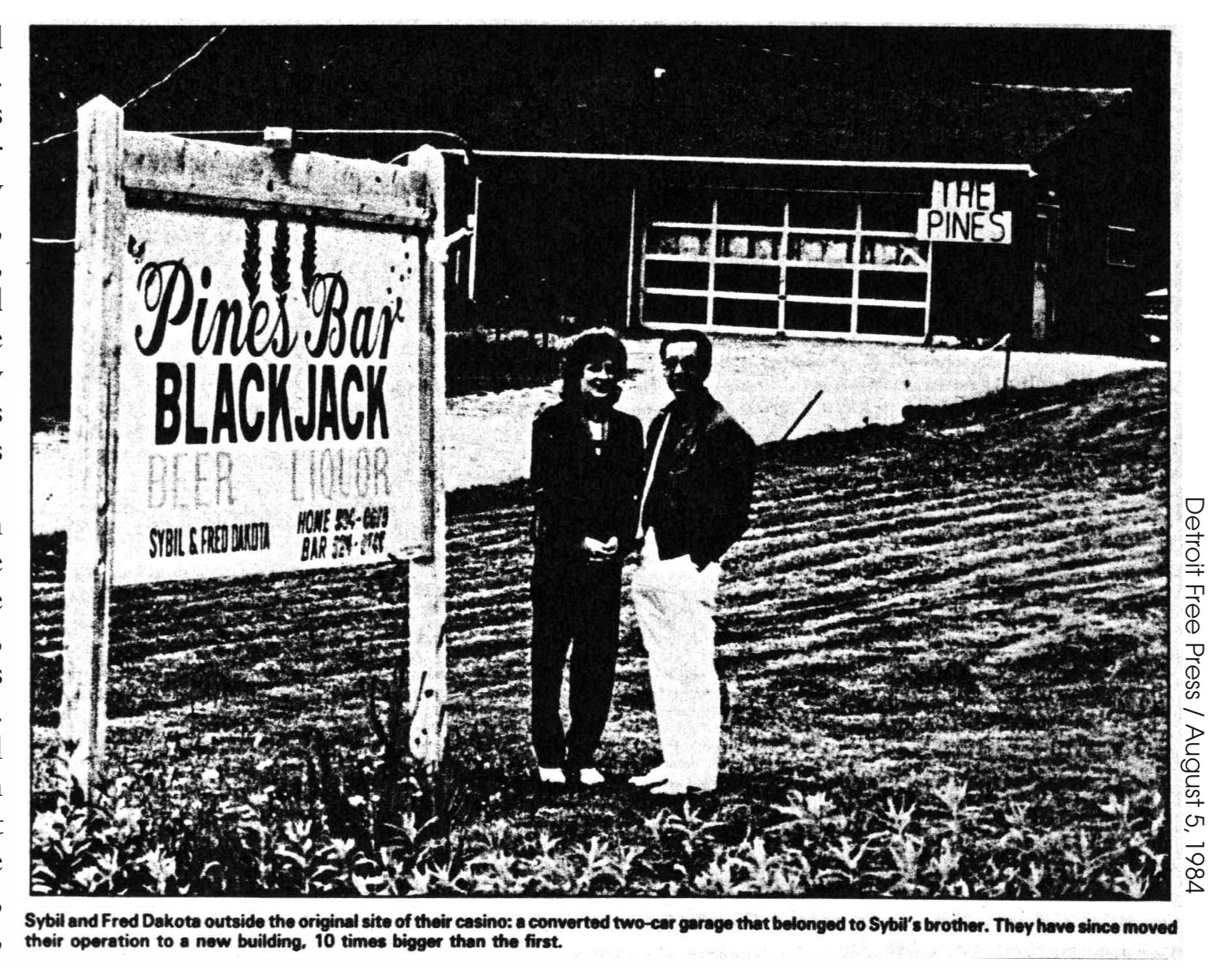
Fred Dakota Walks On

Here. And here.

The Father of Indian Casino Gambling.”

Supreme Court Decides Brnovich v. DNC (voting rights)

On July 1, 2021, the U.S. Supreme Court released a decision in Brnovich v. DNC that upheld two Arizona voting policies that make it harder for people—and especially people of color and Native Americans—to vote.

BACKGROUND:
On March 2, the US Supreme Court heard arguments in Brnovich v. Democratic National Committee. The case looks at whether two issues of Arizona voting law—restricting out-of-precinct ballots and ballot collection—violate Section 2 of the Voting Rights Act. In 2016, Arizona lawmakers passed laws limiting ballot collection and out-of-precinct voting. Ballot collection is an essential tool that rural Native American communities use to make voting accessible to all eligible voters.

At about 17 minutes into the hearings, Justice Sotomayor addresses the voting burdens in Native communities. The points that Justice Sotomayor raises, echo those found in the National Congress of American Indians’ (NCAI) “friends of the court” amicus brief in the case. NCAI’s brief, which was filed by the Native American Rights Fund in January, explains how American Indian and Alaska Native voters face substantial obstacles and documented discrimination as they try to participate in the American democratic process.

Native Americans are entitled to full access to the political process, but failures rooted in devastating policies and discrimination create needless barriers to the ballot.  Services such as post offices and drivers’ license sites require hours of travel, postal delivery and residential addressing is insufficient or completely absent, poorly maintained dirt roads become impassable during November election season, lack of internet and cell phone coverage abound on reservation, and insufficient economic means and transportation make it impossible to access basic government services. There also have been instances of untrustworthy election officials capitalizing on these inequities to disenfranchise voters and undermine Native American political power.  Section 2 of the Voting Rights Act provides much needed protections against this type of systemic voter disenfranchisement.

Read more about the barriers that Native American voters face in the report, Obstacles at Every Turn: Barriers to Political Participation Faced by Native American Voters.

Paul Finkelman: “America’s ‘Great Chief Justice’ Was an Unrepentant Slaveholder”

From the Atlantic here.

WaPo: “Deb Haaland: My grandparents were stolen from their families as children. We must learn about this history.”

Here.

Ninth Circuit Says Quiet Part Loud: Open Carry Laws Originated to Kill Indians and Slaves

Here is the opinion in Young v. State of Hawaii. An excerpt:

Some colonies’ issuance of carry requirements—especially to church, public gatherings, and other travel—reflects “adaptation to the realities of colonial life, especially [considering] the ongoing hostile relationship with Native Americans.” Cornell, 80 Law & Contemp. Probs. at 28. In addition to tense relations with Native Americans, southern colonies also feared the possibility of slave uprisings. Id

page 60, note 16.

Judge Bradley Letts on the Cherokee Court System

Judge Bradley Letts has published “The Cherokee Tribal Court: Its Origins and Its Place in the
American Judicial System
” in the Campbell Law Review.

Highly recommended.