Caballero v. United States Cert Petition

Here:

Cert Petition

Questions presented:

  1. Whether the Trial Court and the Court of Appeals committed prejudicial error in barring/blocking a Native American tribe from pursuing in rem / quiet title remedies on lands promised and granted to them by the USA from that tribe, but stolen by another tribe based on lack of subject matter jurisdiction due to the non-justiciable political question doctrine.
  1. Whether or not, the Court committed prejudicial error by blocking a native American tribe from pursuing an in rem/quiet title/stolen tribal lands case, on the basis of USA sovereign immunity tribal sovereign immunity.
  2. Whether the waiver by the United States of America of its sovereign immunity over quiet title claims
    impermissibly discriminates in violation of the Equal Protection Clause of the 14th Amendment against Native American tribes having quiet title claims that are barred by the Native American lands express exceptions set forth in 28 USC section 2409a.
  3. Whether the Trial Court and the Court of Appeals committed prejudicial air in barring/blocking the
    Indian tribes pursuit of Land title claims constitutes an impermissible denial of the right to access to
    courts as guaranteed by the First Amendment right to petition the court government for redress of grievances.

Lower court materials here.

Justice Breyer to Retire

The Guardian. They don’t hide behind paywalls . . . much.

Riding bus to A2 but will post on Breyer’s Indian law record in a bit. It’s incomplete since the Court has decided to take many, many cases this Term.

Sneak preview . . . He voted with tribal interests about 40 percent of the time, but up through his abomination of a vote in Baby Girl, he voted favorably for tribal interests only 20 percent of the time. This isn’t going to be pretty.

Not sure we’re buying it. . .
Not sure they are, either.

Images from the Mason NALSA Talk

Thanks again to Ali Slader for organizing. Full comic here.

Beverly Clark & Lynnmarie Johnson American Indian Law Section of the State Bar of Michigan Bar Study Scholarship

Deadline: February 25, 2022 at 5pm EST

See details here

Beverly Clark (Aamjiwnaang First Nation, Sarnia Reserve).
Mary 21, 1939 – February 16, 2013.
Beverly received her BA in 1961 and her MA in 1963 from the University of Michigan. Prior to entering into the practice of law, Beverly was a public school teacher. She received her JD from Wayne State University in 1972. Her law practice focused on family law in the Detroit area. In 1983, Beverly became the first woman President of the Michigan Trial Lawyers Association (now known as the Michigan Association for Justice). She served on the Detroit Human Relations Commission as a Chair and Vice-Chair. She was the first Native American Commissioner for the Michigan Civil Rights Commission and served between 1982 and 1991. She was the 2006 awardee of the American Indian Law Section’s Tecumseh Peacekeeping Award and served on the Board for Michigan Indian Legal Services.

Lynnmarie Johnson (Saginaw Chippewa descendant).
December 15, 1960 – July 21, 2015.
Lynnmarie was born in Flint, Michigan and was a resident of the Flint area all of her life. On February 23, 1980 she married Michael Bryan Johnson. Lynnmarie received her BBA from the University of Michigan in 1991, after receiving her AA, with honors, in 1989 from Mott Community College. Lynnmarie graduated from University of Michigan Law School in 1994. Not only was she a licensed attorney, she was also a certified public accountant. Her law practice had a focus on Bankruptcy and Estate Planning. She was a past Chair of the American Indian Law Section of the State Bar of Michigan and a board member for both Michigan Indian Legal Services and Legal Services of Eastern Michigan.

Requirements:

The following guidelines will be used in administering and making awards from the Beverly Clark
& Lynnmarie Johnson American Indian Law Section of the State Bar of Michigan Bar Study
Scholarship. Applicants must:

• Be an actively enrolled 3L law student or a recent law school graduate.
• Intend to sit for the Michigan Bar Examination.
• Compose and submit a Letter of Interest in the scholarship, which outlines your
commitment to Indian Country and/or to Native American communities.
• Submit a current resume and a recent law school transcript.

Submission Deadline:

Applications are due by February 25, 2022 at 5 p.m. EST by email to lmulhern@rosettelaw.com

Selection:

The American Indian Law Section Council will select the recipient based on the above guidelines.
Applicants will be notified via e-mail regarding their status after the selection committee has met.

Award:

This shall be a one-time award, with the dollar amount and number of awards being based on the
available funds each year. The aggregate total maximum award amount to be distributed shall be
$1500 per year to one or more recipients. e.g. Three Recipients * Three $500 awards = $1500.

SCOTUS Grants Oklahoma Petition to Consider Whether the State Can Prosecute Non-Indian – on – Indian Crime in Indian Country

Here is today’s order.

The grant is limited to question 1 — here are the questions presented:

  1. Whether a State has authority to prosecute non- Indians who commit crimes against Indians in Indian country.
  2. Whether McGirt v. Oklahoma, 140 S. Ct. 2452 (2020), should be overruled.

Cert stage materials in Oklahoma v. Castro-Huerta:

Lower court materials:

Montana Federal Court Allows Blackfeet Farmers to Sue US for Race Discrimination

Here are the materials in Wellman v. Orcutt (D. Mont.):

1 Complaint

5 Motion to Dismiss

6 Response

8 Reply

14 DCT Order

Photograph of a Blackfeet Indian’s Farm – Harvesting Field of Oats (National Archives)

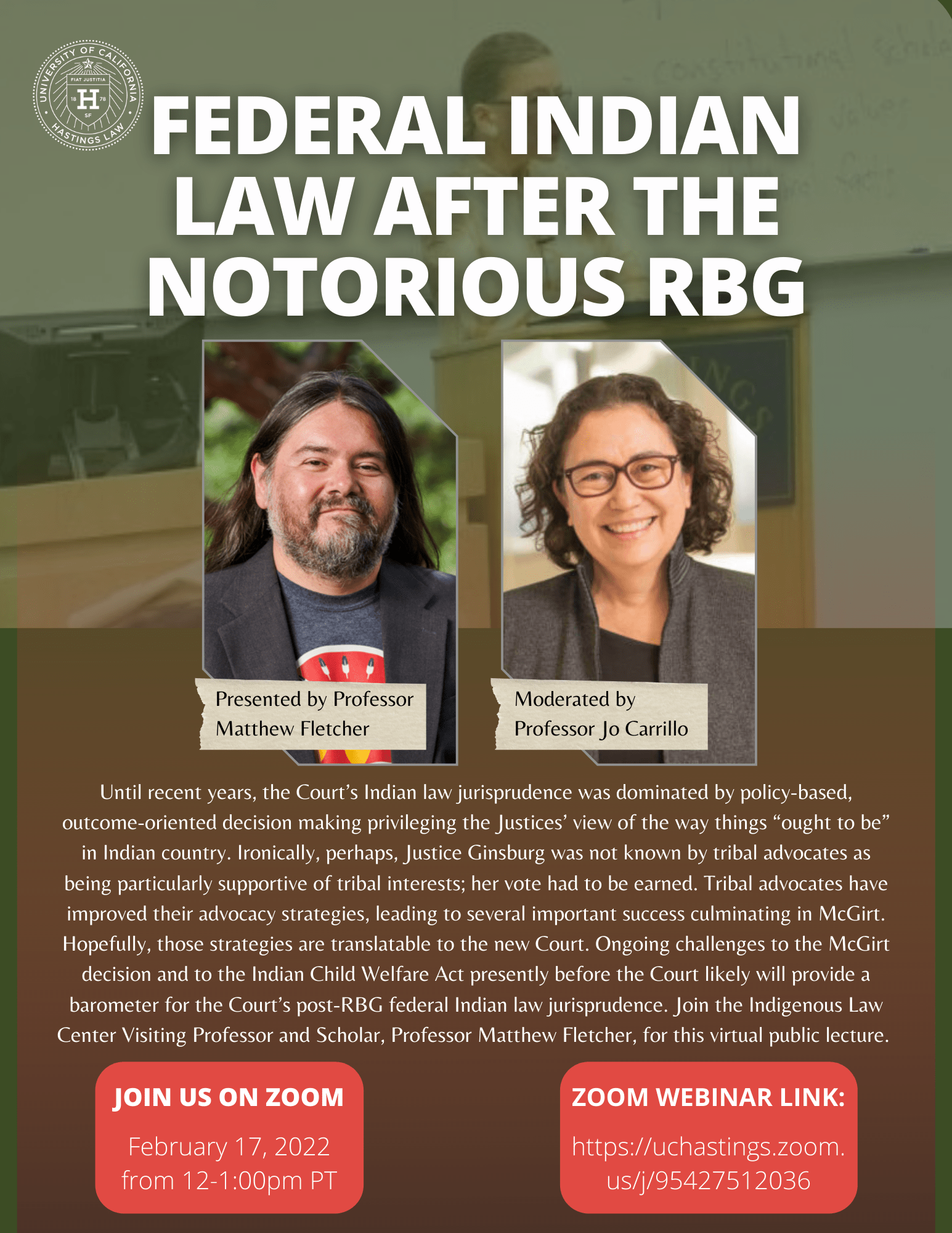
Fletcher Talk at Law School FKA Hastings on Feb. 17: “Federal Indian Law after the Notorious RBG”

Arizona Federal Judge Acquits Border Wall Protester after Assertion of Religious Freedom Restoration Act Defense [Tohono O’Odham Lands]

Here are the materials in United States v. Ortega (D. Ariz.):

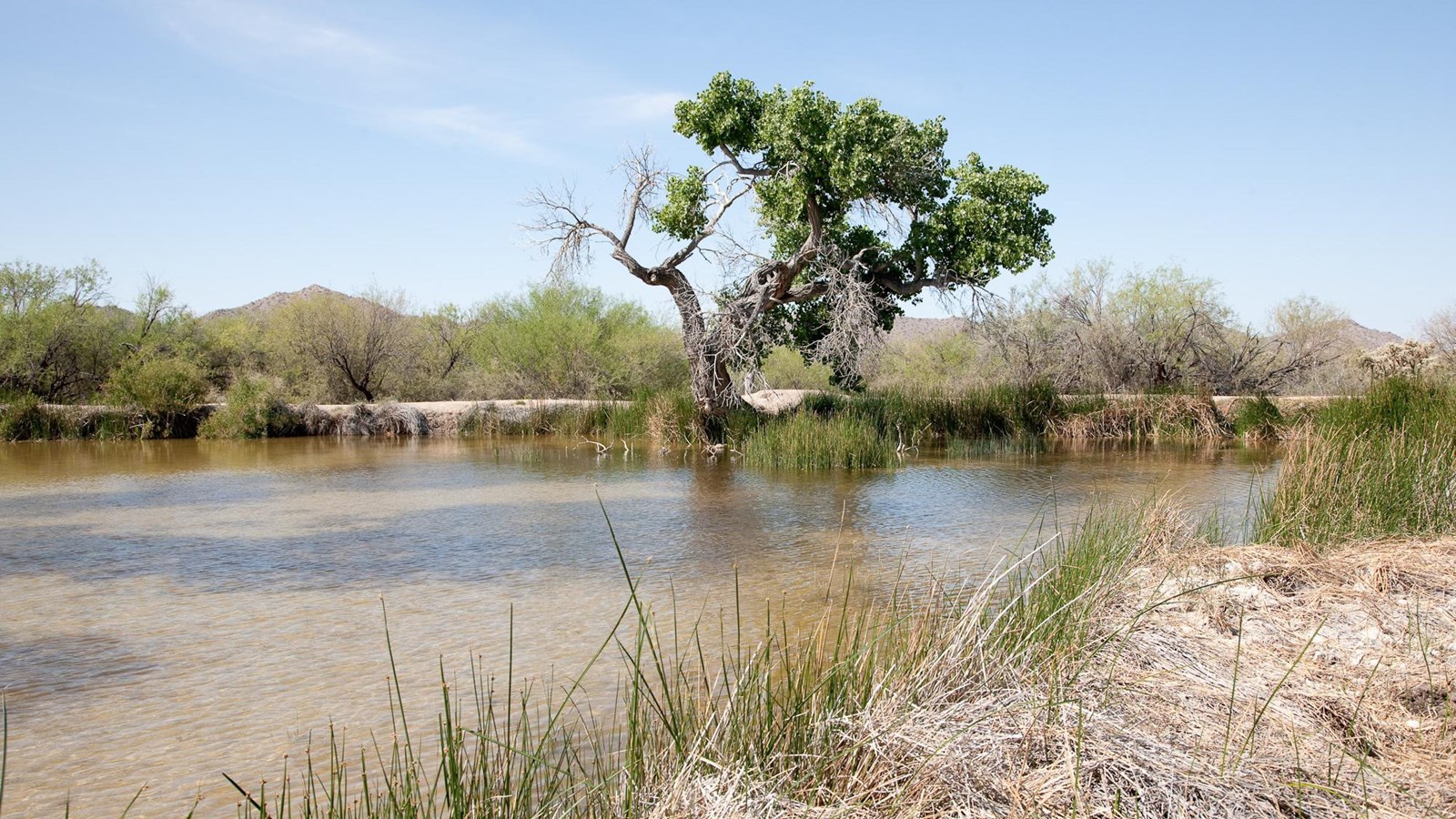
Quitobaquito Springs (NPS)

News coverage of the acquittal here.