Description here.
I’ll be presenting a survey paper on tribal justice systems. Paper here.
Home of the Allegheny Alligators
.
Description here.
I’ll be presenting a survey paper on tribal justice systems. Paper here.
Home of the Allegheny Alligators
.
The Bureau of Justice Statistics (BJS) released a federal register notice requesting comments on a Tribal Court Survey that they will soon be releasing to all of Indian country. This survey represents a much needed and significant study of tribal court systems, and will serve as “the nation’s key measure of tribal court systems.” This data will be used to inform policy, funding program decisions and future areas of issues to address. Questions range from tribal court structure to case load to collaboration with other sovereigns.
Here are the Federal Register notice and three surveys:
Fed. Reg. Notice — Tribal Court Survey Mar. 25, 2014
NSTCS Draft__LOWER 48 SURVEY_2 5 14
NSTCS Draft_CFR COURT SURVEY_2 5 14
Note that there are three versions of the survey attached, one for Lower 48 Tribes, one for Alaska Tribes, and one for Tribes with CFR Courts.
BJS is currently accepting comments from the public regarding this survey. We highly encourage you, and especially your tribal court personnel, to take a look and provide any thoughts. Even short responses are welcome, as the quality of this survey will directly impact the quality of the results.
Public comments will be accepted until May 27, 2014.
Submit your comments (and/or questions) to:
Steven Perry
Statistician, Bureau of Justice Statistics
810 Seventh Street NW
Washington, D.C. 20531
(202) 307-0777
Steven.W.Perry@usdoj.gov
Here are the materials in Caddo Nation of Oklahoma v. Court of Indian Offenses for the Anadarko Agency (W.D. Okla.):
Here are the materials in Las Vegas Tribe of Paiute Indians v. Phebus (D. Nev.):
1-1 Tribal Court of Appeals Opinion
8 Motion for Declaratory Judgment
An excerpt:
The Court DECLARES that the Tribe may assert criminal jurisdiction over any person qualifying as an Indian under the ICRA, as interpreted in cases such as United States v. Bruce, 394 F.3d 1215 (9th Cir. 2005), but in such a prosecution the Tribe must prove Indian status beyond a reasonable doubt, and the Tribal Court must submit the question to a jury where the crime is punishable by imprisonment, unless the jury right is properly waived, and there is no evidence that these procedures were followed as to Phebus in the cases cited. Furthermore, if the Tribe seeks to prosecute a non-member whose membership it has revoked or rejected, the Indian status analysis in such a prosecution may not rely upon political affiliation with the Tribe, but only upon actual or de facto membership in another tribe.
Here are the materials in Styliest v. Rosebud Sioux Tribe (D.S.D.):
5 DCT Order Denying Habeas Writ
The Eighth Circuit denied petitioner’s direct appeal of his federal conviction here.
Here is the amended opinion:
The main amendment appears to be that the panel will no longer rely upon the Ninth Circuit’s holding in Water Wheel — and instead finds that the tribe retains jurisdiction over the underlying tort claim under the Montana 1 consensual relations exception.
The court also voted 9-5 to deny the en banc petition: CA5 Order Denying Dolgencorp En Banc Petition
En banc petition materials here.
Panel materials here.
Lower court decision and materials here.
Here:
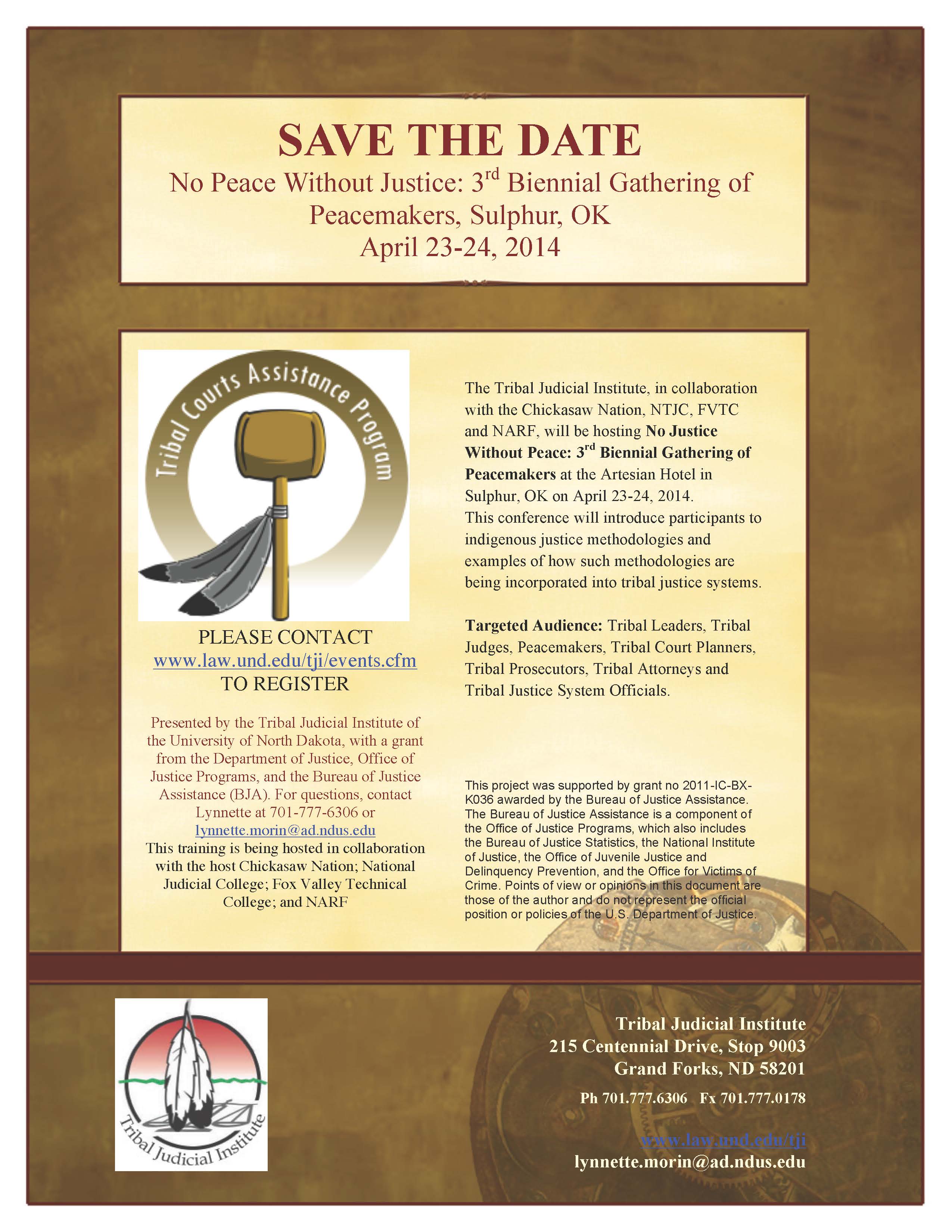
Here.
Abby Abinanti squints at her docket. “The court is going to call — the court is going to put on its glasses,” she says dryly, reaching to grab her readers and snatch some candy from a staff member.
As chief judge of the Yurok Tribal Court, Abinanti wears no robe. On this day, she’s in jeans and cowboy boots, her silver hair spilling down the back of a black down vest. In contrast to her longtime role as a San Francisco Superior Court commissioner, she doesn’t perch above those who come before her; she shares a table with them.
http://www.latimes.com/local/la-me-yurok-tribal-judge-20140305-dto,0,320867.htmlstory#ixzz2v8BFclZJ
 Turtle Talk
You must be logged in to post a comment.