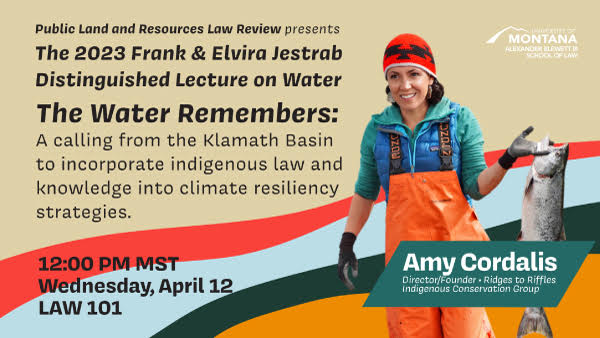
Join us Wednesday, April 12th at noon in LAW 101, or on Zoom.
Amy Cordalis, Director/Founder of Ridges to Riffles Indigenous Conservation Group, will give the lecture The Water Remembers:A calling from the Klamath Basin to incorporate indigenous law and knowledge into climate resiliency strategies.
Public health measures to combat COVID-19, especially in the first year before vaccines became widely available, required individuals to be able to access fresh water while remaining isolated from most of their fellow human beings. For the approximately 500,000 households in the United States and over two million Americans who lacked access to reliable indoor running water, these COVID-19 measures presented a considerable added challenge on top of the existing risks to their health from an insecure water supply.
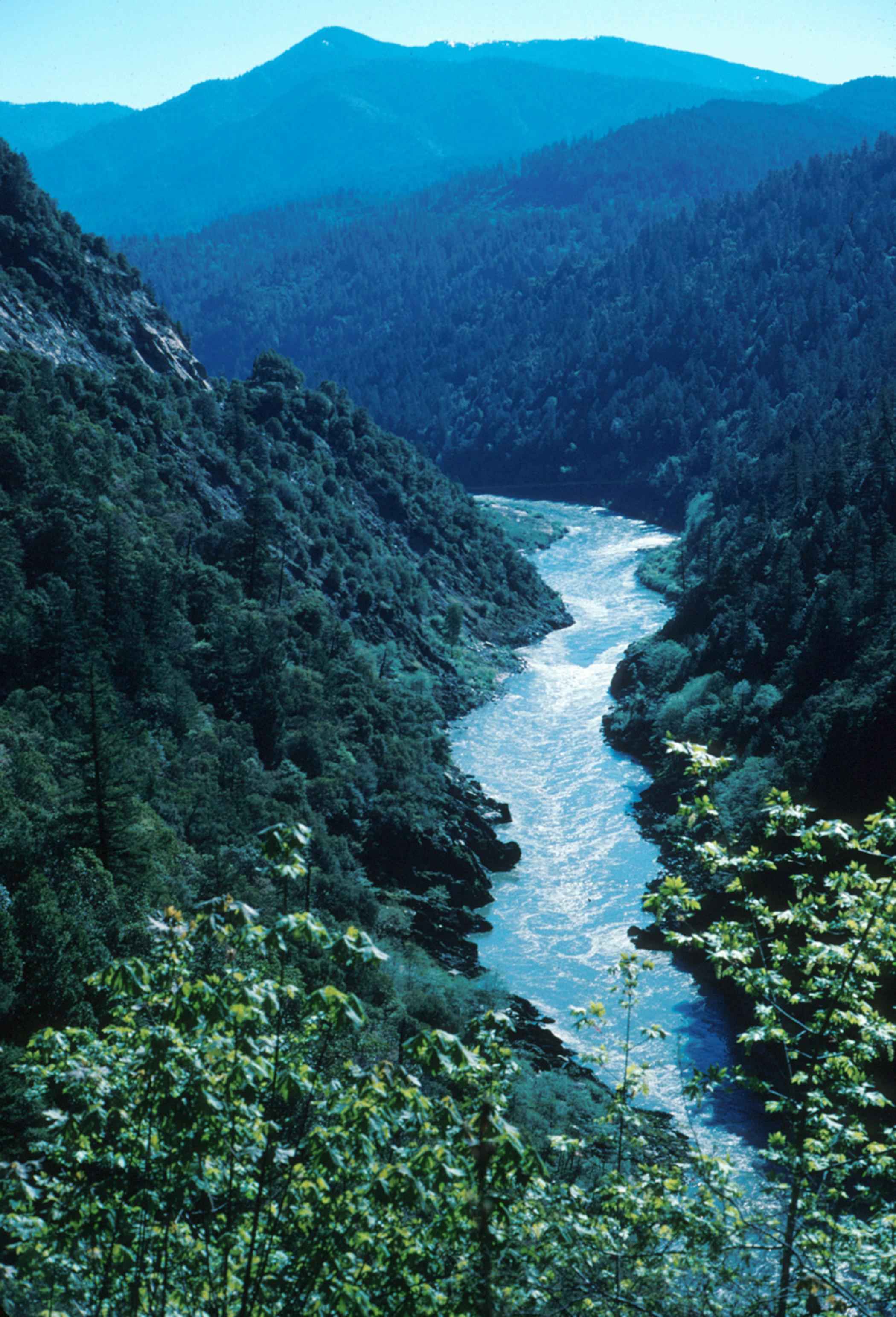
Many of these people were Native Americans, whose Tribes often lack fully adjudicated, quantified, and deliverable rights to fresh water. To highlight the critical role that water rights played in Tribes’ capacities to cope with the pandemic, this essay compares the Klamath Tribes in Oregon, who after 40 years of litigation have fairly securely established themselves as the senior water rights holders in the Klamath River Basin, to the Diné (Navajo Nation), whose reservation—the largest in the United States—covers well over 27,500 square miles of Arizona, Utah, and New Mexico but largely lacks quantified water rights or the means to deliver water to households. While access to water was not the sole factor in these two Tribes’ vastly different experiences with COVID-19, it was an important one, underscoring the need for states and the federal government to stop procrastinating in actualizing the water rights for Tribes that have been legally recognized since 1908.
Whether the federal government owes the Navajo Nation an affirmative, judicially enforceable fiduciary duty to assess and address the Navajo Nation’s need for water from particular sources, in the absence of any substantive source of law that expressly establishes such a duty.
Here is the petition and the partial acquiescence by Justice in Arizona v. Navajo Nation:
I. Does the Ninth Circuit Opinion, allowing the Nation to proceed with a claim to enjoin the Secretary to develop a plan to meet the Nation’s water needs and manage the mainstream of the LBCR so as not to in- terfere with that plan, infringe upon this Court’s re- tained and exclusive jurisdiction over the allocation of water from the LBCR mainstream in Arizona v. California? II. Can the Nation state a cognizable claim for breach of trust consistent with this Court’s holding in Jicarilla based solely on unquantified implied rights to water under the Winters Doctrine?
I. Does the Ninth Circuit Opinion, allowing the Nation to proceed with a claim to enjoin the Secretary to develop a plan to meet the Nation’s water needs and *ii manage the mainstream of the LBCR so as not to interfere with that plan, infringe upon this Court’s retained and exclusive jurisdiction over the allocation of water from the LBCR mainstream in Arizona v. California?
II. Can the Nation state a cognizable claim for breach of trust consistent with this Court’s holding in Jicarilla based solely on unquantified implied rights to water under the Winters Doctrine?





You must be logged in to post a comment.