Andrea Martin on ICWA and an Antiracist Child Welfare Policy

Andrea Martin has posted “Beyond Brackeen: Active Efforts Toward Antiracist Child Welfare Policy,” forthcoming in the Yale Law and Policy Journal, on SSRN. Here is the abstract:

Due to structural racism, legal protections afforded to families of children in the foster care system have been significantly eroded and continue to be challenged. As a result, families of color, who are disproportionately represented in the foster care system, do not receive the support needed to maintain or regain custody of their children and preserve their families.

The latest attempt to dismantle child welfare protections for a historically marginalized group was a prolonged attack on the Indian Child Welfare Act. In Haaland v. Brackeen, Indian adversaries reached the pinnacle of their incessant attack on the law’s heightened requirements to protect Indian children, families, and tribes. This Article shows that federal child welfare legislation once provided similar safeguards for non-Indian children, but those protections were eroded based on the racist ideology that many children in foster care would fare better if adopted by white families.

In 1978, Congress passed the Indian Child Welfare Act, requiring ā€œactive effortsā€ toward family preservation for Indian children and their families. Two years later, Congress passed similar legislation for non-Indian children, mandating the use of ā€œreasonable effortsā€ toward enabling families to remain together. Although varying standards were used, both required high levels of involvement by social agencies in providing necessary resources to maintain families. This alignment and focus on family preservation significantly benefited groups and individuals subjected to systemic issues that intersect with the child welfare system including racism, poverty, and homelessness.

However, after twenty years, child welfare protections for non-Indian children were substantially reduced with the passage of the Adoption and Safe Families Act in 1997. Premised on racist assumptions that the disproportionately represented Black and brown parents of thousands of children in foster care were inherently unfit parents, this legislation reduced ā€œreasonable effortsā€ to a negligible standard. Many families in the child welfare system no longer receive the level of services required to prevent unnecessary removals of their children or to regain custody of their children. This substantially affects African American children who are overrepresented in foster care.

On the other hand, child welfare protections for Indian children and their families remained constant for 45 years. Nevertheless, White foster families seeking to adopt Indian children ignored past discrimination against American Indian families, failed to acknowledge the importance of cultural preservation, and engaged in a concerted effort to dismantle the Indian Child Welfare Act. However, by accentuating the Act’s critical family preservation standards, its opponents fortuitously offered insight into how federal child welfare policies should be realigned to protect all children against unwarranted removals from their homes.

Regardless of the outcome of Brackeen, this Article urges Congress to bolster the level of remedial services offered to all families by requiring ā€œactive effortsā€ to prevent the removal of children from their homes and assist in family reunification. Employing a standard of ā€œactive effortsā€ would reestablish consistency in federal child welfare legislation, better serve families in foster care, and improve outcomes for all children. This standard comports with the new and developing American Law Institute’s Restatement of the Law, Children and the Law, which is ā€œbuilt on the understanding that the state’s goal is to assist parentsā€ in providing adequate care for their children, ā€œnot to remove children from their homes if other assistance suffices.ā€

Hawai’i State Court Agrees to Extradite Prisoner to Pascua Yaqui

Here are the briefs in In the Matter of the Extradition of Moreno (Haw. Cir. Ct.):

Motion to Dismiss – Carlos Moreno

Moreno MIO

Moreno Reply

Indigenous Breastfeeding Research Project

Seeking Indigenous people who have given birth to participate in a research study to learn about your stories and experiences with feeding your baby.

Angie Sanchez ndizhnikaaz, ajijaak ndodem, Odawa minwaa Ojibwekwe ndaw. My family comes from Kewadin and Northport on my mom’s side, and Sault Ste. Marie and Sheshegwaning, ON on my father’s side. I am a fourth year PhD student at Michigan State University studying Geography, and my research focuses on increasing access to breastfeeding support resources in Indigenous communities. I am looking for life givers to interview either in a talking circle (focus group) or in single interviews or surveys. If you are willing to participate, please see the eligibility requirements below and then fill out the application at the link provided.

Please fill out application to participate, found at https://bit.ly/Indigi_BF

Eligibility:
• Must have given birth and fed a baby (breastmilk or formula)
• Be at least 18 years old
If selected, you will be invited to participate in ONE of the following:
• In person talking circle (focus group) plus survey, receive $150 Visa Gift Card
• In person or zoom interview plus survey will receive $75 Visa Gift Card
• Online survey only will receive a $25 Visa Gift Card

Contact Information:
Angie Sanchez (Doctoral Student, Co-PI)
Email: asanchez@msu.edu Phone: 231.642.0114
Dr. Sue Grady (Co-PI)
Email: gradys@msu.edu Phone: 517.432.9998
For information about the IRB:
IRB# STUDY00002828
irb@msu.edu

Louisiana Federal Court Dismisses Civil Rights Suit by Former Chair against Chitimacha Council

Here are the materials in Darden v. Vines (W.D. La.):

Adam Crepelle on an Intertribal Business Court

Interesting idea.

Adam Crepelle has published ā€œAn Intertribal Business Courtā€ in the American Business Law Journal. Here is the abstract:

Few Indian reservations have any semblance of a private sector. Consequently, poverty and unemployment are major problems in much of Indian country. While there are many reasons why private enterprise is scarce in Indian country, one of the foremost reasons is businesses do not trust tribal courts. Businesses’ distrust of tribal courts is not unique as outsiders often fear bias in foreign tribunals. Similarly, businesses are often concerned about a court’s capacity to adjudicate complex disputes. Federal diversity jurisdiction was developed to allay fear of bias, and many states have developed business courts to address questions about court capacity. Tribes can overcome these issues by creating an intertribal business court (IBC). Tribes will be free to sculpt the IBC as they see fit. However, the IBC’s intertribal nature will help reduce fears of bias, and an IBC’s focus on business disputes will answer doubts about court capacity. An IBC will also make tribal law more accessible, further increasing confidence in this new tribunal. As businesses gain greater confidence in tribal legal institutions through the IBC, they will be more likely to operate in Indian country. Accordingly, the IBC could help to transform tribal economies.

MSU Indigenous Law & Policy Center Fall 2022 Recap Newsletter

As we continue through 2023, the Michigan State University College of Law Indigenous Law & Policy Center invites you to join us in reflecting upon and celebrating the accomplishments and achievements of our students,Ā faculty, alumni, and community in the fall of 2022. PleaseĀ view our newsletter, andĀ stay up to date on current events in Indian law withĀ Turtle TalkĀ and follow us onĀ social media for information on future events!

Follow & Contact Us:

Facebook: Click here.

Twitter: @ILPCTurtleTalkĀ 

Instagram: @msu_ilpc

Email: indigenous@law.msu.edu

Call for Art for the 20th Annual Indigenous Law Conference

2023 Call for Art Now Open!

Submit materials to indigenous@law.msu.edu by April 23, 2023. See past conference art here.

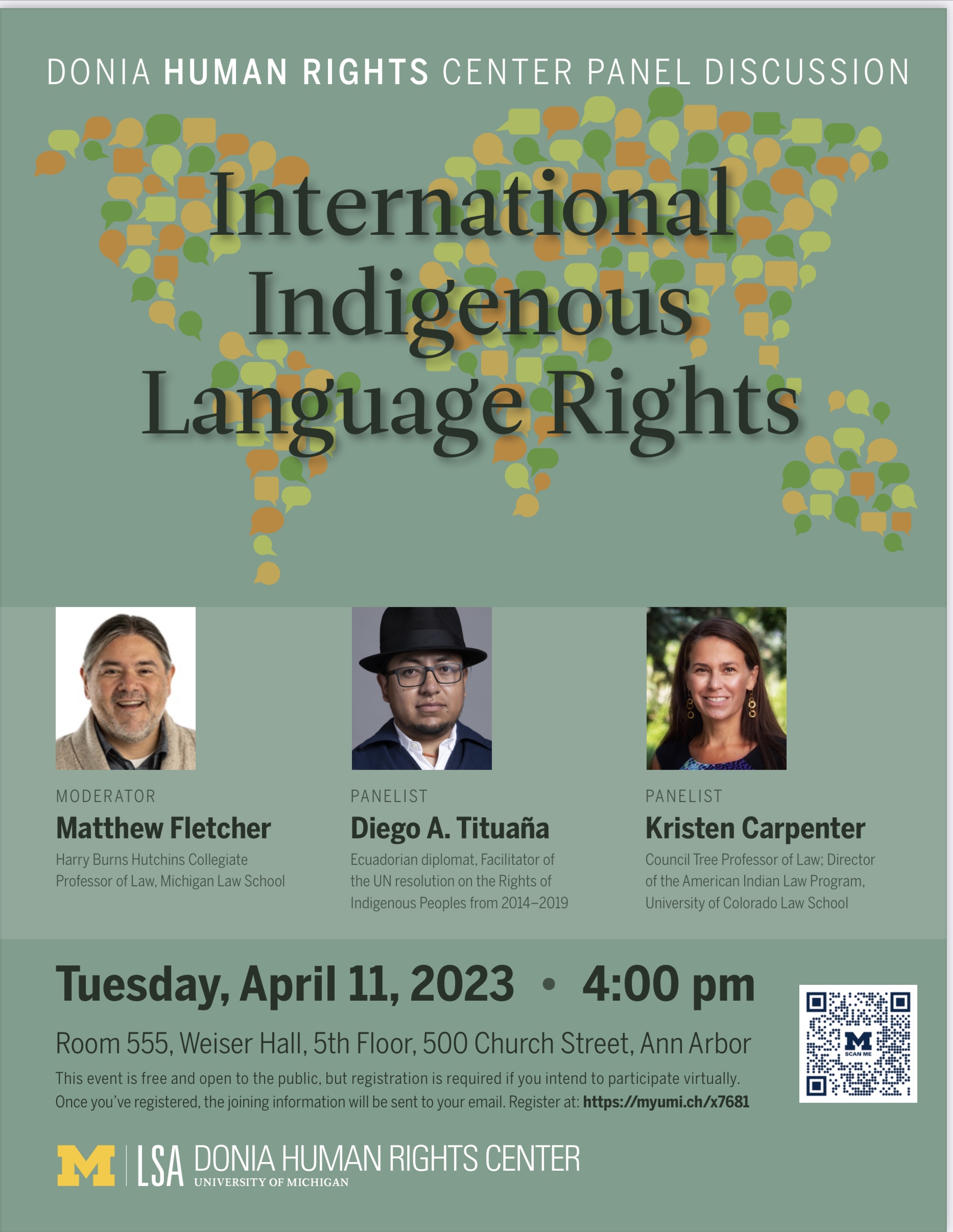
Donia Center [UMich] Panel on Indigenous Language Rights on April 11 @ 4PM

Panel Discussion: International Indigenous Language Rights
April 11 @ 4 PM, 555 Weiser Hall

Panelists: Diego A. TituaƱa, Ecuadorian diplomat, Facilitator of the UN resolution on the Rights of Indigenous Peoples from 2014-2019, and Kristen Carpenter, Council Tree Professor of Law; Director of the American Indian Law Program, University of Colorado Law School; Moderator: Matthew Fletcher, Harry Burns Hutchins Collegiate Professor of Law & Professor of American Culture, University of Michigan

Sho-Ban Tribes Prevail (in part) in Challenge to BLM Land Transfer to Polluter

Here are the materials in Shoshone-Bannock Tribes v. Daniel-Davis (D. Idaho):