ICWA Expert Witness Case out of Colorado

Opinion here. The Colorado Court disagrees with holdings in Montana and Michigan on the same issue–what does a qualified expert witness have to say for it to count under 25 U.S.C. 1912(f).

Congress’s primary reason for requiring qualified expert testimony was to prevent courts from basing decisions “solely upon the testimony of social workers who possessed neither the specialized professional education nor the familiarity with Native [American] culture necessary to distinguish between cultural variations in child-rearing practices and actual abuse or neglect.” Steven H., 190 P.3d at 185 (quoting L.G. v. State, 14 P.3d 946, 952- 53 (Alaska 2000)). This purpose would not necessarily be furthered by a requirement that an expert witness recite the precise language of 25 U.S.C. § 1912(f).

***

Although [the Regulations and Guidelines] emphasize the need for a qualified expert witness to offer testimony supporting a finding regarding likely damage to the child, they stop short of demanding a verbatim recitation of the statutory standard by the expert.

***

Additionally, the Department presented testimony from a
qualified expert witness under ICWA — a social worker with Navajo Children and Family Services. The social worker did not directly opine that the child would suffer damage in mother’s care. Rather, when asked to give her opinion regarding whether the child would suffer serious emotional or physical harm if returned to a parent, the social worker indicated that mother had not fulfilled the treatment requirements to address the reasons for the child being placed in the Department’s custody. The social worker also testified that the recent domestic violence issues between the parents were concerning.
Supreme Court of Canada Rejects First Nation’s Religious Exercise Claims

Here is the 7-2 opinion in Ktunaxa Nation Council v. Minister of Forests:

Ktunaxa_en

An excerpt:

The Ktunaxa are a First Nation whose traditional territories include an area in British Columbia that they call Qat’muk. Qat’muk is a place of spiritual significance for them because it is home to Grizzly Bear Spirit, a principal spirit within Ktunaxa religious beliefs and cosmology. Glacier Resorts sought government approval to build a year-round ski resort in Qat’muk. The Ktunaxa were consulted and raised concerns about the impact of the project, and as a result, the resort plan was changed to add new protections for Ktunaxa interests. The Ktunaxa remained unsatisfied, but committed themselves to further consultation. Late in the process, the Ktunaxa adopted the position that accommodation was impossible because the project would drive Grizzly Bear Spirit from Qat’muk and therefore irrevocably impair their religious beliefs and practices. After efforts to continue consultation failed, the respondent Minister declared that reasonable consultation had occurred and approved the project. The Ktunaxa brought a petition for judicial review of the approval decision on the grounds that the project would violate their constitutional right to freedom of religion, and that the Minister’s decision breached the Crown’s duty of consultation and accommodation. The chambers judge dismissed the petition, and the Court of Appeal affirmed that decision.

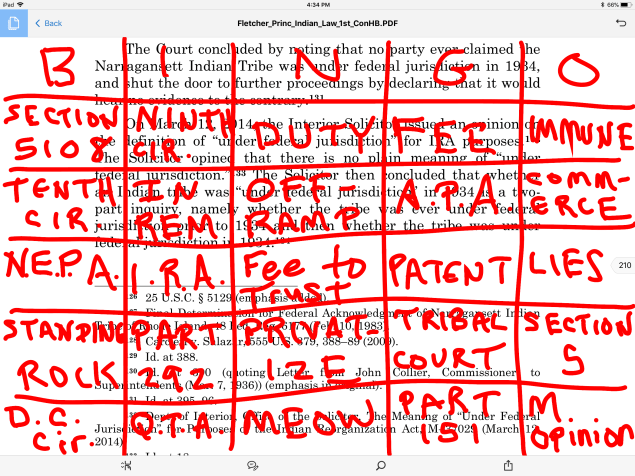
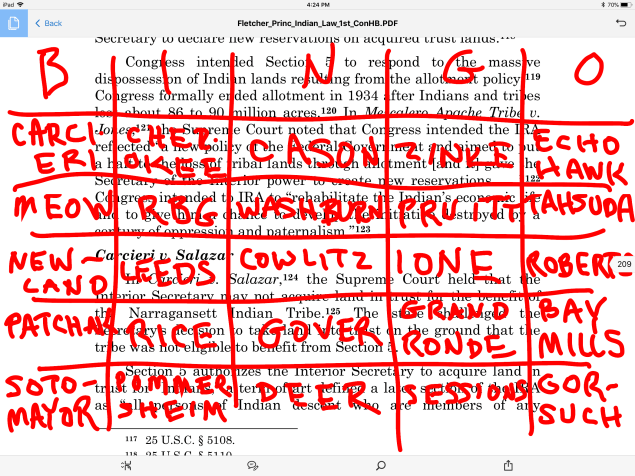
2017 DC Fed Bar: Indian Law BINGO

Use these to certify your participation in your continuing legal education to your licensing jurisdiction.

3C148CE3-F562-470E-A08C-184BE5A1D715F91266FA-960F-4DEB-BF73-511B8891786E1584B776-C2D0-4774-8A72-47D57A1969B3

Crow Indian Tribe Sues to Keep Yellowstone Grizzlies on Threatened Species List

Here are the documents and materials in the matter of Crow Indian Tribe et al v. U.S.A. et al, 17-cv-00089 (D. Mont. 2017):

Litigation Update on Cases Addressing the “Under Federal Jurisdiction” Requirement of the Indian Reorganization Act (Plus Other Things)

Here.

Prepared for the FBA’s DC Indian Law Conference this Friday!

Job opening: Office/Human Resource Administrator at NARF (Boulder, Colorado)

The Native American Rights Fund in Boulder, Colorado has a position opening for Office/Human Resource Administrator.  Read the full announcement and job description.

Apply by November 30, 2017.

Pennsylvania First State to Offer Online Gambling & Lottery Sales

Pennsylvania became the first state to offer both online gambling and lottery sales when Democratic Gov. Tom Wolf signed the recent online gambling legislation offered up by a Republican controlled state legislature.

It will be interesting to see how this same type of scenario plays itself out in a state that has Class III compacts with tribes.

More here.

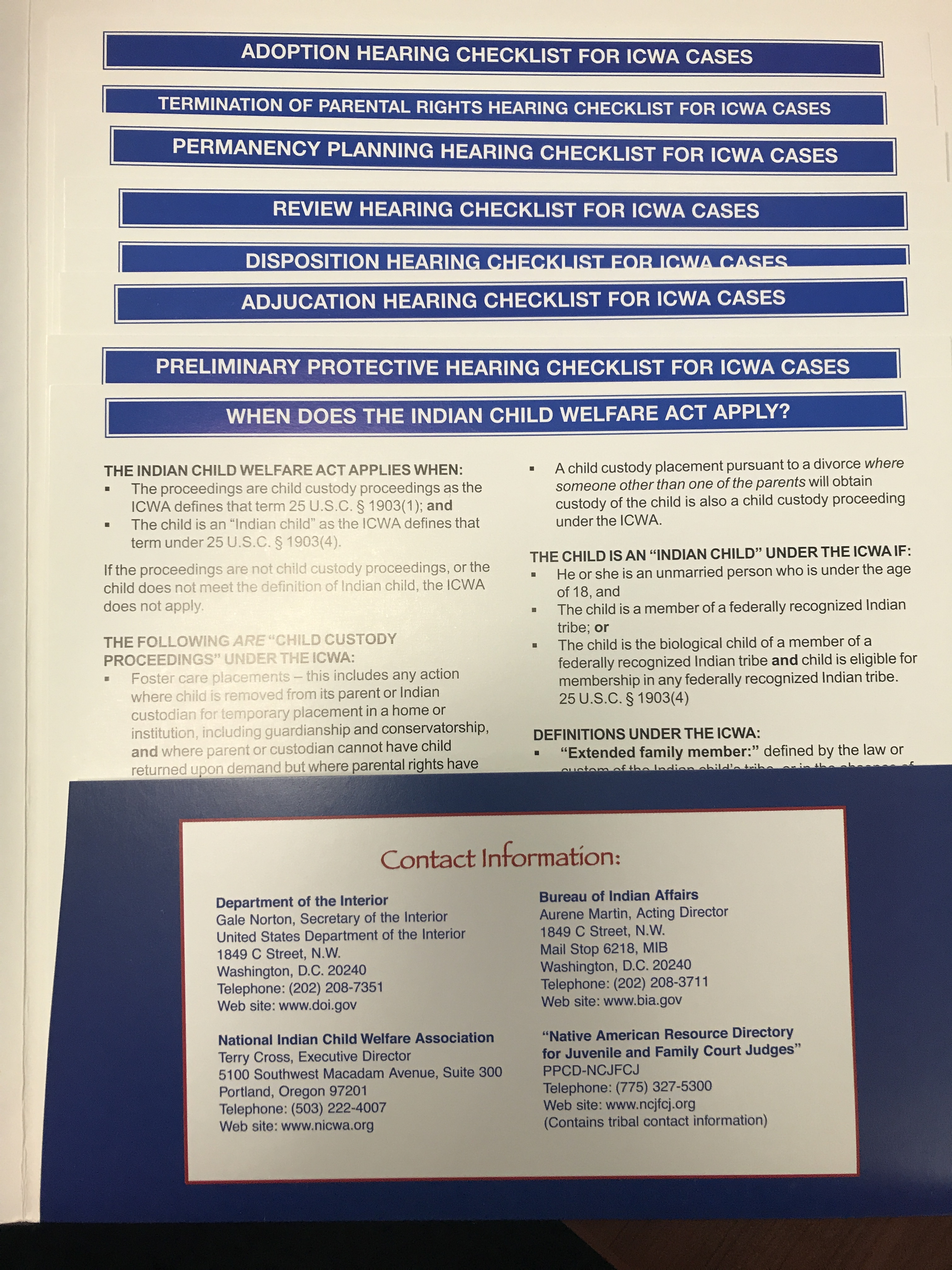
NCJFCJ ICWA Bench BOOK is Now Available!

Last published in 2003 as bench cards, NCJFCJ has issued a new and improved ICWA bench book for judges. There are a few of you who have been asking me about these weekly–here they are!

Press release here

NCJFCJ_ICWA_Judicial_Benchbook_Final_Web

New!

Old!


National Indian Law Library Bulletin (10/26/2017)

Here:

The National Indian Law Library added new content to the Indian Law Bulletins on 10/26/17.

News Bulletin
http://www.narf.org/nill/bulletins/news/currentnews.html
In the Intergovernmental section, we feature an article about the Alaska Attorney General’s opinion upholding tribal sovereignty for Alaska tribes and native villages.

U.S. Federal Courts Bulletin
http://www.narf.org/nill/bulletins/federal/2017.html
Makah Indian Tribe v. Quileute Indian Tribe (Fishing Rights – Whaling & Sealing)
Oneida Nation v. Village of Hobart, Wisconsin (Jurisdiction)
Amerind Risk Management Corporation v. Blackfeet Housing (Tribal Sovereign Immunity)

Tribal Courts Bulletin
http://www.narf.org/nill/bulletins/tribal/2017.html
Pablo v. Ak-Chin Indian Community (Same-Sex Marriage)

State Courts Bulletin
http://www.narf.org/nill/bulletins/state/2017.html
Paquin v. City of St. Ignace (Employment; Elections)
In the Interest of C.A. (Indian Child Welfare Act – Application)
Becerra v. Rose (Taxation – Tobacco)

U.S. Regulatory Bulletin   
http://www.narf.org/nill/bulletins/regulatory/2017.html
The Bureau of Indian Affairs, Bureau of Indian Education, asks for feedback on a proposed strategic plan.

U.S. Legislation Bulletin
http://www.narf.org/nill/bulletins/legislation/115_uslegislation.html
The following bills were added:
S.1986: A bill to amend the Indian Civil Rights Act of 1968 to extend the jurisdiction of tribal courts to cover crimes involving sexual violence, and for other purposes.
H.R.4114: Environmental Justice Act of 2017.

Law Review & Bar Journal Bulletin
http://www.narf.org/nill/bulletins/lawreviews/2017.html
We feature this article:
The global protection of traditional knowledge: Searching for the minimum consensus.

Ninth Circuit Materials in Nisqually Indian Tribe v. Squaxin Island Indian Tribe

Here (aka United States v. Washington subproceeding 14-2):

Nisqually Opening Brief

Lower court materials here.