Cert Stage Briefs in Herrera v. Wyoming

2017-10-05 Herrera Cert Petition

Question presented:

Whether Wyoming’s admission to the Union or the establishment of the Bighorn National Forest abrogated the Crow Tribe of Indians’ 1868 federal treaty right to hunt on the “unoccupied lands of the United States,” thereby permitting the present-day criminal conviction of a Crow member who engaged in subsistence hunting for his family.

Additional briefs:

17-532 Amici Brief Indian Law Professors

Crow Tribe Brief

Scholars Brief

Wyoming opposition to Herrera petition

Cert Stage Reply


Alaska SCT Affirms Attorney Fees Saga Involving Alaska Native Corporation

Here is the opinion in Merdes & Merdes, P.C. v. Leisnoi, Inc.

An excerpt:

An attorney represented a Native corporation in litigation nearly three decades ago. The corporation disputed the attorney’s claim for fees, and in 1995, after the attorney’s death, the superior court entered judgment on an arbitration award of nearly $800,000 to the attorney’s law firm, then represented by the attorney’s son. The corporation  paid eight installments on the judgment but eventually stopped paying, citing financial difficulties. The law firm sought a writ of execution for the unpaid balance, and the writ was granted. The corporation appealed but under threat of the writ paid $643,760 while the appeal was pending. In a 2013 opinion we held the writ invalid and required the firm to repay the $643,760.

The corporation was never repaid. The original law firm moved its assets to a new firm and sought a stay of execution, averring that the original firm now lacked the funds necessary for repayment. The corporation sued the original firm, the successor firm, and the son for breach of contract, fraudulent conveyance, conspiracy to fraudulently convey assets, violations of the Unfair Trade Practices Act (UTPA), unjust enrichment, and punitive damages. The firm counterclaimed, seeking recovery in quantum meruit for attorney’s fees it claimed were still owing for its original representation of the corporation. 

The superior court granted summary judgment for the corporation on the law firm’s quantum meruit claim and, following trial, found that the son and both law firms fraudulently conveyed assets and were liable for treble damages under the UTPA. The son and the law firms appeal. They argue that the superior court erred in these ways: (1) holding that the quantum meruit claim was barred by res judicata; (2) holding the defendants liable for fraudulent conveyance;(3) awarding damages under the UTPA; and (4) making mistakes in the form of judgment and award of costs. But seeing no error or abuse of discretion in the superior court’s decision of most of these issues, we affirm its judgment, with one exception. We remand for reconsideration of whether all three defendants are liable for prejudgment interest from the same date.

National Indian Law Library Bulletin (11/9/2017)

Here:

The National Indian Law Library added new content to the Indian Law Bulletins on 11/9/17.

News Bulletin
http://www.narf.org/nill/bulletins/news/currentnews.html
In the Land & Water section, we feature an article about the Trump administration delaying the roll-out of a controversial trust land rule.

U.S. Federal Courts Bulletin
http://www.narf.org/nill/bulletins/federal/2017.html
Mitchell v. Tulalip Tribes of Washington (Tribal Taxation – Real Estate)
Redding Rancheria v. Hargan (Health Insurance – Tribally-funded Program)
Ute Indian Tribe v. Lawrence (Jurisdiction; Breach of Contract)

State Courts Bulletin
http://www.narf.org/nill/bulletins/state/2017.html
Rocks Off Inc. v. Ute Indian Tribe of the Uintah and Ouray Reservation (Tribal Sovereign Immunity; Jurisdiction)
Coeur D’Alene Tribe v. Johnson (Tribal Court Judgments – Full Faith and Credit)

U.S. Regulatory Bulletin   
http://www.narf.org/nill/bulletins/regulatory/2017.html
The Administration for Native Americans publishes rules relating to funding areas.

U.S. Legislation Bulletin
http://www.narf.org/nill/bulletins/legislation/115_uslegislation.html
The following bills were added:
H.R.4208: Wildland Fires Act of 2017 (See Sec. 3 Definitions: (5) Indian Tribe)

Law Review & Bar Journal Bulletin
http://www.narf.org/nill/bulletins/lawreviews/2017.html
We feature these articles:
Native Hawaiians wage an ongoing battle to organize into a sovereign nation.
“To further justice in the greater Native American community”: Ethical responsibilities of a tribal attorney in disenrollment disputes.
Hope for Indian tribes in the U.S. Supreme Court?: Menominee, Nebraska v. Parker, Bryant, Dollar General.

Tenth Circuit Issues Slightly Modified Opinion in Murphy v. Royal, Denies En Banc Petition

Here is the order with the corrected opinion, and an opinion concurring in the denial of en banc review from Judge Tymkovich:

Order Denying En Banc Petition

En banc petition stage materials here.

Panel materials here.

Split Utah SCT Affirms Tribal Immunity, Adopts Tribal Court Exhaustion Doctrine

Here is the opinion in Harvey v. Ute Indian Tribe.

UPDATE (11/10/17) Briefs:

Appellant’s Brief

Appellant’s Reply Brief

Appellee’s Brief-LaRose

Appellee’s Brief-Newfield

Appellee’s Brief-Ute Indian Tribe

Joinder in Brief

Response to Supplemental Authority-Appellee 1

Response to Supplemental Authority-Appellee 2

Supplemental Authority-Appellant

An excerpt:

The oil and gas industry is a major economic force in the Uintah Basin. This industry relies, to some extent, on access to the Uintah and Ouray Reservation of the Ute Indian Tribe. The plaintiffs allege that, through its ability to restrict the industry’s access to tribal lands, the tribe has held hostage the economy of the non-Indian population.

Ryan Harvey, a plaintiff and part owner of the two corporations that are the other plaintiffs in this case, alleges that tribal officials from the Ute Tribe attempted to extort him by threatening to shut down his businesses if he did not acquiesce to their demands, despite the fact that his businesses do not operate directly on tribal land. After his refusal to make certain payments, the tribal officials sent a letter to the oil and gas companies operating on tribal land informing them that they would be subject to sanctions if they used any of Harvey’s businesses. The tribal official’s letter dried up a large portion of Harvey’s business, and Harvey brought claims against the tribe, the tribal officials, various companies owned by the tribal officials, oil and gas companies, and other private companies he alleges are complicit in this extortionate behavior. Most of the defendants filed motions to dismiss on various grounds and the district court dismissed Harvey’s claims against all of the defendants. On direct appeal, Harvey seeks to set aside the dismissals. We affirm the dismissal of the Ute Tribe under sovereign immunity and the dismissal of Newfield, LaRose Construction, and D. Ray C. Enterprises for failure to state a claim upon which relief can be granted. But we vacate the dismissal of the remaining defendants and remand for further proceedings consistent with the tribal exhaustion doctrine.

If anyone has the briefs in this fascinating case, please send them along.
NYTs: “Running Through the Heart of Navajo”

Here.

ABA Human Rights Issue on Indian Law: “NEW HORIZONS IN INDIAN COUNTRY? WHAT LIES AHEAD”

Here:

PDF

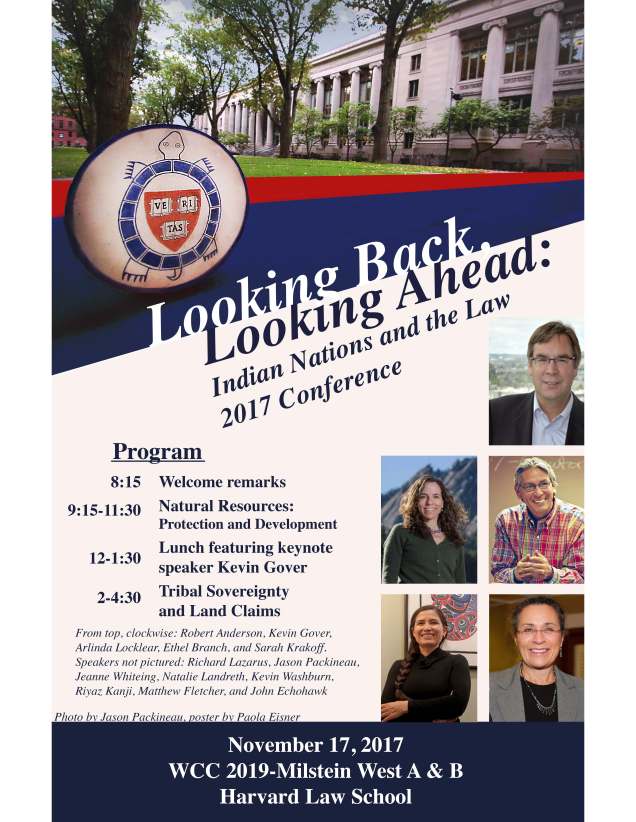
Harvard Indian Nations and the Law — 2017 Conference

Here (PDF):

Fed Indian Law Conference

ABA Human Rights Journal: “Tribal Disenrollment Demands a Tribal Answer”

William R. Norman Jr., Kirke Kickingbird, and Adam P. Bailey have published “Tribal Disenrollment Demands a Tribal Answer” in the ABA Human Rights Journal.

Tolowa Nation Complaint for Federal Recognition

Here is the complaint in Tolowa Nation v. United States (N.D. Cal.):

1 Complaint