Doesn’t get much better.
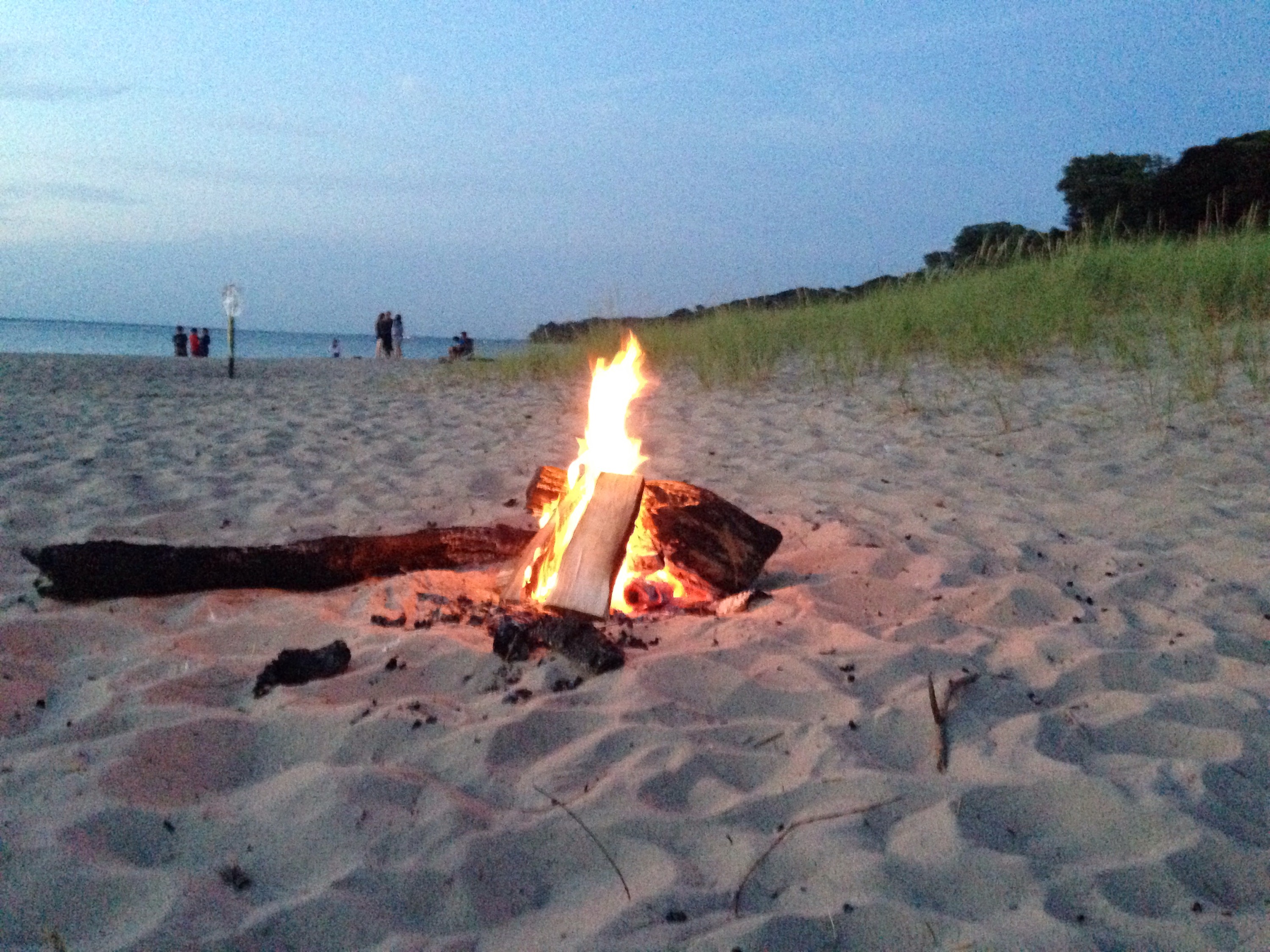


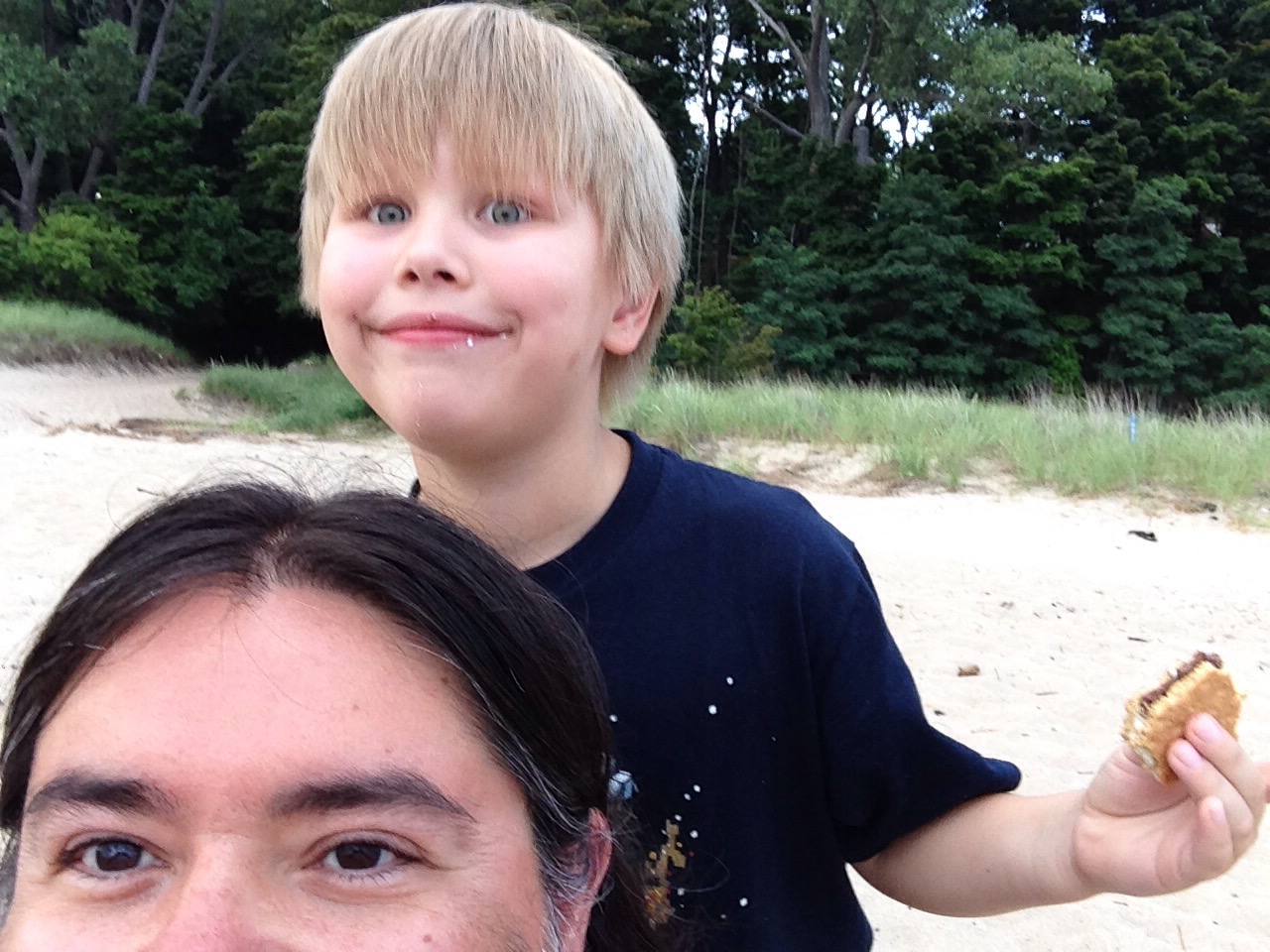

Doesn’t get much better.
Link to media coverage here.
Full text of Arizona Borderlands Protection and Preservation Act here.
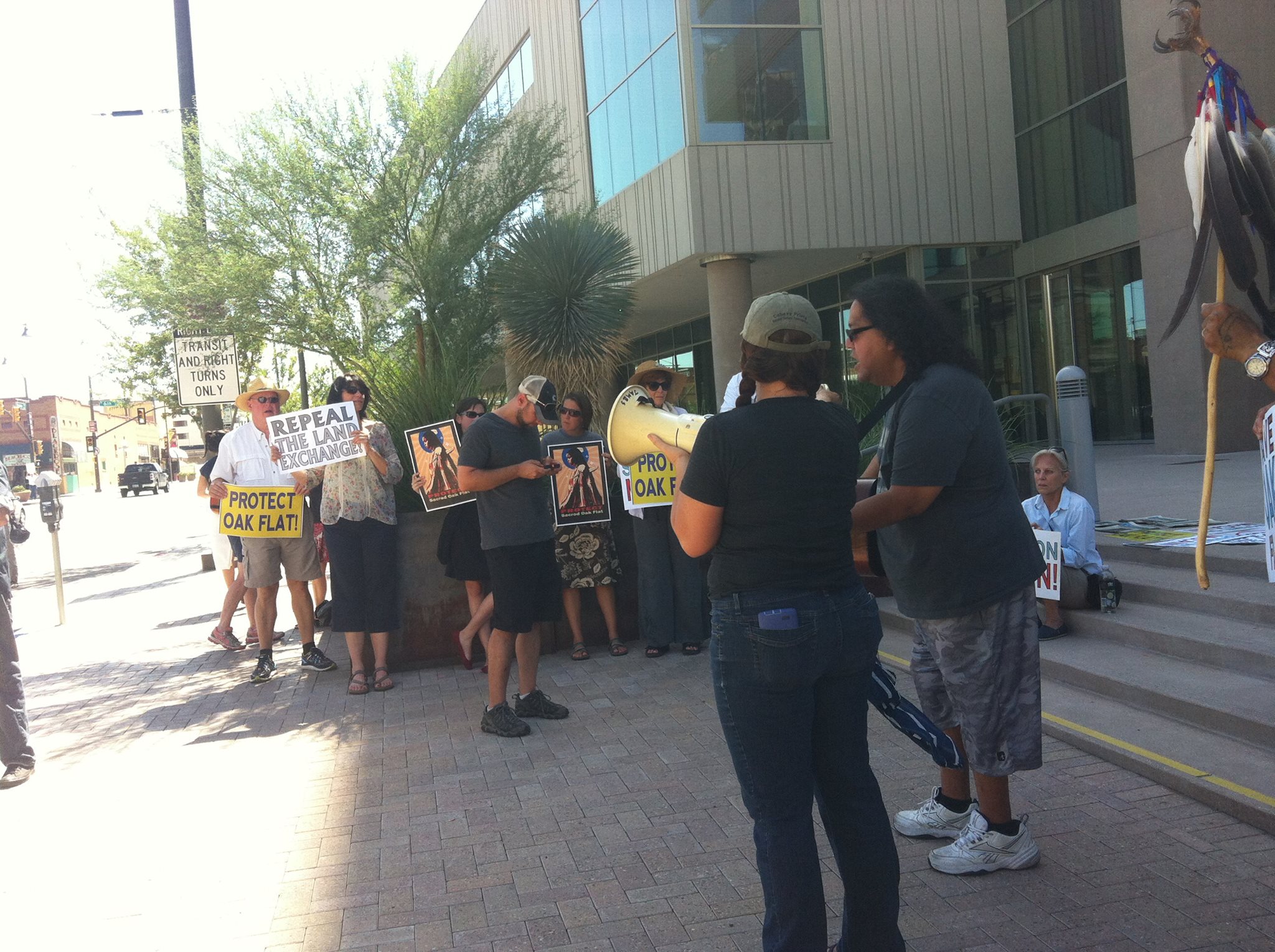
Native advocates protested a meeting today at Tucson Electric Power headquarters where Senator John McCain (R) was meeting. The protest was largely a response to the passing of a rider on last December’s National Defense Authorization Act that transfered title to sacred lands over to mining companies. It also passed along another message: No on S.R. 750.
Arizona Senators John McCain and Jeff Flake (R) introduced the Arizona Borderlands Protection and Preservation Act in March 2015 and it would allow unfettered access to federal lands in Arizona and parts of California. It was voted out of committee in May, but has yet to make an appearance on the Senate floor.
The bill calls for the Secretaries of Agriculture and the Interior to “provide U.S. Customs and Border Protection personnel with immediate access to Federal lands for border security activities, including routine motorized patrols and the deployment of communications, surveillance, and detection equipment.”
Environmental and tribal advocates are perturbed by what Arizona representatives are suggesting: unfettered entry and occupation of reservations and national parks situated within a hundred miles of the border.
This bill would waive all laws on federal public and tribal lands for 100 miles north of the U.S. Mexico Border, affecting Apache, Tohono O’odham, Hia-Ced sacred sites and the very existence of all tribal people residing on those lands. – Nellie David, Tohono O’odham
McCain believes the border will not be “secure” until 100% of it is being monitored, but analysts are not so sure this is possible:
No state has ever prevented all attempted unauthorized entries into its territory. Roberts et al. (2013) review several historical cases, including East Germany during the Cold War, which experienced mass outmigration in the 1950s and attempted to stop it completely by establishing a “kill zone” on its borders and severely punishing those who were caught and not killed. Even under such an extreme approach, in the late 1970s, 5 percent of those trying to cross succeeded. -Bipartisan Policy Center Feb. 2015 report
Even the Department of Homeland Security has criticized previous bills that purportedly expand the Border Patrol’s powers without providing additional funding.
A community forum will meet August 20, 2015, at 7:30PM at the Alliance for Global Justice at 225 E. 26th St. in Tuscon where panelists include U.S. Rep. Raúl Grijalva, who introduced a house bill to repeal the Oak Flat giveaway.
A federal judge put the regulations on hold in response to a suit filed by the Osage Producers Association and a similar suit filed by Osage Minerals Council, a tribal entity. A news article is here, and Fredericks Peebles & Morgan’s press release is here: 08 12 15 Press Release
Legal Aid of Nebraska, a law firm providing free civil legal services to low-income persons, seeks an attorney to serve Native American victims of domestic violence in Western Nebraska. Must be admitted to practice in Nebraska or have a Nebraska license pending, and be licensed or willing to become licensed in the Ponca, Winnebago, Omaha and Santee Tribal Courts. This position entails extensive travel throughout panhandle and Cherry counties.
Duties will include but will not be limited to:
The attorney in this position also provides quality and aggressive representation of low-income Native American domestic violence victims who are clients of LAN primarily in state court, and, engages in the day-to-day practice of law according to the priorities and practices set by Legal Aid of Nebraska. Ideal candidate will possess expertise in the area of domestic violence and have a connection to Native American issues. This is a full-time position requiring a committed individual. Company cell phone and laptop will be provided. Location in Scottsbluff, Nebraska.
Legal Aid of Nebraska offers excellent supervision, training and support, and state-of-the-art technology. Loan assistance repayment may be available assuming eligibility for Legal Aid’s repayment program. Experience-based competitive salary. Excellent benefits package. Please send resume, references, writing sample, and cover letter via email to: Jonathan Seagrass, Managing Attorney of Legal Aid of Nebraska’s Native American Project, at jseagrass@legalaidofnebraska.org. EOE. Position open until filled.
Application here. Closes September 1, 2015.
Previous coverage of the Keystone XL pipeline in South Dakota.
TransCanada received a permit with conditions in 2008, but lack of DOS approval led to it expiring before the foreign company could start construction on the Keystone XL pipeline. Several tribes and state citizens are fighting renewal before the South Dakota Public Utilities Commission, which recently concluded nine days of hearings about the pipeline. Tribes asserted TransCanada had not met its burden of satisfying federal law as a condition of the permit.
Link to recordings and documents on the SDPUC website.
There already is a Keystone pipeline that runs through South Dakota. The Phase 1 pipe starts in Canada, at the same location the Keystone XL pipeline will start, then cuts east across Saskatchewan and Manitoba before going south to Nebraska. The XL version is bigger, obviously, and will cut an almost straight line from Alberta to Nebraska on its way to the Gulf of Mexico to take advantage of the Bakken crude boom in Montana and the Dakotas. PUC previously concluded that the negative effects generated from billions of gallons of oil pumping over the State’s water sources unsupervised was greatly outweighed by its benefits, namely the $9.1 million in tax revenue it was supposed to pay counties. However, the full amount was never paid and now TransCanada promises to pay even more money and still guarantees job growth that DOS has reported is negligible.
Judge Koh (N.D. Calif.) set aside and remanded the Fish & Wildlife Service’s Final 30-Year Rule that extended the maximum duration of permits to take bald and golden eagles from five years to thirty years. The order states that the FWS failed to demonstrate that neither an EIS nor EA was needed for this twenty-five year extension.
The motion for summary judgment was granted for all NEPA claims, denied in part due to unsubstantiated (two sentences) ESA claims.
Order here.
Original complaint and previous coverage here.
Here.
Opening sentences:
The Tribe brings this action against the Department of Health and Human Services (“HHS”) and its agency, the Indian Health Service (“IHS”) seeking redress for their decision to use $1.6 million in funds appropriated for the Pine Ridge Service Unit, which provides health services to tribal members and other Indian beneficiaries, to fund a settlement of overtime pay that the IHS reached with unions. The IHS intends to use these funds to pay for the settlement even though the funds are required by law to be used to make improvements in the programs of the IHS operated by or through the Pine Ridge Service Unit which may be necessary to achieve or maintain compliance with the applicable conditions and requirements of Medicare and Medicaid.
The American Indian Law Center will be holding its 8th Annual Tribal Leadership Conference: Transitions, September 22-23, 2015 in Santa Ana Pueblo, NM.
This conference invites all tribal leaders, key tribal administrators, tribal court judges, and court administrators and clerks to participate, learn, and share experiences on federal, state, and local issues important to tribal nations.
Register by September 16; discounted hotel rooms available until September 1. A full agenda will be available soon.
Registration form and hotel information available here.

Here. From Kalamazoo County.
Of note: There are six tribes in Michigan alone that should be noticed if a parent family in a “Chippewa tribe,” and DHHS noticed one of them. MIFPA requires the notice of the tribe in the county where the case arises, though the Pokagon Band service area does not include Kzoo county, while the other two (unnoticed) Potawatomi tribes do cover the county. Finally, it’s not clear from the opinion why Cherokee was noticed at all.
There is no question that the ICWA and MIFPA notice requirements were triggered early in these proceedings when father indicated at an April 2013 preliminary hearing that he might have some family membership—specifically, through his brother—in the “Chippewa tribe.” There is some indication in the record that respondent-mother also claimed potential Indian heritage, although it is unclear what tribes, if any, she identified. Because “sufficiently reliable information” of possible Indian heritage was provided, the trial court had “reason to know” that an Indian child could be involved, thus triggering the ICWA and MIFPA notice requirements. 25 USC 1912(a); MCL 712B.9(1); In re Morris, 491 Mich at 109.
The record indicates that DHS sent notifications to several different tribes, including the Eastern Band of Cherokee Indians, the United Keetoowah Band of Cherokee, the Cherokee Nation, the Sault Ste. Marie Tribe of Chippewa Indians, and the Pokagon Band of Potawatomi Indians. DHS also sent a notification to the Midwest Bureau of Indian Affairs. On June 18, 2013, both the Eastern Band of Cherokee Indians and the Sault Ste. Marie Tribe of Chippewa Indians responded and indicated that the child was not eligible for membership. The Cherokee Nation also responded with a request for more family information, although there is no indication that further information was thereafter provided. There is also no indication that the remaining tribes or the Bureau of Indian Affairs responded. Based on the responses that had been received, the trial court indicated at a November 2013 review hearing that the ICWA/MIFPA inquiry was “at an end.”
We conclude that the record sufficiently evidences DHS’s compliance with the ICWA and MIFPA notice requirements. DHS sent notifications to several tribes, as well as the Bureau of Indian Affairs. On appeal, father does not identify any other tribes that should have been notified. Moreover, while father takes issue with the fact that DHS apparently never provided further information to the Cherokee Nation, he does not identify what further information could have been provided, nor does he argue that he provided the information requested to DHS but that DHS failed to forward it to the Cherokee Nation. Moreover, we note that DHS does not have an affirmative responsibility “to conduct independent research to obtain a parent’s detailed genealogical information.” In re Morris (On Remand), 300 Mich App 95, 105; 832 NW2d 419 (2013). Finally, despite father’s argument to the contrary, the trial court did in fact make a conclusive determination that the child was not an Indian child by noting that the issue was “at an end” and by leaving unchecked, in its subsequent orders, the box indicating that the proceedings involved an Indian child. There was no plain error affecting substantial rights.
Here is DHHS’s map of tribal service areas in Michigan.
 Turtle Talk
You must be logged in to post a comment.