Article on Birth Mother in Adoptive Couple Case Dropping Federal Suit

Here.

In a statement Tuesday, Cherokee Nation Assistant Attorney General Chrissi Ross Nimmo said officials did not actively follow the suit because they were never served with a complaint, meaning they were unaware the case was closed until last week.

“We are pleased Ms. Maldonado and the unnamed plaintiffs voluntarily dismissed the suit,” she said. “We never believed the suit had any merit, and we’re prepared to actively defend the suit had we ever been served.”

Kristen Carpenter and Lorie Graham on Human Rights and Adoptive Couple v. Baby Girl

Kristen Carpenter and Lorie Graham have posted a very compelling and powerful paper about the Supreme Court’s decision in Adoptive Couple v. Baby Girl. It is required reading for anyone interested in the case, and is destined to be the definitive paper on the international human rights aspects of the case.

The article is titled Human Rights to Culture, Family, and Self-Determination: The Case of Adoptive Couple v. Baby Girl. Here is the abstract:

The well-being of indigenous children is a subject of major concern for indigenous peoples and human rights advocates alike. In 2013, the U.S. Supreme Court decided in Adoptive Couple v. Baby Girl that the Indian Child Welfare Act did not prevent the adoption of a Cherokee child by a non-Indian couple. This occurred over the objections of her Cherokee biological father, extended family, and Tribal Nation. After the decision, Baby Girl’s father and the adoptive couple contested the matter in a number of proceedings, none of which considered the child’s best interests as an Indian child. The tribally-appointed attorney for Baby Girl, as well as the National Indian Child Welfare Association and National Congress for American Indians, began examining additional venues for advocacy. Believing that the human rights of Baby Girl, much like those of other similarly situated indigenous children, were being violated in contravention of the United Nations Declaration on Indigenous Peoples Rights, and other instruments of international law, they asked us to bring the matter to the attention of the United Nations Special Rapporteur for Indigenous Peoples Rights (“UNSR”). We prepared a “statement of information” to alert the UNSR of the human rights violations occurring in the case. With the permission of the attorneys and organizations involved, this chapter introduces the Baby Girl case, contextualizes the claims in international human rights law, and then reproduces the statement of information, and portions of the UNSR’s subsequent public statement. It concludes with an update on the Baby Girl case and broader discussion about the potential for using international law and legal forums to protect the human rights of indigenous children.

Unpublished Active Efforts Decision from the Michigan COA

Here.

With some troubling language, given this was an abuse and neglect case:

fn 4
In this appeal, the parties have not directly addressed whether respondent father ever had “custody” of the children, or whether respondent father is part of an “Indian family” within the meaning of ICWA or MIFPA. For purposes of this appeal only, we assume that respondent father was a parent from whose custody the Indian children were removed, within the meaning of 25 USC 1914 and MCL 712B.39. We further assume that mother, respondent father, and the children comprise an “Indian family” within the meaning of ICWA and MIFPA. Cf. In re SD, 236 Mich App 240, 244; 599 NW2d 772 (1999) (holding that no “active efforts” were required when the family had already been broken up at the time the proceedings began); Adoptive Couple v Baby Girl, ___ US ___; 133 S Ct 2552, 2563-2564; 186 L Ed 2d 729 (2013) (same).

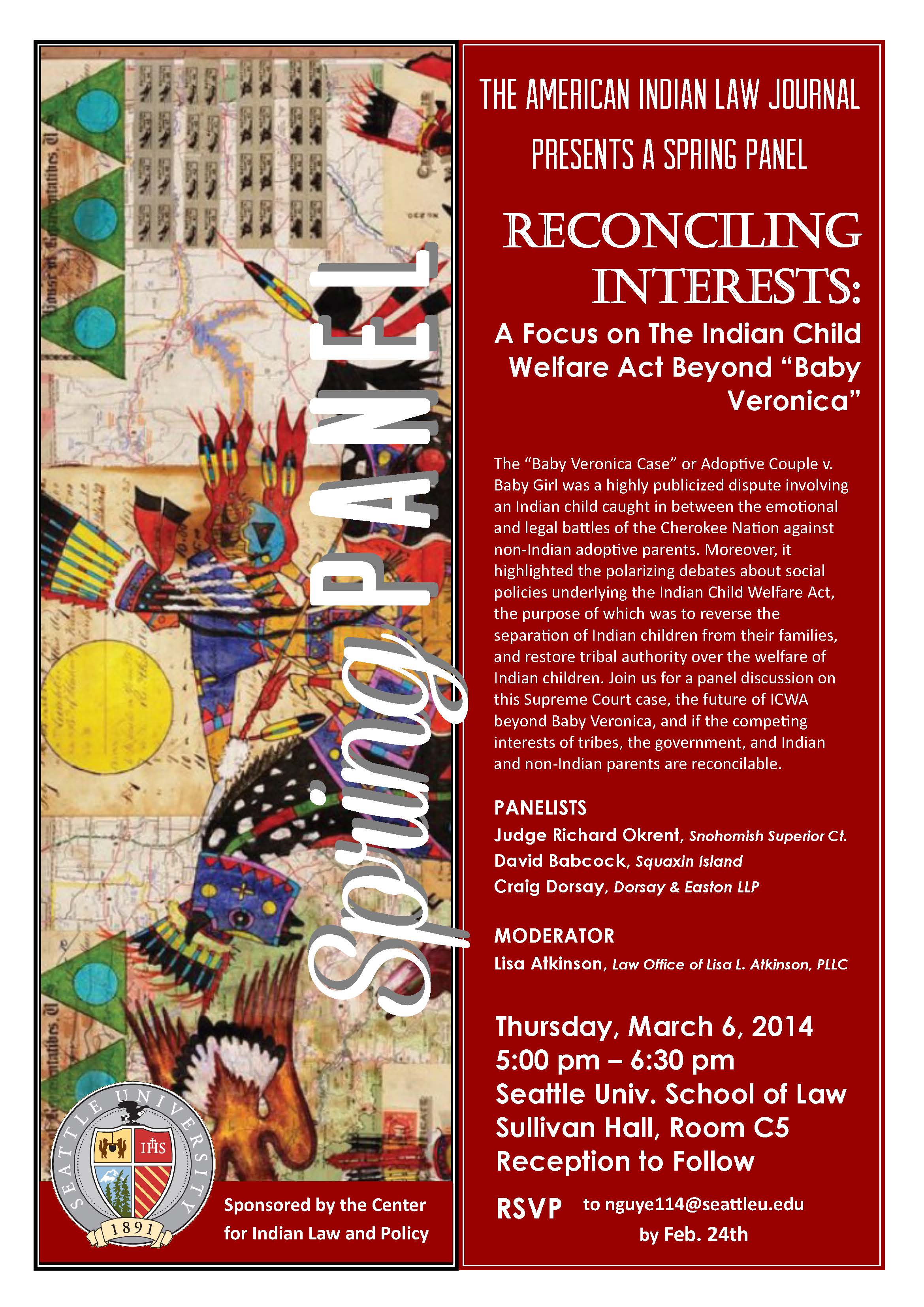
Two Events at Seattle U. Law School — Storytelling (Feb. 26) and ICWA (March 6)

Spring Panel 2014 Poster_A3i Final

Fernades event git-hoan3 February26

Continue reading

Investigation into Tulsa Adoption Agency

Story here.

Oklahoma’s Department of Human Services is looking into a Tulsa adoption agency.

Heritage Family Services and its director Mike Nomura are contracted with the state to administer a report that’s done for every case where a child is adopted across state lines.

The chairman of the board for Heritage Family Services is the attorney who represented Matt and Melanie Capobianco as they fought for custody of Veronica Brown.

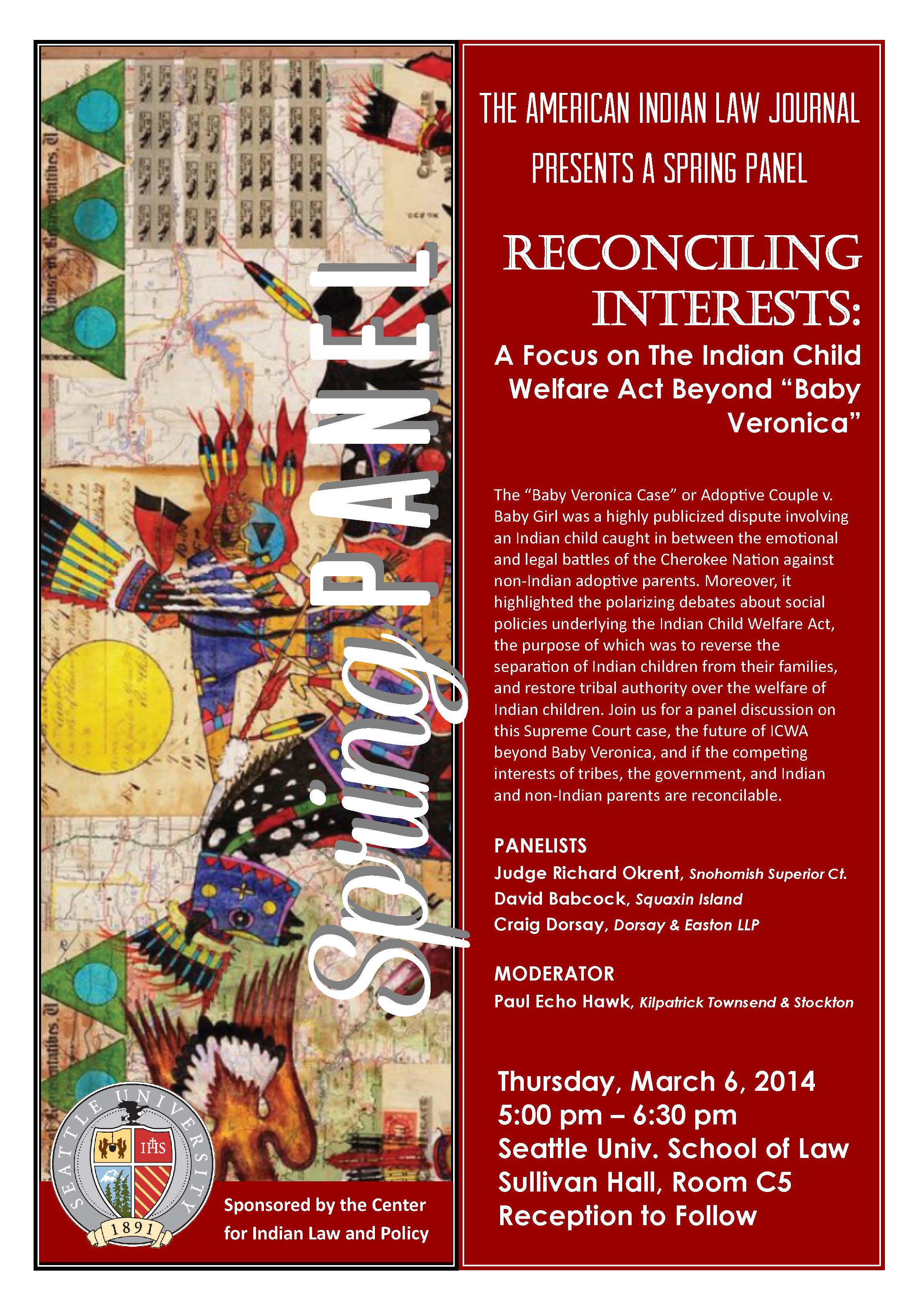
Seattle Law, American Indian Law Journal Event on Adoptive Couple v. Baby Girl

Here:

Spring Panel 2014 Poster_A3i

Yale NALSA Event on Adoptive Couple v. Baby Girl

Deconstructing the “Baby Veronica” Case: Implications for the Future of the Indian Child Welfare Act

Friday, February 21, 5:15-6:45 p.m.

Yale Law School, New Haven, CT

Panelists:

  • Jacqueline Pata, Executive Director, National Congress of American Indians
  • Joel West Williams, Staff Attorney, Native American Rights Fund

In June 2013, the Supreme Court decided Adoptive Couple v. Baby Girl, a widely publicized case involving the adoption of a Cherokee child by non-Natives over the objections of her Cherokee father. At the heart of the controversy was the Indian Child Welfare Act, a federal law designed to protect the best interests of Native children and promote the stability and security of Indian tribes and families. This panel will explore the history behind this landmark law, the current landscape of Indian child welfare, and the implications of the “Baby Veronica” decision for the future placement of Native children. Additionally, panelists will discuss how their organizations collaborated with both tribal and non-tribal stakeholders to develop legal, media, and other advocacy strategies for the case as part of the Tribal Supreme Court Project.


Registration: http://www.rsvpbook.com/event.php?439305


This panel is part of Yale Law School’s 2014 Rebellious Lawyering Conference. To learn more about the conference, please visit: http://www.yale.edu/reblaw.

Cherokee Nation Changes Placement Preferences Under ICWA

Article here.

The tribal resolution, which passed unanimously, states: “In any adoptive placement of a Cherokee child under state law, a preference shall be given, in the absence of good cause to the contrary, to a placement with a biological parent or parents; a member of the child’s extended family; other members of the Cherokee Nation; or other Indian families.”

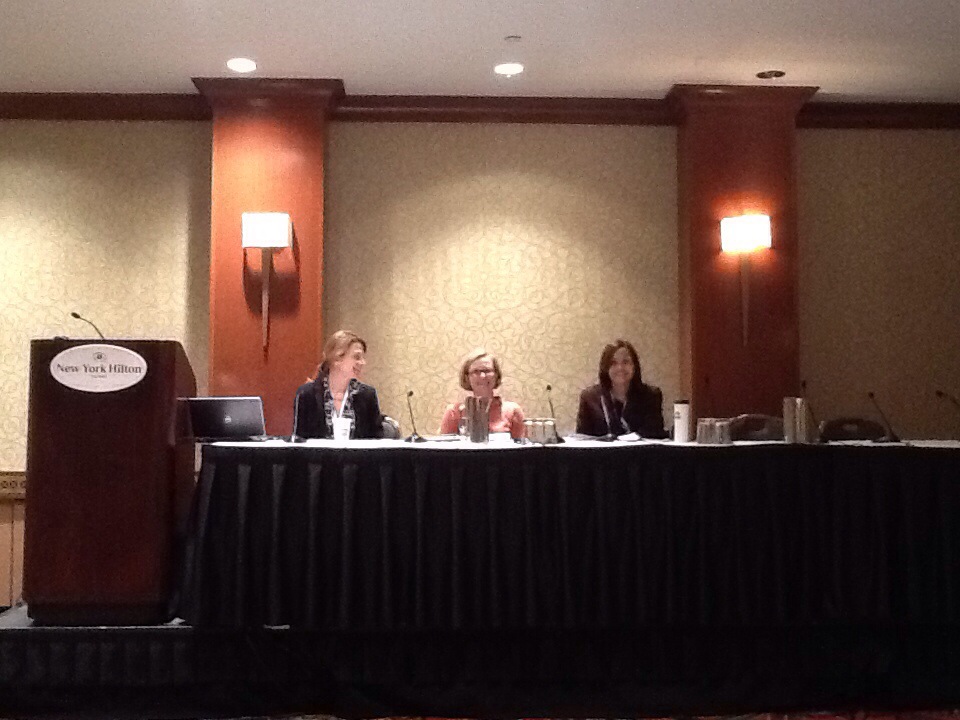
AALS Hot Topics Session on Adoptive Couple v. Baby Girl

Bethany Berger, our own Kate Fort, and Solangel Maldonado

20140104-082735.jpg

AALS Bridge Program on Adoptive Couple v. Baby Girl

Adoptive Couple v. Baby Girl:  At the Intersection of Family Law, Indian Law, and Civil Rights

On June 15, 2013, the Supreme Court decided Adoptive Couple v. Baby Girl, its first case on the Indian Child Welfare Act in 24 years.   The case raises conflicting visions of child welfare, race, adoption, fatherhood, and the status of Indian tribes.   The 5-4 decision turns on divided views of the statute, with a controlling interpretation that may decimate the rights of birth fathers in ICWA cases and even the scope of ICWA itself.  Conflicting amicus briefs from the National Council for Adoption (the trade group for private adoption agencies) and the 18 leading child welfare organizations in the country raise equally divided questions of the connection between the law and the best interests of children.  Finally, with claims by the adoptive couple and their amici of race-matching and equal protection concerns, and claims by the birth father and Indian tribes of an adoption industry illegally preying on Indian children, perspectives on the role of race in adoptions and even the constitutional status of Indian tribes are placed in conflict as well.   This panel explores these questions with scholars of federal Indian law, family law, constitutional law, and critical race theory.

Panelists:
Kathryn Fort  (Michigan State University-College of Law)
Solangel Maldonado (Seton Hall Law School)
Gerald Torres (University of Texas Law School; Visiting Cornell Law School)
Bethany Berger (University of Connecticut School of Law)

Thanks to Bethany for sending this along.