New Scholarship on Montana Indian Students and the “Prison Pipeline”

Melina Angelos Healey has published “The School-to-Prison Pipeline Tragedy on Montana’s American Indian Reservations” in the NYU Review of Law & Social Change.

Here is the description:

American Indian  adolescents in Montana are caught in a school-to-prison pipeline. They are plagued with low academic achievement, high dropout, suspension and expulsion rates, and disproportionate contact with the juvenile and criminal justice systems.  This phenomenon has been well documented in poor, minority communities throughout the country. But it has received little attention with respect to the American Indian population in Montana, for whom the problem is particularly acute. Indeed, the pipeline is uniquely disturbing for American Indian youth in Montana because this same population has been affected by another heartbreaking and related trend: alarming levels of adolescent suicides and self-harm.

The statistical evidence and tragic stories recounted in this report demonstrate beyond doubt that American Indian children on the reservations and elsewhere in Montana are moving into the school-to-prison pipeline at an alarming and tragic rate. The suicides of so many children is cause for despair, and the complicity of the education system in those deaths, whether through deliberate actions or through inattention, is cause for serious self-reflection and remediation. This article has been written in the hope that the people of Montana, government officials at all levels, teachers and school administrators, and public interest lawyers will have some of the information they need to take action. Despair, prison, and untimely death should not and need not be the ending places of public education for our most vulnerable children.
Education Week Special Report on American Indian Education

Here.

Education Week just completed a special package on education in Indian Country. In addition to news stories from Pine Ridge and Morongo and a number of multimedia elements, they have also published Commentaries from four Native authors in collaboration with NIEA. They are illustrated by Brent Greenwood (Chickasaw/Ponca).

New Scholarship: “The Academic Achievement of American Indians”

Stefanie Fischer and Christiana Stoddard will published “The Academic Achievement of American Indians” in Economics of Education Review.

Here is the abstract:

The academic achievement of American Indians has not been extensively studied. Using NAEP supplements, we find that the average achievement relative to white students resembles other disadvantaged groups. However, there are several differences. Family characteristics explain two times as much of the raw gap as for blacks. School factors also account for a larger portion of the gap than for blacks or Hispanics. The distribution is also strikingly different: low performing American Indian students have a substantially larger gap than high performing students. Finally, racial self-identification is more strongly related to achievement, especially as American Indian students age.

Continue reading

Montana SCT Holds N. Cheyenne Tribe May Bring Some Claims for Unjust Enrichment against Catholic Church

Here is the opinion in Northern Cheyenne Tribe v. Roman Catholic Church ex rel. Dioceses of Great Falls/Billings:

NCT v Catholic Church

An excerpt:

We reverse and remand the District Court’s decision to grant summary judgment to the Diocese and St. Labre on NCT’s claim for unjust enrichment and the imposition of a constructive trust that may arise from St. Labre’s fundraising activities after 2002. The court improperly determined that NCT had to establish evidence of loss by NCT or  wrongdoing by the Diocese and St. Labre in order to make out a claim for unjust enrichment. We also reverse and remand the District Court’s decision to grant summary judgment to the Diocese and St. Labre regarding St. Labre’s fundraising activities before 2002. The District Court should evaluate in the first instance the accrual date of NCT’s unjust enrichment claim pursuant to the standards set forth herein. The District Court can address on remand those defenses raised by the Diocese and St. Labre not resolved through the summary judgment proceedings. We affirm the District Court’s grant of summary judgment on all of NCT’s remaining claims.

Briefs here.

Nokomis Learning Center Book Club — “American Indian Education” — Jan. 21

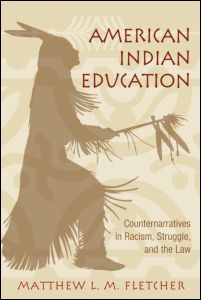
Nokomis Learning Center will be hosting a book club meeting about my book “American Indian Education: Counternarratives in Racism, Struggle, and the Law” tomorrow night at 6 PM. Check out the events calendar.

“American Indian Education” Reading and Signing — Saturday 1-3 PM

On October 25, I will be reading from and discussing my book, “American Indian Education: Counternarratives in Racism, Struggle, and the Law,” at Everybody Reads bookstore, located at 2019 Michigan Avenue, Lansing, Michigan.

The website for the reading is here. And the link to the my book page is here.

“American Indian Education” Profiled by ICT

From ICT:

TEMPE, Ariz. – Matthew L.M. Fletcher is an associate professor at Michigan State University College of Law and he is the director of the Indigenous Law and Policy Center. He recently published, ”American Indian Education: Counternarrative in Racism, Struggle, and the Law” through Routledge. He graduated from University of Michigan Law School.

Indian Country Today: Why did you choose to pursue a career in law?

Matthew L.M. Fletcher: I just want to be able to contribute something to the community and I also was thinking in different ways, even before I started college, what I could do. I had talks with people who are from my community and elders from Michigan who talked a lot about how in the ’70s and ’80s, the big treaty fishing cases were going on and people were really happy with the outcomes with those cases but they were sad to see all the litigation conducted and organized and control by people that were not from the community.

ICT: Do you feel like you have helped your tribe?

Fletcher: I feel like I’ve contributed something and I continue to contribute something. My whole life will be a process of contributing. I think it has been real good.

ICT: What is the future of Indian law?

Fletcher: It’s interesting. The ’70s and ’80s were about litigating treaty rights. The key for Indian lawyers is not so much about going to court but it’s about developing governmental structures within the tribe which is what lawyers do. It’s actually a folly to go to federal courts now. All you have to do is ask anyone who does any kind of litigation in federal court if you’re representing a tribe or tribal interest you can’t expect to win. It’s going to be that way for a long time. The thing that you see is institution building within Indian country. There are some incredible things going on that are not getting a lot of attention. There is a lot of creativity with people bringing back indigenous culture and tradition.

ICT: How would you define sovereignty?

Fletcher: My view of sovereignty is that it is the right to make your own mistakes and to decide things for yourselves. That is really what it is about. Tribes have the wherewithal, the ability and the legal authority to pursue different avenues of governance. They are going to do something where everyone shakes their heads, and then they are going to do other things where people are going to just say, ”Wow.” There is an incredible amount of diversity and creativity going on right now.

Continue reading

Book Reading at Everybody Reads (Lansing) — October 25

I’ll be reading from my book “American Indian Education: Counternarratives in Racism, Struggle, and the Law” at Everybody Reads, located at 2019 E. Michigan, Lansing, Michigan. The reading and book signing will take place at October 25, 2008, from 1-3 PM.

More details here.

Weblink to My Appearance on Interlochen Public Radio Today

Here it is. Thanks to Linda Stephan!

“American Indian Education” on Interlochen Public Radio

This morning! How’s that for late notice. It starts at 9:06, they tell me.

I’ll be on Interlochen Public Radio‘s Points North this morning talking about my book, “American Indian Education: Counternarratives in Racism, Struggle, and the Law.” Hope you can catch it.