Reported Inquiry Case from California [ICWA]

E077791

So for the first time since 2015, I’m giving myself permission to only read the reported ICWA cases rather than all of the unreported ones. So what does California do? Start reporting way more cases! Five in this first quarter (as opposed to 1 in 2021).

This case itself notes that this is not a particularly unique, but that by reporting it, just the reporting might lead to compliance.

We publish our opinion not because the errors that occurred are novel but because they are too common. Child protective agencies and juvenile courts have important obligations under ICWA. Failing to satisfy them serves only to add unnecessary uncertainty and delay into proceedings that are already difficult for the children, family members, and caretakers involved. Delayed investigation may also disadvantage tribes in cases where it turns out ICWA does apply, as their opportunity to assume jurisdiction or intervene will come at a late stage in the proceeding.

Unfortunately, I don’t think just reporting a case will lead to compliance, especially when this is the final result:

We conditionally reverse the section 366.26 orders. On remand, the juvenile court shall (1) direct CFS to comply with the inquiry and notice provisions of ICWA and sections 224.2 and 224.3 and update the court on their inquiry and the tribes responses and (2) determine whether ICWA applies. If the court determines ICWA does not apply, the orders terminating parental rights shall be reinstated and further proceedings conducted, as appropriate.

(emphasis added)

I haven’t crunched the numbers, but I am not convinced conditional reversal helps with compliance. Vivek Sankaran made this argument in the In re Morris case here in Michigan, and the sheer numbers in California indicate conditional reversal doesn’t seem to do much to change practice. I’m not sure reporting the case will change that. I still believe we should be reporting far more of the ICWA cases than we currently do, given that only about 20% of total ICWA appellate cases are reported.

Jurisdiction Case out of Alaska Supreme Court [ICWA]

sp-ord-116

These kind of cases feel like they are coming in a rapid speed right now–this is the third one I am aware of that have been/will be decided this spring. The issue is the attempted interference by foster parents in a transfer to tribal court proceeding, usually by trying to achieve party status.

Having considered the parties’ briefing — and assuming without deciding both that J.P. and S.P. were granted intervenor-party status in the superior court and that such a grant of intervenor-party status would have been appropriate4 — we dismiss this appeal as moot. “If the party bringing the action would not be entitled to any relief even if it prevails, there is no ‘case or controversy’ for us to decide,” and the action is therefore moot.5 As explained in our order of July 9, 2021, even if we were to rule that the superior court erred in transferring jurisdiction, we lack the authority to order the court of the Sun’aq Tribe, a separate sovereign, to transfer jurisdiction of the child’s proceeding back to state court.6 And we lack authority to directly review the tribal court’s placement order.7

The Court cites my all time favorite transfer case–In re M.M. from 2007. Not only is that decision a complete endorsement of tribal jurisdiction, it also explains concurrent jurisdiction (especially useful when you are operating in a PL280 state), which is not the power to have simultaneous jurisdiction, but the power to chose between two jurisdictions.

When we speak of “concurrent jurisdiction,” we refer to a situation in which two (or perhaps more) different courts are authorized to exercise jurisdiction over the same subject matter, such that a litigant may choose to proceed in either forum.FN13 As the Minnesota Supreme Court explained in a case involving an Indian tribe, “[c]oncurrent jurisdiction describes a situation where two or more tribunals are authorized to hear and dispose of a matter *915 and the choice of which tribunal is up to the person bringing the matter to court.” (Gavle, supra, 555 N.W.2d at p. 290.) Contrary to Minor’s apparent belief, that two courts have concurrent jurisdiction does not mean that both courts may simultaneously entertain actions involving the very same subject matter and parties.

Transfer to Tribal Court Case from Iowa Supreme Court [ICWA]

210243_816EBFA59A154

This is a very useful decision directly addressing one for the most difficult parts of a transfer process–whether the state court will use a best interest analysis to determine jurisdiction.

These are not reasons to deny a tribe jurisdiction over a child welfare case:

The State argued that transfer should be denied because of the lack of
responsibility by Mother and Father, the efforts of the foster parents to promote
the children’s Native American heritage, and the good relationship between the
current professionals and the children. The guardian ad litem for the children
joined the State in resisting the transfer of the case to tribal court.

Oh, and would you look at that, a CASA:

The juvenile court noted that the court appointed special
advocate (CASA) for the children recommended that the parental rights of the
parents be terminated and the children continue living with the foster parents.

But don’t worry–the Iowa Supreme Court clearly channeled the Washington Supreme Court in its thoughtful discussion of ICWA and its purpose, summarizing that

The federal ICWA and accompanying regulations and guidelines establish a framework for consideration of motions to transfer juvenile matters from state court to tribal court. Although good cause is not elaborated at length, both the statute and regulations state in some detail what is not good cause. Absent an objection to transfer or a showing of unavailability or
substantial hardship with a tribal forum, transfer is to occur. Clearly, Congress
has an overall objective in enacting ICWA to establish a framework for the preservation of Native American families wherever possible.

The Court goes on to discuss the Iowa ICWA at length, along with some bad caselaw in Iowa, specifically the In re J.L. case, which is a really awful decision and has been a pain to deal with for years.

This Court states,

State courts have struggled with the statutory question of whether federal
or state ICWA statutes permit a child to raise a best interests challenge to
transfer to tribal courts. In In re N.V., 744 N.W.2d 634, we answered the
question. After surveying the terms of the federal and state ICWA statutes, we
concluded that the statutes did not permit a child to challenge transfer on best
interests grounds. Id. at 638–39.

***

In short, there can be no substantive due process violation arising from a
statute that refuses to allow a party to present on an issue irrelevant to the
proceeding. To that extent, we overrule the holding ofIn re J.L. (emphasis ADDED)

***

In conclusion, if there is no objecting child above the age of twelve, we hold
that the transfer provisions of ICWA which do not permit a child from raising the
best interests of the child to oppose transfer does not violate substantive due
process.

Therefore,

In an ICWA proceeding, the United States Supreme Court observed that
“we must defer to the experience, wisdom, and compassion of the . . . tribal
courts to fashion an appropriate remedy” in Indian child welfare cases. Holyfield,
490 U.S. at 54 (quoting In re Adoption of Halloway, 732 P.2d at 972). These
observations apply in this case

There is a small dissent on whether the Father could appeal this case, but no issues with the Tribe’s appeal. Also, a reminder that the issue of jurisdiction was never a question Brackeen and decisions like this one are tremendously helpful for tribes seeking to transfer cases.

Brackeen/ICWA CLE from Fort

Since we all now have to deal with it, might as well deal with it together:

022822_BrackeenWebinar_Flyer

Supreme Court Grants Texas v. Haaland

Here is the order

The Court granted the petition with no limitations, so the issues are not limited the way the government and four tribes requested. Arguments will be held next term (terms start in October, so after October, 2022).

North Carolina Supreme Court on Reason to Know [ICWA]

59A21-1

DSS and the guardian ad litem for Carrie (GAL) disagree, arguing that respondent
conflates the existence of or possibility of a distant relation with an Indian with
reason to know that a child is an Indian child.

States and courts are really struggling with how much information from a parent gives the court reason to know there is an Indian child in the case–I think this is especially since the regulations now make clear that if you do have reason to know, you must treat the child as an Indian child until demonstrated otherwise. At the same time, there is real issue with lack of nuance on this issue–when a trial court takes the facts from a case like In re Z.J.G. and treats them the exact same way as the facts in this case, which is essentially what happened, then states really have to go send notice for both, which is what the WA Supreme Court held. You don’t do the reverse, which is what the North Carolina Supreme Court has done in this case.

Now, I got an email from California recently and there is a lot of discussion there about the state’s laws there distinguishing between “reason to believe” and “reason to know.” There are a LOT of bumps with implementation, but they are essentially requiring a level, or duty, of inquiry and further inquiry from their state workers to ensure they aren’t missing ICWA cases.

I’d love to get into why is the GAL arguing against the application of ICWA or ensuring the child has the information she may need to be a tribal citizen, but I do have to do some other things today . . . https://turtletalk.blog/2013/11/25/fletcher-fort-indian-children-and-their-guardians-ad-litem/

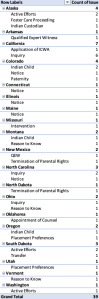
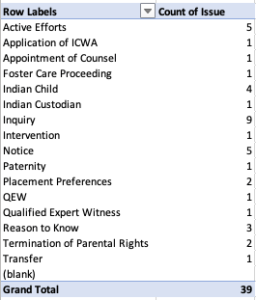
2021 ICWA Cases–Initial Screenshots

I’m still cleaning the data for the 2021 ICWA cases, but here are a few screen shots that might be interesting. Federal cases are excluded. This dataset is based on my reading of Lexis/Westlaw alerts as well as a few individual state alerts. Mistakes are mine.

Reason to Know Decision out of Colorado Court of Appeals [ICWA]

The Colorado Court of Appeals analyzed the regs on the reason to know issue, a similar argument to the In re Z.J.G. case from Washington. And as in Z.J.G., the Department is arguing for a narrower interpretation. However, the Court of Appeals reasoned:

Recall that the federal regulation and the Colorado statute implementing ICWA’s “reason to know” component distinguish between information that the child is an Indian child, 25 C.F.R. § 23.107(c)(1); § 19-1-126(1)(a)(II)(A), and information indicating that the child is an Indian child, 25 C.F.R. § 23.107(c)(2); § 19-1- 126(1)(a)(II)(B). These two provisions cannot have the same meaning because that would make one superfluous.

***

As a result, divisions of this court have repeatedly recognized that, where a district court receives information that the child’s family may have connections to specific tribes or ancestral groups, the court has “reason to know” that the child is an Indian child — even where the information itself does not establish that the child fully satisfies the definition of an Indian child

Haaland v. Brackeen [ICWA] Cert Stage Briefing Completed

All the briefs are here. The Court will first consider the case at this Friday’s conference (1/7).

Indian Law CLE: “Cutting Edge Indian Law Issues: McGirt v. United States Ramifications and Indian Child Welfare Act Constitutional Challenges”

This Indian law CLE is hosted by Thomas Reuters West LegalEdcenter and is available for on-demand viewing. See more information here.

Program Description:

“Under an 1833 treaty, the United States and the Muscogee (Creek) Nation agreed to set aside land for the latter’s occupation in the Indian Territory, now encompassed within the eastern half of the State of Oklahoma. An 1866 treaty reduced the reservation’s size.  Following the influx of non-Indian settlers in the latter half of the century and passage of various federal statutes to establish a uniform set of laws for both Oklahoma Territory and Indian Territory residents, Congress in 1907 admitted Oklahoma to statehood whose boundaries combined the Territories. Thereafter, the State and its courts treated the Creek Reservation as disestablished and all residents, regardless of Indian status, as subject to state law. In a 5-4 decision, however, the Supreme Court held that the Reservation remained intact and overturned state-law felony convictions of Jimcy McGirt, an Indian, for conduct within the Reservation. The majority reasoned that that the Reservation was not disestablished by Congress and therefore remains Indian country subject the Major Crimes Act, 18 U.S.C. § 1153, and not state criminal law with respect to offenses committed by Indians of the type for which McGirt was convicted. McGirt v. United States, 140 S. Ct. 2452 (2020).  

The McGirt decision raises substantial Indian-law doctrinal issues beyond the immediate question of reservation disestablishment. Ann E. Tweedy, Associate Professor, University of South Dakota Knudson School of Law, will explore those issues, particularly in light of other recent Supreme Court decisions and the Court’s changing composition. Anthony J. “A.J.” Ferate, Of Counsel, SpencerFane, is an Oklahoma practitioner with broad legal and governmental experience and will discuss McGirt’s on-the-ground impact. 

The United States, four Tribes, the State of Texas, and private parties filed petitions for writ of certiorari in September 2021 seeking review of the Fifth Circuit’s closely-divided en banc opinion in Brackeen v. Haaland, 994 F.3d 249 (2021). In complex and multi-pronged constitutional challenges to various provisions of the Indian Child Welfare Act and Administrative Procedure Act-based challenges to regulations issued by the Secretary of the Interior to implement ICWA, the court of appeals affirmed in part, reversed in part, and affirmed in part by an equally divided court without a precedential opinion a district court judgment that had accepted most of the challenges. Brackeen v. Zinke, 338 F. Supp. 3d 514 (N.D. Tex. 2018). It appears likely that the Supreme Court will grant review. Christina M. Riehl, Deputy Attorney General, California Department of Justice, Bureau of Children’s Justice, has been involved in the litigation from its outset through amicus filings on behalf of California and will discuss the constitutional issues raised by the certiorari petitions. 

The program will be moderated by Tania Maestas, Deputy Executive Director, Attorney General Alliance.”