Here:
Indian Civil Rights Act
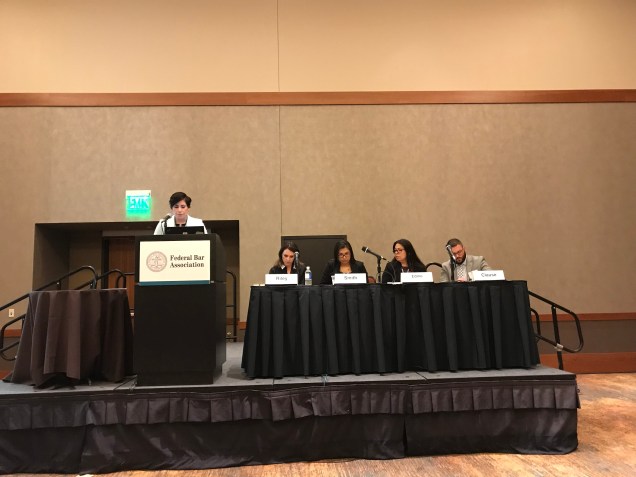
FBA Indian Law Conference ICRA Panel
Karla General, Angela Riley, Terri Smith, Se-ah-dom Edmo, and Josh Clause
Federal Court Declines to Suppress Statements Made by Criminal Suspect to Tribal Police
Here are the materials in United States v. Gillette (D.S.D.):
32 Motion to Suppress Statements
Tavares v. Whitehouse Cert Petition Denied
Federal Court Dismisses Former Tribal Employee’s ICRA Claims
Here are the materials in Munoz v. Barona Band of Mission Indians (S.D. Cal.):
UNM’s ICRA Symposium March 8-9, 2018
Here’s a link to the web page that we’ve established for people interested in registering for the upcoming UNM symposium titled “50 Years of the Indian Civil Rights Act: Protection and Denial of the Civil Rights of Native Americans.” The symposium, sponsored by the UNM Law and Indigenous Peoples Program and the Tribal Law Journal, will take place on the afternoon of Thursday, March 8 and all day Friday, March 9, 2018, at Isleta Casino and Resort in Albuquerque.
http://lawschool.unm.edu/events/icra/index.html
Registration is free, and space may become limited, so please act soon! Hotel rooms at Isleta Casino and Resort are available at a discount rate of $93 until February 15. Please call the hotel reservation line at 877-475-3827 and use the discount code LAW0318.
We look forward to an invigorating, wide-ranging discussion of the experiences and struggles of Native people during the five decades since passage of the Indian Civil Rights Act in 1968. We hope you will be able to join us!
John P. LaVelle
Professor of Law & Regents’ Lecturer
Director, Law and Indigenous Peoples Program
University of New Mexico School of Law
Tribal Law Journal Call for Papers — ICRA Symposium
UNM Symposium on the Indian Civil Rights Act, March 2018
New Scholarship on Federal Restrictions on Tribal Customary Law
Concetta Tsosie de Haro has posted “Federal Restrictions on Tribal Customary Law: The Importance of Tribal Customary Law in Tribal Courts.” The paper was published in the Tribal Law Journal.
Here is the abstract:
This article examines the adverse effects of federal case law and legislation on tribal courts and tribal courts’ ability to incorporate tribal customary law. Tribal customary law is the law given to tribes by holy deities which governs tribal ways of life. It is important to maintain tribal customary law because it strengthens tribal communities’ identities and cultural foundations. While Supreme Court precedent has, at different times, both restricted and promoted tribes’ ability to use tribal customary law to adjudicate the cases of tribal members, federal legislation including the Major Crimes Act, the Indian Civil Rights Act, the Tribal Law and Order Act, and the Violence Against Women Act continues to restrict tribes’ ability to apply customary law in tribal courts. To illustrate one way in which current federal Indian policy limits tribes’ ability to use customary law, the author highlights the ways in which two-spirit tribal members are excluded and ignored by the protections established in the Violence against Women Act. As the use of tribal customary law is critical to the maintenance of tribal sovereignty, this article advocates for corrections to these legislative restrictions to promote tribal court’s use of tribal customary law.
Rosebud Sioux Tribe Supreme Court Decision in Tribal Chairman’s Removal Dispute
Here is the opinion in Scott v. Kindle:
An excerpt:
The case at bar is fraught with such risk. There is no doubt that the action of the Tribal Council in removing President Scott from office is of historical significance. As such, it ought not be too readily set aside, especially when no practical remedy is available. As noted above, a new Tribal president, William Kindle, has recently been elected and taken office. Mr. Scott, even if he could prevail on his substantive arguments, cannot be placed back in office.3 Under these circumstances, it’s best to avoid any unnecessary constitutional conflict.
 Turtle Talk
You must be logged in to post a comment.