Here.
Riyaz Kanji Webinar on McGirt for Michigan Judicial Institute
Here.
Here.
Here are the available materials in Spears v. State of Oklahoma:
Here are the materials in Grayson v. State of Oklahoma:
Here are the materials in Sizemore v. State of Oklahoma:
Here.
This panel will explore the U.S. Supreme Court’s decision in McGirt v. Oklahoma, including how the decision could affect future cases involving tribal rights as well as the ruling’s on-the-ground impacts on environmental regulatory authority within the recently reaffirmed reservation boundaries in eastern Oklahoma.
The U.S. Supreme Court’s July 2020 opinion in McGirt v. Oklahoma affirmed the historic reservation boundaries of the Muscogee (Creek) Nation in eastern Oklahoma, ruling that Congress’s lack of any clear action or intent to diminish that reservation’s boundaries left them intact. Hailed by some Indian law scholars and practitioners as the most significant Indian law case of the twenty-first century, the U.S. Supreme Court’s July 2020 ruling in McGirt v. Oklahoma has potentially wide-ranging impacts for future litigation involving tribal rights and Indian reservation boundaries throughout the United States. Although the McGirt case itself focused on one reservation in eastern Oklahoma, the Supreme Court’s adoption of a strong, textualist-based approach in the McGirt opinion could signal a new era in federal Indian law that has ramifications for treaty rights and reservation-diminishment cases far beyond Oklahoma’s borders. Meanwhile, despite the Court’s reaffirmation of Indian reservation boundaries in eastern Oklahoma, the U.S. Environmental Protection Agency (EPA) recently approved Oklahoma Governor Kevin Stitt’s request to grant the State, not Native Nations, authority over environmental issues within their reservations, raising new jurisdictional questions for Oklahoma Tribes.
Our esteemed panel will offer attendees an understanding of the potentially wide-ranging nature of the McGirt decision, as well information about the ruling’s on-the-ground impacts in eastern Oklahoma. Native American law scholar Matthew L. M. Fletcher (Michigan State University) will provide crucial perspective that places McGirt within the broader framework of federal Indian law, while Riyaz Kanji (Kanji & Katzen) will offer insight into the arguments that led to the McGirt decision, as well as commenting on how Tribes outside of Oklahoma might rely on the ruling in future cases involving tribal rights and reservation boundaries. Finally, Cherokee Nation Attorney General Sara Hill will share her perspective about the post-McGirt regulatory landscape, following the EPA’s October 2020 decision to grant the State of Oklahoma environmental authority within the Indian reservations in eastern Oklahoma.
Register here.
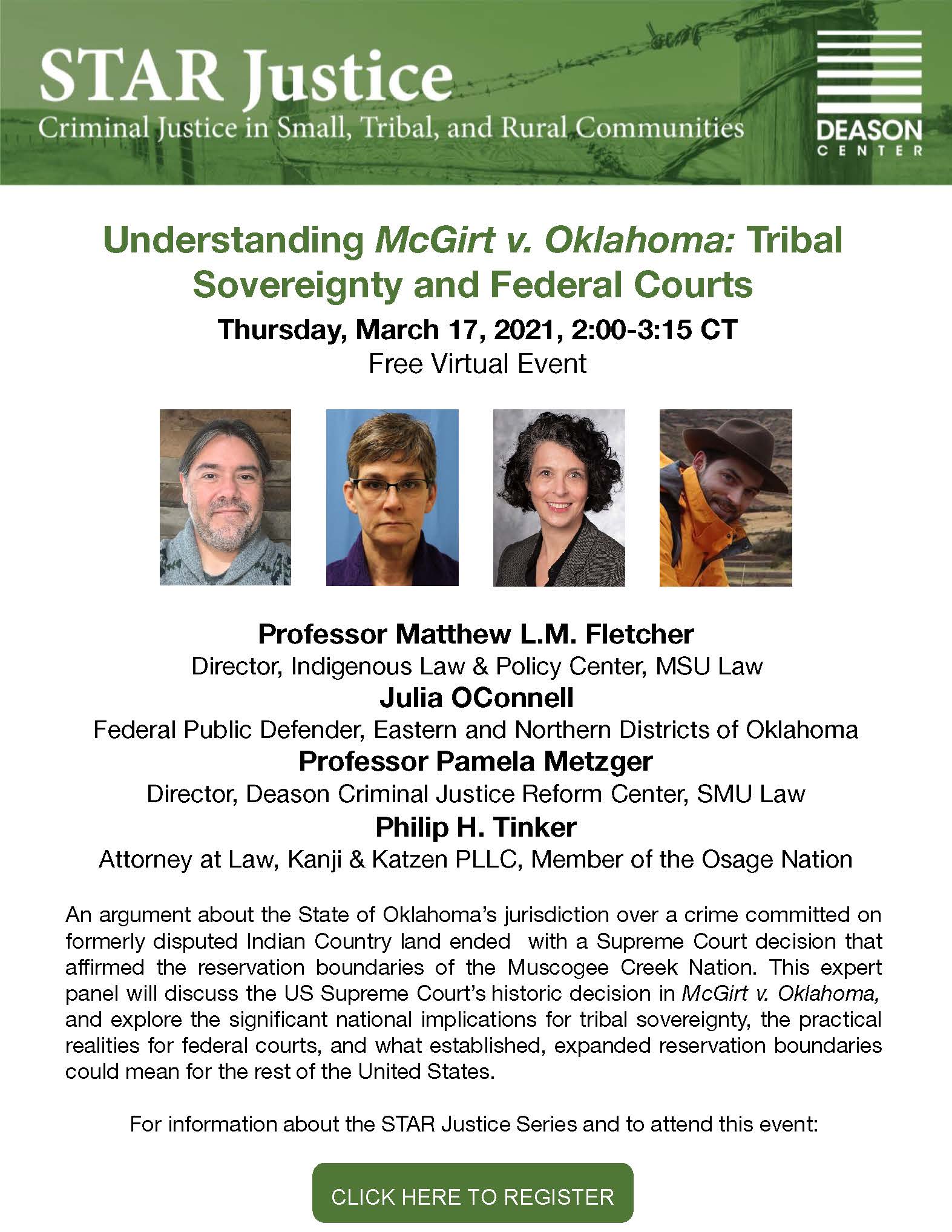
Here are the materials in State of Oklahoma v. Brester (Ottawa Co. Dist. Ct.):
Ottawa and Miami Tribes Amicus Brief
We also find this District Court appropriately applied McGirt to determine that Congress did establish a Cherokee Reservation and no evidence was presented showing that Congress explicitly erased or disestablished the boundaries of the Cherokee Reservation or that the State of Oklahoma had jurisdiction in this matter.
Hogner v. State of Oklahoma
Briefs:
Based on the evidence, the District Court concluded that Congress never erased the boundaries and disestablished the Chickasaw Nation Reservation. The Court further concluded that the crimes at issue occurred in Indian Country. We adopt these conclusions.
Bosse v. State of Oklahoma
Briefs:
Lower court materials here.
Dylan Hedden-Nicely and Stacy Leeds have posted “A Familiar Crossroads: McGirt v. Oklahoma and the Future of the Federal Indian Law Canon” on SSRN. The paper is forthcoming in the New Mexico Law Review.
The abstract:
Federal Indian law forms part of the bedrock of American jurisprudence. Indeed, critical parts of the pre-civil war constitutional canon were defined in federal Indian law cases that simultaneously provided legal justification for American westward expansion onto unceded Indian lands. As a result, federal Indian law makes up an inextricable part of American rule of law. Despite its importance, federal Indian law follows a long and circuitous road that requires “wander[ing] the maze of Indian statutes and case law tracing back [over] 100 years.” That road has long oscillated between two poles, with the Supreme Court sometimes applying foundational principles that view tribes as sovereigns “retaining all their original natural rights,” and at other times treating tribes as mere “wards subject to a [self-imposed] guardian.”
Supreme Court respect for tribal sovereignty and self-determination reached its zenith in the so-called “modern era” of federal Indian law, spanning from 1959 through the late 1970s. During this era, the Court tended to adhere to federal Indian jurisprudence and solidified a relatively coherent doctrine based upon the foundational principles developed in the 1830s. The late Dean David Getches described the modern era as a time that “encouraged a reinvigoration of tribal governments throughout the country. During this period, tribes gained political influence and economic security as [the federal government] generally promoted a policy of tribal self-determination.”
The Court turned away from its foundational Indian law principles with the onset of the 1980s and the departure intensified as Chief Justice William Rehnquist was appointed chief justice in 1986. Since then, the touchstone of the Supreme Court’s federal Indian jurisprudence has been to employ a “subjectivist” approach whereby it “gauges tribal sovereignty as a function of changing conditions”—demographic, social, political, and economic—and the expectations of non-Indians that may be potentially by the exercise of tribal power. As a result, the Supreme Court became a strikingly hostile place for American Indian tribes as the Court became increasingly willing to divest tribes of governmental powers, not by upholding the enactments of Congress, but through its own interpretation of what tribal inherent governmental rights ought to be.
The appointment of Justice Sonia Sotomayor and, more recently, Justice Neil Gorsuch seems to have brought change to the Court’s direction in Indian law cases. Since then, cases have been consistently decided in favor of tribal litigants by reaffirming treaty rights through the application of foundational principles that focus on the plain language of treaties and the application of the Indian canons of construction. However, to be sure, even the Rehnquist Court did “recite[] and sometimes act[] upon foundation principles,” but those cases were limited to situations where “non-Indian interests [were] not seriously threatened.” All of Indian Country waited for, or perhaps dreaded, a true litmus test.
That test came to the Supreme Court in the form of two Indian law cases—Sharp v. Murphy and McGirt v. Oklahoma—both of which were framed by non-Indian parties to affect the interests of an estimated 1.8 million people in eastern half Oklahoma. Ready or not, Indian Country found its test case, which squarely placed the Court’s competing jurisprudential philosophies— its foundation principles versus its “subjectivist” approach—on a collision course.
In a powerful and uncharacteristically passionate decision, Justice Gorsuch wrote for a 5-4 majority, upholding treaty-based rights to re-recognize the historic reservation boundaries of the Muscogee (Creek) Nation, the fourth largest Indigenous nation in the United States. The decision was the fourth consecutive treaty-rights victory and seemed to solidify a shift toward a consistent approach rooted in foundational principles.
The victory was short-lived. Just weeks after the Court’s decision in McGirt, Justice Ruth Bader Ginsburg passed away, once again shifting the make-up of the United States Supreme Court. As a result, Federal Indian law once again finds itself at a crossroads. The Murphy and McGirt decisions are landmark decisions that bring change to the legal landscape of much of Oklahoma. It remains to be seen whether the perceived new Supreme Court era in Indian law is here to stay.
Highly recommended!!!


You must be logged in to post a comment.