Here (PDF):
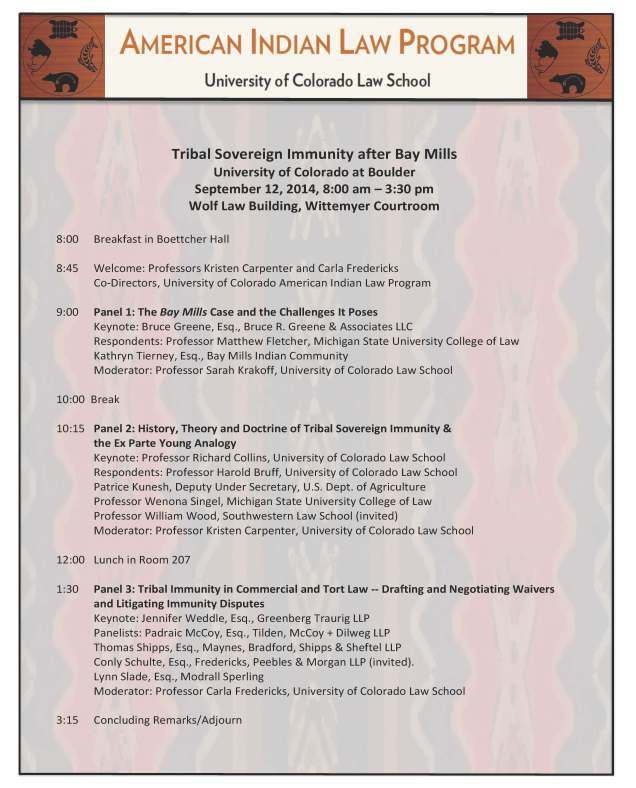
Click agenda to register.
| AMERICAN INDIAN LAW SECTION OF THE STATE BAR OF MICHIGAN Annual Business Meeting & Program This event is offered in conjunction with the Bar’s Annual Meeting Date: Thursday, September 18, 2014 Michigan v. Bay Mills 2014 Tecumseh Peacekeeping Award recipient: Assistant United States Attorney Jeff J. Davis |
Here are the materials in Cayuga Indian Nation v. Seneca County:
The syllabus:
Appeal from a district court order preliminarily enjoining Seneca County from foreclosing upon certain parcels of the Cayuga Indian Nation of New York’s real property to satisfy unpaid ad valorem property taxes. We conclude, in light of recent Supreme Court guidance, that tribal sovereign immunity from suit bars the County’s proceedings against the Nation and therefore AFFIRM the order of the district court.
Lower court materials are here.
Here are updated materials in State of Michigan v. Sault Ste. Marie Tribe of Chippewa Indians (W.D. Mich.):
53-1 Michigan Motion to Revise DCT Order Dismissing Tribal Officials
55 Michigan Response to Motion to Dismiss
Sault Tribe’s motion is here.
Here:
Oklahoma Supplemental Brief re Bay Mills
Tribal Supplemental Brief re Bay Mills
The Tenth Circuit previously abated this matter pending the outcome in Michigan v. Bay Mills.
Call for Papers for the AALS Annual Meeting
Friday, January 2 – Monday, January 5, 2015, Washington DC
The AALS Indian Nations and Indigenous Peoples Section invites submissions on the topic “Bay Mills and the Future of Sovereign Immunity” for the Section’s 2015 AALS conference panel. Please submit abstracts (preferred to received full papers) to the Section Chair, Alex Pearl, at alex.pearl@ttu.edu by August 1, 2014. We anticipate interpreting the topic broadly, so please submit if you are doing work related to this concept. The Section Executive Committee will inform you if you have been chosen to be on the panel by September 1, 2015 so that you will know in time for the Spring Law Review submission cycle.
Scott Wheat and Amber Penn-Roco have written a short paper, “No Good Deed Goes Unpunished: Personal Liability Exposure for Tribal Officials in the Wake of Maxwell v. County of San Diego (PDF).
An excerpt:
From firefighting in California, to clearing mudslides in Washington State, tribal governments routinely respond when calamity strikes: both on and off the reservation. Unfortunately, the Ninth Circuit Court of Appeals’ recent decision in Maxwell v. County of San Diego, 708 F.3d 1075 (9th Cir. 2013), creates personal liability exposure for the tribal officials carrying out these good deeds. The Supreme Court’s suggested “special justification” for allowing off-reservation tort victims to sue tribal governments in Michigan v. Bay Mills Indian Community, 572 U.S. ___ (2014), only complicates matters. This article provides a brief background of the Ninth Circuit’s prior holdings concerning the extension of tribal sovereign immunity to tribal employees, a summary of the Maxwell decision, a discussion of the potential implications of the decision, and an overview of precautionary measures to limit Maxwell personal liability exposure.
Here:
Filed right before the decision in Michigan v. Bay Mills came out, so it doesn’t take that case’s outcome into consideration.
 Turtle Talk
You must be logged in to post a comment.