South Dakota Law Review Indian Law Symposium Call for Papers

Call for Papers for the South Dakota Law Review’s Access to Justice in Indian Country Symposium

The South Dakota Law Review seeks article proposals, speakers, and panel participants for a symposium on issues related to access to justice in Indian Country. The Access to Justice in Indian Countrysymposium will be held in Vermillion, South Dakota, on September 29th, 2025. 

Abstracts of 300-500 words are due June 27, 2025.

The symposium will focus on Indian Country. The editors seek articles and speakers that address one or more of the following topics, or other related topics:

1. Indigent defense in Indian Country

2. Tribal Justice Systems 

3. The practice of law in Indian Country, including on rural reservations 

4. Incarceration and recidivism 

5. The study Federal Indian Law and Tribal Law as an academic discipline 

6. Tribal Law Enforcement 

7. Legal aspects of the Land Back Movement 

8. Land ownership on reservations 

9. Licensure policies and impact on reservation areas

The editors actively seek diverse viewpoints and diverse scholarly approaches.  Although the symposium is not a historical or comparative project, the editors welcome articles with historical or comparative features.

In your proposal, please indicate whether you would be interested in (1) publishing your topic, (2) speaking at the symposium, or (3) both. Priority will be given to proposals where the contributor expects to both publish and speak at our in-person event, although we will consider other proposals. 

The Call for Papers opens today with abstracts due on June 27, 2025. Please send abstracts to tia.vlasman@coyotes.usd.edu. Selected contributors will be notified by July 3, 2025. Finished articles will be due Monday, December 1, 2025. Our editors will work with you over the winter 2023-24 to prepare your work for publication. The symposium volume will be published and released in the summer of 2026.
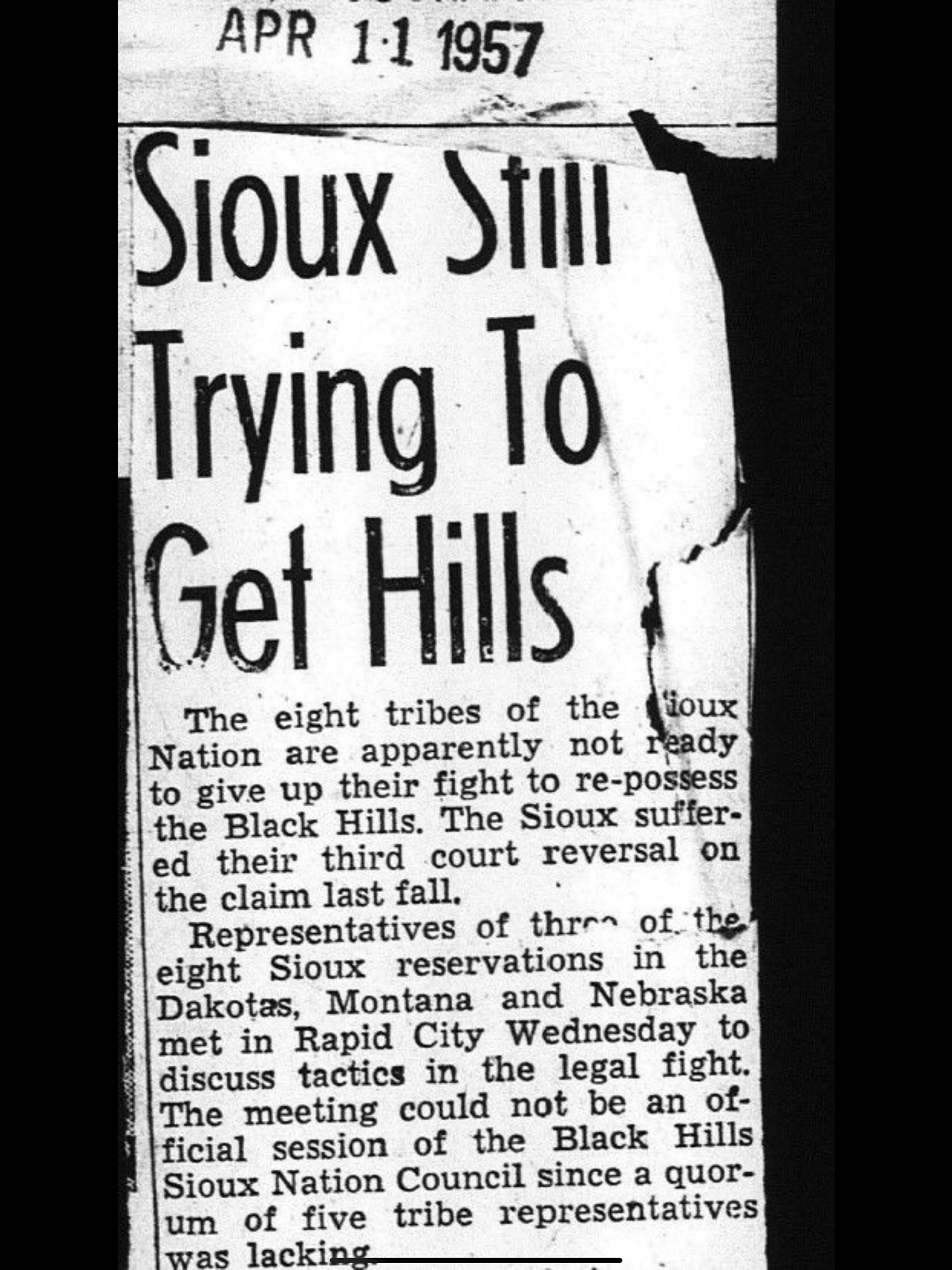
Pommersheim and Drapeau on the Black Hills SCT Case

Frank Pommersheim and Bryce Drapeau have published “United States v. Sioux Nation of Indians Revisited: Justice, Repair, and Land Return” in the South Dakota Law Review. PDF

HIGHLY RECOMMENDED!! A Frank Pommersheim joint is always worth it.

The abstract:

The amazing legal journey of this case begins in 1923 and ends with a Sioux Nation of Indians “victory” in the Supreme Court in 1980. Before reaching the Supreme Court, the case was litigated four different times before the Court of Claims because of the ineffective assistance of counsel and the necessity of a congressional statute to clear away the threatening ghost of res judicata. The historical backstory begins not in 1923, but with the signing of the Fort Laramie Treaty of 1868 and the United States’ illegal taking of the sacred Black Hills in1877. And the case does not end with the Sioux “victory” before the Supreme Court and its award of “just compensation” for the illegal taking. The Sioux Nation of Indians rejected—and continues to reject—the remedy of financial compensation without an attendant search for mutual repair and a justice that includes some form of land return. Despite some modest examples of land return in other parts of Indian country, no such efforts involve the Black Hills. This article seeks to inform all, but particularly those two generations of Lakota and non-Native citizens born since 1980, that now is the time for renewed effort and commitment to realize reconciliation and a justice that includes land return. This must be done before history closes its door for a second and final time and the Black Hills will remain stranded in historical infamy. No, this article is not just another twist on classic Indian Law principles gone awry, but the first of something we might call the Historical (Trauma) Trilogy of stealing Lakota land (and breaking treaties), suppressing the teaching and learning of the Lakota language and culture, and the battering ram of boarding schools to break-up Lakota families where a core value has always been to be a “good relative.” In its own careful way, this article is also about the persistence of Lakota resistance and the hard work of restoring the (sacred) hoop of land, language, and family for these new days.

Study of South Dakota Indian Country Lawyers

Bryce Drapeaux & Hannah Haksgaard have published Indian Country Lawyers: A South Dakota Survey in the South Dakota Law Review.

Here is an abstract representation of South Dakota:

Paul Mooney on Cannabis in Indian Country

Paul Mooney has published “Making Marijuana Less Illegal: Challenges for Native American Tribes Entering the Marijuana Market” in the South Dakota Law Review.

Frank Pommersheim’s Valedictory Notes and Collage

Frank Pommersheim has published “I Was So Much Older Then/I’m Younger Than That Now: Valedictory Notes and Collage” in the South Dakota Law Review (pdf).

Here is an excerpt:

Teacher, Scholar, Tribal Justice, Colleague. These are theseasons turning and braiding across my years and decades in thefield, the factory, and the monastery of my work and vocation.The toil of craft and building community. Yet there is alsosomething valedictory and elegiac that guides this pen and spillsthis ink in the desire to provide both a professional and personalsense of my thirty-five years of service at the University of SouthDakota School of Law (hereinafter USD).

Frank (far right) at the Montana Law Review symposium 2018

Frank Pommersheim on the Crazy Horse Malt Liquor Case

Frank Pommersheim has posted Part III of his South Dakota Law Review trilogy, The Crazy Horse Malt Liquor Case: From Tradition to Modernity and Halfway Back.

Here is the abstract:

Tasunke Witko, or Crazy Horse as he is known in English, is a revered nineteenth century warrior and spiritual leader of the Oglala Band of the Lakota (or Sioux) Nation. He is renowned for both his skills as a warrior and his high spiritual concern for the welfare of his people. He also often seems to stand apart as a mysterious, even mystical, individual. His picture was never taken by a photographer. He never went to Washington, D.C. to meet the “white fathers.” He never signed a treaty with the United States government. He never claimed to be a chief or tribal leader. He was ultimately killed in 1877, when he was held captive pursuant to his “surrender” at Camp Robinson in Nebraska. This, too, is shrouded in mystery.

Two-Thirds of Frank Pommersheim’s South Dakota Law Review Trilogy

Incl. Electronic Paper Amicus Briefs in Indian Law: The Case of Plains Commerce Bank v. Long Family Land & Cattle Co.
56 S.D. Law Review 86 (2011)
Frank Pommersheim
University of South Dakota Law School
Date Posted: August 06, 2012

Incl. Electronic Paper At the Crossroads: A New and Unfortunate Paradigm of Tribal Sovereignty
South Dakota Law Review, Vol. 55, No. 48, 2010
Frank Pommersheim
University of South Dakota Law School
Date Posted: August 06, 2012

We’ll post part III (“The Crazy Horse Malt Liquor Case”) when we get a nice pdf.

“Rebooting Indian Law in the Supreme Court” Paper Available

You can read my paper, “Rebooting Indian Law in the Supreme Court,” on SSRN here.

The paper is an edited version of the 2010 Dillon Lecture delivered at the University of South Dakota School of Law on February 18, 2010, and will be published in the South Dakota Law Review.

Here is the abstract:

This talk, delivered as the 2010 Dillon Lecture at the University of South Dakota School of Law, argues Indian nations and advocates – and the federal judiciary – view Indian law through a reactionary lens, deciding major issues as the cases arise. There are a few mini-movements, long-term strategies on a particular issue, such as the Cobell litigation, the fishing rights cases of the 1960s and 1970s, and perhaps a few others. But even those series of cases could hardly be called a strategic “movement.” As a result of a lack of a viable long-term strategy, I posit that tribal interests are and will continue to be punching bags in Supreme Court litigation.

I offer suggestions on how to reboot federal Indian law in the federal judiciary and the Supreme Court. I will discuss cases or lines of cases that demonstrate how Indian nations can persevere in the Supreme Court, and suggest potential long-term strategies for tribal interests to pursue.

Comments welcome, as this is still a draft.

Press Release on National NALSA Moot Court Competition

NATIONAL NATIVE AMERICAN LAW STUDENTS ASSOCIATION
MOOT COURT COMPETITION
and
NALSA INDIAN LAW/SOUTH DAKOTA LAW REVIEW SYMPOSIUM
UNIVERSITY OF SOUTH DAKOTA SCHOOL OF LAW

Vermillion, South Dakota
February 18-20, 2010
Sponsorship Opportunity

On February 18-20, the University of South Dakota School of Law will host the nation’s pre-eminent Indian Law event. It will include the National Native American Law Students Association (NALSA) Moot Court Competition, the foremost annual Indian law academic competition. The competition will be conducted in conjunction with a scholarly symposium co-sponsored by the South Dakota Law Review and the USD NALSA chapter and with the biennial Dillon Lecture on Indian law. The symposium represents the first time the annual Law Review Symposium has been combined with the NALSA Indian Law Symposium. The latter has been held biennially for more than two decades, making it the longest-running Indian law symposium in the nation. The Dillon Lecture is one of the Law School’s three major scholarly lectures; it is held biennially in conjunction with the Indian Law Symposium and features a major national speaker on Indian law.

Student teams from across the country will compete in the National NALSA Moot Court Competition. Teams from 55 schools have already registered, including teams from the University of Arizona, Arizona State University, University of California-Berkeley, University of Colorado, Columbia University, Gonzaga University, University of Hawaii, University of Iowa, Kansas University, Lewis & Clark University, University of Michigan, Michigan State University, University of Minnesota, University of New Mexico, University of North Dakota, University of Oklahoma, Stanford University, University of Tulsa, UCLA, University of Wisconsin, and William Mitchell College of Law. Many schools are sending multiple teams; for example, Columbia has registered six teams. The current registration represents a 25% increase over the number of teams that participated in last year’s competition in Boulder, Colorado.

The appellate problem for the competition has been drafted by USD Professor Frank Pommersheim, an internationally recognized Indian law expert who sits on several tribal supreme courts. It will involve issues of free exercise of religion in Indian Country. Judges for the Moot Court Competition will include members of the tribal, federal, and state judiciary and lawyers with expertise in Indian law.

The Dillon Lecture will be presented by Professor Matthew Fletcher (Grand Traverse Band of Ottawa and Chippewa Indians), Director of the Indigenous Law & Policy Center of the Michigan State University College of Law. Professor Fletcher is a co-author of the leading national casebook on federal Indian law and a judge and consultant to tribal supreme courts. Continue reading

Call for Papers: South Dakota Law Review

From the South Dakota Law Review:

The South Dakota Law Review is pleased to announce that it has
selected the 20th anniversary of the Employment Division v. Smith
decision as the topic for its annual symposium issue.  The Smith
decision remains central to our understanding of the scope of religious
protection Americans enjoy and continues to provoke much debate.  The
anniversary provides an occasion for scholars to engage the decision,
its impact on Free Exercise doctrine, and the subsequent actions by
Congress and the federal courts in the area of Free Exercise.

The Law Review invites the submission of abstracts on any facet of policy
or law research relating to the symposium topic.  The topic will
encompass diverse areas of religion and the law, with an emphasis on Indian law and constitutional law.

To submit an abstract for publication consideration, send an electronic copy of the abstract by email to kelly_jo_minor@yahoo.com by August 10, 2007.  All abstracts must contain original work that has not previously been published.