Here:

Kate Fort, Mike Petoskey, and Jill Tompkins (miigwetch to Dylan Miner for designing the drum).
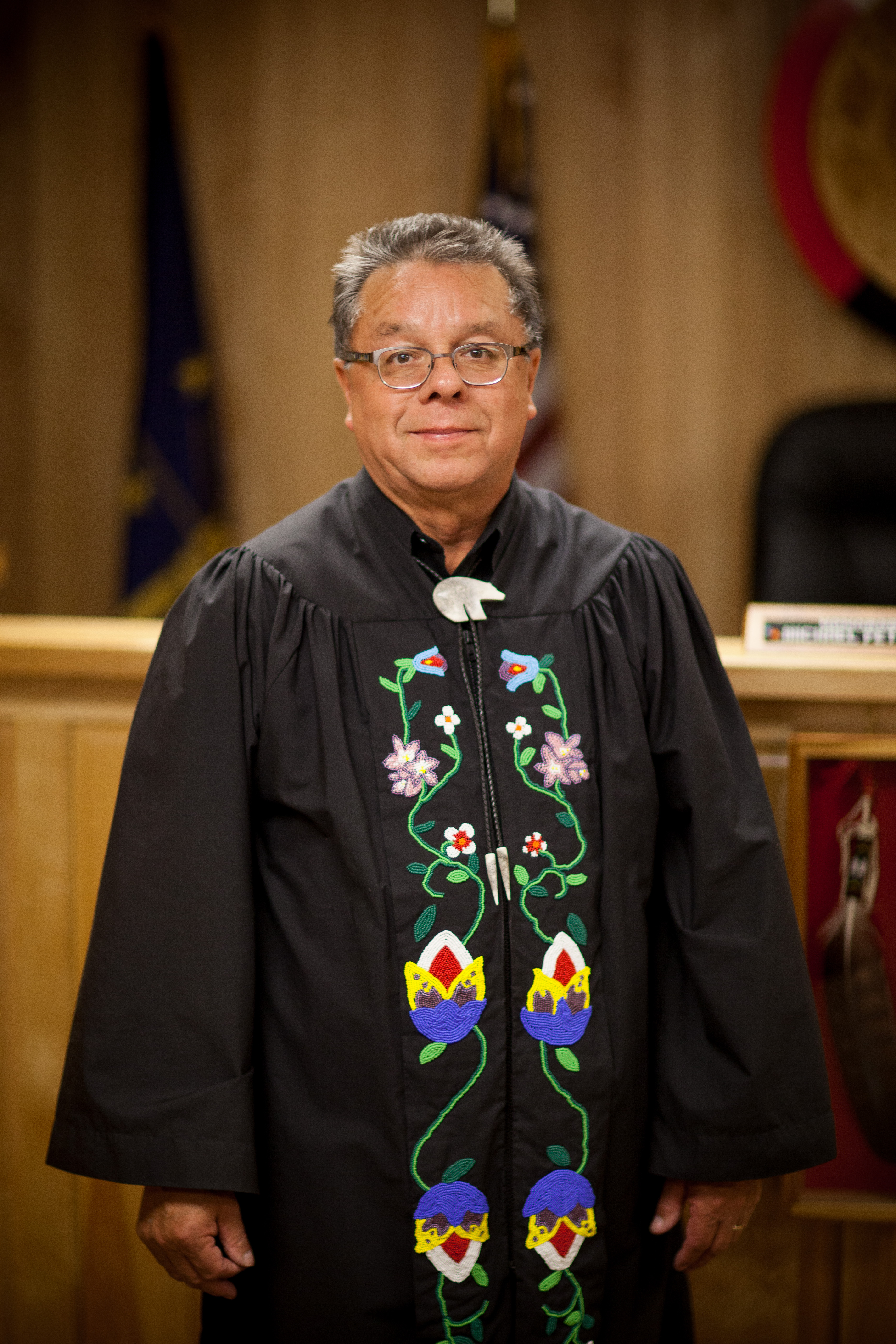
A more regal Mike…
More pics as we get them…..
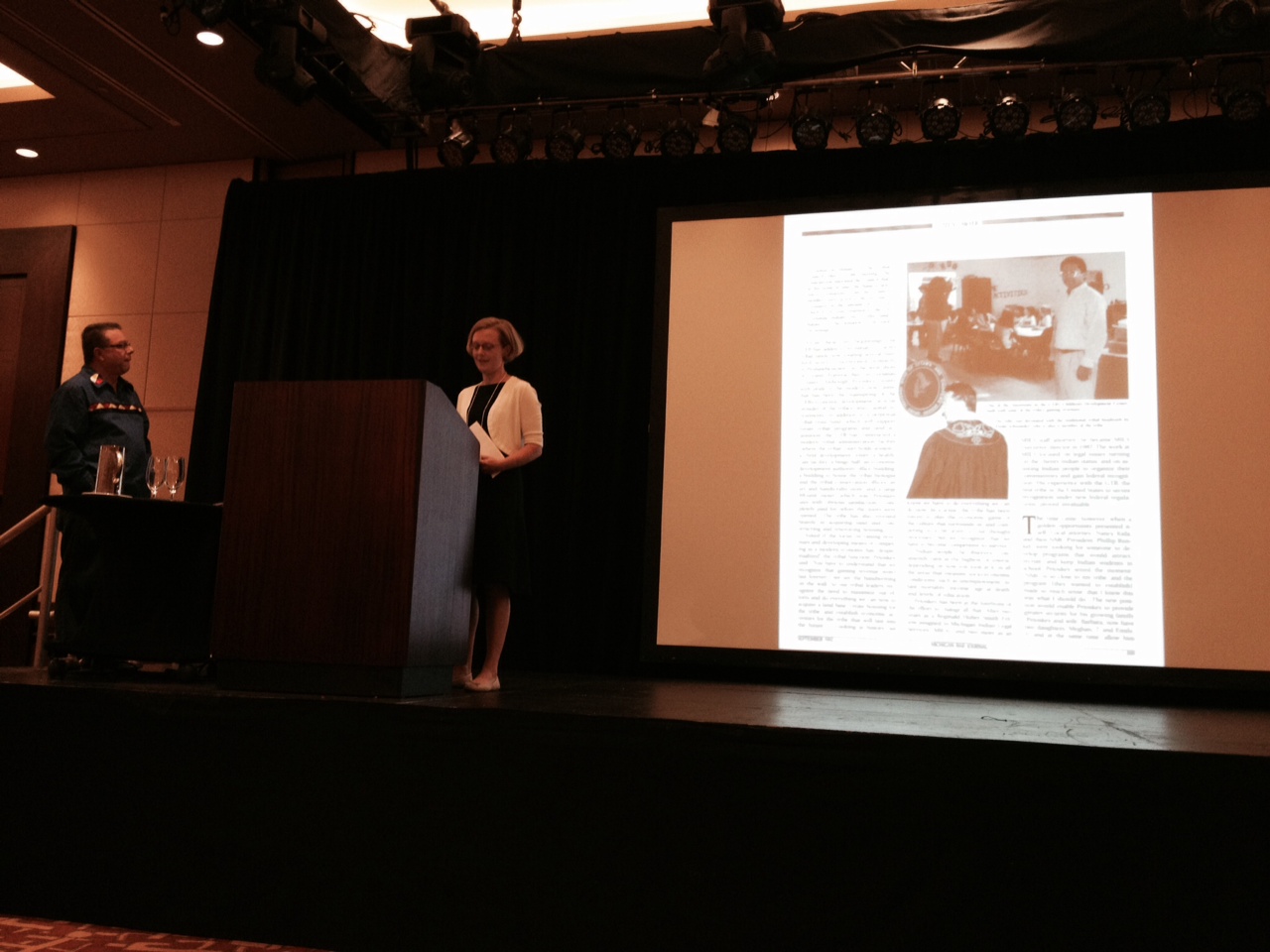
And Dean Leeds waits to accept her award from Judge Amanda Rockman:

Here:
Kate Fort, Mike Petoskey, and Jill Tompkins (miigwetch to Dylan Miner for designing the drum).
A more regal Mike…
More pics as we get them…..
And Dean Leeds waits to accept her award from Judge Amanda Rockman:
From Carolina Academic Press comes Mastering American Indian Law by Angelique Townsend EagleWoman and Stacy L. Leeds.
The description:
Mastering American Indian Law is a text designed to provide readers with an overview of the field. By framing the important eras of U.S. Indian policy in the Introductory Chapter, the text flows through historical up to contemporary developments in American Indian Law. This book will serve as a useful supplement to classroom instruction covering tribal law, federal Indian law and tribal-state relations. In ten chapters, the book has full discussions of a wide range of topics, such as: Chapter 2 – American Indian Property Law; Chapter 3 – Criminal Jurisdiction in Indian Country; Chapter 4 – Tribal Government, Civil Jurisdiction and Regulation; Chapter 8 – Tribal-State Relations; and Chapter 9 – Sacred Sites and Cultural Property Protection. Throughout the text, explanations of the relevant interaction between tribal governments, the federal government and state governments are included in the various subject areas. In Chapter 10 – International Indigenous Issues and Tribal Nations, the significant evolution of collective rights in international documents is focused upon as these documents may be relevant for tribal governments in relations with the United States. For Indian law courses, law school seminars on topics in American Indian Law, undergraduate and graduate level American Indian Studies classes, and those interested in the field, this book will provide an easy-to-read text meant to guide the reader through the historical to the contemporary on the major aspects of American Indian law and policy.
A draft of chapter three, Criminal Jurisdiction in Indian Country, is available on SSRN.
The first panel, Dean Stacy Leeds, and Professors John Borrows and Joseph Singer. Moderator, Estrella Torrez.

Estrella:
Incredible news!!!!
Here is the link the news release. And the text:
FAYETTEVILLE, Ark. – Stacy L. Leeds, interim associate dean for academic affairs, professor of law and director of the Tribal Law and Government Center at the University of Kansas School of Law, has been named dean of the University of Arkansas School of Law. She will assume her duties effective July 1.
“We are honored to welcome Dean Leeds to the University of Arkansas,” said G. David Gearhart, university chancellor. “As a nationally recognized scholar, judge and administrator, she is the ideal person to guide our law school to unprecedented heights.”
Leeds has focused her teaching and extensive research on property, natural resources and American Indian law. While at the Kansas School of Law she has served as interim associate dean for academic affairs and as director of the Tribal Law and Government Center. Prior to joining Kansas, she was a professor and director of the Northern Plains Indian Law Center at the University of North Dakota School of Law. She began her career of teaching law at the University of Wisconsin School of Law, where she served as a William H. Hastie Fellow. She received her master of laws degree from the University of Wisconsin, her juris doctor from the University of Tulsa, her master of business administration from the University of Tennessee and her bachelor of arts degree from Washington University in St. Louis.
Among her many honors, Leeds was awarded the prestigious Fletcher Fellowship to support her work on tribal sovereignty and citizenship issues. As a Fletcher Fellow, she was named a nonresident fellow of the W.E.B. DuBois Institute at Harvard University during the 2008-09 academic year. In addition, she has served as a judge for many tribes including the Cherokee Nation, where she was the only woman and youngest person to ever serve as a Supreme Court Justice.
“Since first meeting Stacy Leeds, I have been impressed with her visionary leadership and drive,” said Sharon Gaber, university provost. “She not only has innovative ideas for moving the law school forward and building on its proud tradition, but the ability to see those ideas through to fruition.”
“I am truly honored to join the University of Arkansas family at this moment in the life of the law school,” Leeds said. “Under Dean Nance’s leadership, the work of the faculty, staff and students has garnered national attention. I am excited to join the law school community at a time of such immeasurable possibilities for continued successes.”
Leeds, a citizen of the Cherokee Nation, becomes the first American Indian woman to serve as dean of a law school. Leeds will replace Cynthia Nance, who has served as dean since her five-year appointment in 2006. Nance will return to the faculty as professor of law after spending a year on a research appointment.
“We are very grateful to Cynthia Nance for all she has done for the School of Law and for the University of Arkansas,” said Gaber. “Her tireless work on campus and her outreach to the bar and our alumni have been invaluable in guiding the law school to greater national prominence.”
Here:
The Cherokee Nation has an automatic 240 day citizenship that attaches to any newborn who is a descendant of the Dawes Rolls. This was enacted to ensure that newborns are Cherokee citizens subject to the Indian Child Welfare Act’s protections and presumes that the parents will make a decision whether the enroll the child as a Cherokee citizen during their infancy. I would like to see our Nation go one step further and simply have natural born citizenship laws like other sovereigns throughout the globe, but that’s an aside. The decision from the the Tenth Circuit is here. The federal court does not like the idea of this “temporary citizenship” for inclusion in protections of a federal statute.
My question for tribal legal reform: why have people “enroll” a child as a citizen in the first place? Why not have Cherokee Nation laws that automatically extend citizenship to children who are eligible for citizenship and if someone chooses to disavow their citizenship, go thru the administrative process to renounce citizenship? When tribes requires someone to “enroll” as members/citizens of the Nation, it contributes to the idea the tribal citizenship is inferior to other citizenship. I envision this sequence: Citizenship by birth, followed by a Cherokee Nation Birth Certificate and/Cherokee Nation ID card for documentation purposes, followed by a Cherokee Nation driver’s license to operate a vehicle.
From Indianz:
Stacy Leeds, a professor at the University of Kansas School of Law, will develop a comprehensive history of the Freedmen of the Cherokee Nation for a fellowship she was awarded by the Fletcher Foundation.
Leeds, a tribal member, was a former justice for the Cherokee Nation’s highest court. She wrote the decision that said the Freedmen were entitled to citizenship. Leeds subsequently ran for chief but lost to incumbent Chad Smith. Smith believes the tribe has a right to deny citizenship to the Freedmen. Leeds was awarded $50,000 fellowship and must complete her project within a year.
Get the Story:
Kansas Law Professor Named Fletcher Fellow (DIVERSE 7/10)
Friend of CAHC awarded Fletcher Fellowship (The Muskogee Phoenix 7/10)
Cherokee Nation Judicial Appeals Tribunal Decision in Freedmen Case:
Allen v. Cherokee Nation (March 7, 2006)
Kansas’s Tribal Law and Government Center is hosting the 2008 conference on Feb. 1, 2008. Speakers include Lance Morgan, Howard Valantra, Phil Frickey, Stacy Leeds, Angelique EagleWoman, Taylor Keen, Russ Brien, and others. Looks like a great field! H/T Legal Scholarship Blog:
 Turtle Talk
You must be logged in to post a comment.