Here.
Also, “Feeding the Fight at Standing Rock.”
Here.
Also, “Feeding the Fight at Standing Rock.”
Here.
Here:
| STATEMENT IN SOLIDARITY WITH THE STANDING ROCK SIOUX |
November 3, 2016
Lands and waters, in our deeply held way of life, are not mere resources nor are they boundaried areas to be owned. They are the foundation of all relationships. Relationships, in a sense deeper than commonly understood, is the foundation of peace, happiness, law and order. Land, waters and human beings are mutual stewards. The tragic consequences of contamination to rivers and oceans has been repeatedly demonstrated by the mining at Black Mesa and Tar Creek, and by the Exxon Valdez and BP oil spills.
The Dakota Access Pipeline is now almost upon the Missouri River despite renewed calls from within the federal government itself for a stop until the environmental impact is formally assessed. Such calls were in existence since spring but were nevertheless ignored by the agencies responsible for such assessments. Instead, the pipeline was “fast tracked.”
The Pipeline directly threatens the Missouri River, which is the source of life for the Standing Rock Sioux. It is understood that the pipeline will carry one million gallons of crude oil an hour, and that any leak that is not quickly stopped will cause irrevocable environmental damage. There are news reports of nearly 300 oil pipeline spills in North Dakota in less than two years in remote areas where leaks are not readily known. Leaks are inevitable. Therefore, indigenous Americans from numerous tribes have gathered in protest to save the source of life; to save the Standing Rock Sioux people.
The gathered protesters are not merely scattered activists; they are representatives of their Indigenous Nations who have all endorsed the request of the People of the Missouri River for stoppage in order to dialog with the Nations. They are also representatives of the American people. They stand together asking that the laws of the United States be followed and honored – the laws establishing a duty to act on behalf of all Americans in managing our natural resources. We must all stand together to protect our limited and irreplaceable waters.
Indian Country Grassroots Support
Finally some rational thinking about TNToT. Here.
Here is the United States’ press release:
JOINT STATEMENT FROM THE DEPARTMENT OF JUSTICE, THE DEPARTMENT OF THE ARMY AND THE DEPARTMENT OF THE INTERIOR REGARDING STANDING ROCK SIOUX TRIBE V. U.S. ARMY CORPS OF ENGINEERS
WASHINGTON – The Department of Justice, the Department of the Army and the Department of the Interior issued the following statement regarding Standing Rock Sioux Tribe v. U.S. Army Corps of Engineers:
“We appreciate the District Court’s opinion on the U.S. Army Corps of Engineers’ compliance with the National Historic Preservation Act. However, important issues raised by the Standing Rock Sioux Tribe and other tribal nations and their members regarding the Dakota Access pipeline specifically, and pipeline-related decision-making generally, remain. Therefore, the Department of the Army, the Department of Justice, and the Department of the Interior will take the following steps.
“The Army will not authorize constructing the Dakota Access pipeline on Corps land bordering or under Lake Oahe until it can determine whether it will need to reconsider any of its previous decisions regarding the Lake Oahe site under the National Environmental Policy Act (NEPA) or other federal laws. Therefore, construction of the pipeline on Army Corps land bordering or under Lake Oahe will not go forward at this time. The Army will move expeditiously to make this determination, as everyone involved — including the pipeline company and its workers — deserves a clear and timely resolution. In the interim, we request that the pipeline company voluntarily pause all construction activity within 20 miles east or west of Lake Oahe.
“Furthermore, this case has highlighted the need for a serious discussion on whether there should be nationwide reform with respect to considering tribes’ views on these types of infrastructure projects. Therefore, this fall, we will invite tribes to formal, government-to-government consultations on two questions: (1) within the existing statutory framework, what should the federal government do to better ensure meaningful tribal input into infrastructure-related reviews and decisions and the protection of tribal lands, resources, and treaty rights; and (2) should new legislation be proposed to Congress to alter that statutory framework and promote those goals.
“Finally, we fully support the rights of all Americans to assemble and speak freely. We urge everyone involved in protest or pipeline activities to adhere to the principles of nonviolence. Of course, anyone who commits violent or destructive acts may face criminal sanctions from federal, tribal, state, or local authorities. The Departments of Justice and the Interior will continue to deploy resources to North Dakota to help state, local, and tribal authorities, and the communities they serve, better communicate, defuse tensions, support peaceful protest, and maintain public safety.
“In recent days, we have seen thousands of demonstrators come together peacefully, with support from scores of sovereign tribal governments, to exercise their First Amendment rights and to voice heartfelt concerns about the environment and historic, sacred sites. It is now incumbent on all of us to develop a path forward that serves the broadest public interest.”
Here:
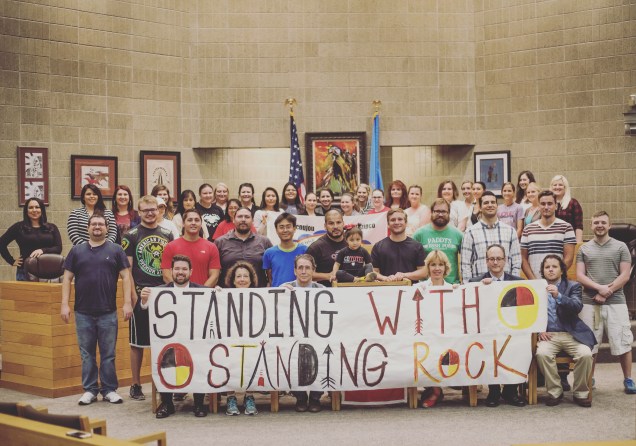
Here is “Taking a Stand at Standing Rock.”
Here (2016 JOB AD – ASSISTANT PUBLIC DEFENDER SRST TRIBAL COURT (FINAL-DMA)):
The Standing Rock Sioux Tribe requests applications for the position of Assistant Tribal Public Defender.
The Assistant Public Defender is responsible for representing, in the Standing Rock Sioux Tribal Court, Tribal members charged with crimes on the Reservation. Duties include advising defendants, conducting research, preparing court pleadings, negotiating with the Prosecutor’s office to reach plea agreements, and participating in bench and jury trials.
In order to meet the statutory prerequisites for employment as the Assistant Public Defender, applicants must: (1) be a member in good standing of the bar in any state or federal court; (2) be at least 21 years of age; (3) be of high moral character and integrity; (4) have a law degree from an (ABA) accredited law school; (5) never have been convicted of a felony; (6) have not been dishonorably discharged from the Armed Services; and (7) be physically able to perform the duties of the office. The selected applicant will be subject to Tribal, State & Federal Criminal Background Checks.
Applications must include: a cover letter, resume, law school transcript, proof of bar acceptance, (3) references, and (3) writing samples.
Applications may be submitted and inquiries may be directed, to Ms. Dellis M. Agard, Court Administrator, Standing Rock Sioux Tribal Court, PO Box 363, Fort Yates, ND 58538, Telephone (701) 854-7244 or by Email to dagard@standingrock.org.
The worksite for this position is located in Fort Yates, ND at the Standing Rock Tribal Court. Sitting Bull College Transit provides bus services, at nominal cost, to and from Bismarck, ND; Mobridge, SD; McLaughlin, SD and Selfridge, ND, and is coordinated with the Tribal work day, which is from 8:00 AM until 4:30 PM (Central Time).
 Turtle Talk
You must be logged in to post a comment.