Federal Prosecutors Decline Half of Indian Country Cases in Arizona

Here is the news article.

An excerpt:

The Arizona letters provide a window into a much larger government study of Department of Justice records in which 50 percent of the 9,000 cases filed from tribal lands during fiscal years 2005-2009 were declined.

In the study, 42 percent of rejections were attributed to weak or insufficient admissible evidence; 18 percent to “no federal offense evident;” and another 12 percent to witness problems.

In the AP’s Arizona review, the reasons – many cases cite more than one – were:

– 59 percent cited insufficient or inadmissible evidence. That could mean anything from inferior investigations by law enforcement to inadequate crime scene preservation.

– 27 percent cited witness problems, which can include witnesses recanting, being viewed as not credible, or simply disappearing.

– 16 percent cited a lack of jurisdiction, which can speak to the level of a crime. For example, the injuries of a detention sergeant beaten by an inmate weren’t serious enough to be a federal crime.

Continue reading

DOJ Issues Proposed Rule on Tribal Law and Order Act Assumption of Criminal Jurisdiction by Tribes in PL280 States

Here is the proposed rule.

New Paper on the Tribal Law and Order Act

Gideon Hart has posted his paper, “A Crisis in Indian Country: An Analysis of the Tribal Law and Order Act of 2010,” on SSRN. It was published in the Regent University Law Review.

The abstract:

Crime and violence have long been a serious problem in Indian Country. In recent years, though, the extraordinary levels of gang activity and high rates of sexual violence against Native American women have received a large amount of media attention. Responding to this problem, Congress passed the Tribal Law and Order Act of 2010. Through this legislation, Congress seeks to lower the rates of crime in Indian Country, particularly with regard to crimes committed against Native American women; the Act significantly increases the resources and authority of federal prosecutors and agencies in Indian Country and increases the sentencing authority of tribal courts.

This Article considers the major provisions of this landmark Act and concludes that it is an important piece of legislation that could potentially have profound effects in many parts of Indian Country. Although the Act was widely supported, however, this Article argues it does not do enough and is instead only a short-term remedy to the problems facing Indian Country. The Article proposes several pieces of legislation that would provide long-term solutions, including increasing the sentencing authority of tribal courts and legislatively overturning the jurisdictional limitations imposed on tribal courts by the United States Supreme Court in Oliphant v. Suquamish Indian Tribe. Both of these major reforms could be used as tools to increase the status and skill of tribal courts, eventually making them a much more equal third sovereign.

ICT Article on Tribal Law and Order Commission

Here. An excerpt:

Federal justice on reservations is discriminatory and harsh, especially for youth, but recently enhanced tribal justice systems – a potential remedy – may not be easy to implement, says a noted advocate for Native rights.

The 2010 Tribal Law and Order Act (TLOA) initiated a nine-member Indian Law and Order Commission that includes Denver-based Troy Eid, a former U.S. Attorney, who has worked with a number of tribes. He and other Commission members have held informal discussions pending full Commission funding.

The Major Crimes Act of 1855, which covers Indian perpetrators and victims on tribal lands, is discriminatory in that it provides harsher penalties for Indian offenders than for non-Natives for essentially the same crimes, he said. It strikes hard at teenaged Indian offenders, about one-third of whom are sentenced as adults as compared to only one to two percent of non-Native youth.

The federal system the Native youth enter requires them to serve about 85 percent of their sentences and there is no parole, while in the state of Colorado, for example, the average proportion of sentences served is 32 percent. There are no juvenile diversion programs, alternative sentencing, restorative justice or other federal rehabilitative programs comparable to those at state level, he said.

Enter TLOA: It reauthorizes substance abuse programs and grants for summer youth programs, constructs youth shelters and detention and treatment centers, develops long-term plans for Indian juvenile detention and substance abuse treatment centers, and supports tribal juvenile delinquency prevention services and care of juvenile offenders.

The Tribal Youth Program would authorize $25 million annually through 2015 for juvenile delinquency prevention services and the care of juvenile offenders.

South Dakota Rep. Kevin Killer (D -Pine Ridge) hailed the potential of the youth programs for his district, where more than half of residents are under age 18, and his state, where nearly 40 percent of those in the juvenile justice system are Native youth. Restorative programs are probably among those the Oglala Lakota would be interested in pursuing, he said.

Other major TLOA provisions allow participating tribal courts to impose penalties of up to three years’ imprisonment compared to the existing one-year limit and require tribal courts to provide court-funded licensed defense attorneys for indigent defendants, with more stringent qualifications for both attorneys and judges.

TLOA offers some financial support for enhanced tribal justice systems – a cost, which Eid himself says is “substantial” and which the Congressional Budget Office estimated at about $1 billion over the first five years.

Continue reading

Top Ten Indian Law Stories of 2010

Based on numbers of hits, and a nice review of the year, here is the First Top Ten Indian Law Stories of the Year:

  1. Wells Fargo v. Lake of the Torches EDC. The effort by the bank to force Lac du Flambeau to pay its obligations had been shut down by the conclusion of a federal court that the trust indenture was a gaming management contract. A Seventh Circuit appeal was briefed and argued, and is pending. Posts are here and here.
  2. Tribal Law and Order Act. Congress finally passed a piece of legislation geared at dealing with a national problem — the incredible rise of violent crime in Indian Country, and most especially violence against Indian women. Top posts are here and here.
  3. Challenges to the PACT Act. Congress’s effort to destroy what remains of Indian country tobacco sales over the internet was initially enjoined, but that injunction was lifted. The cases are now pending in the Second Circuit. Top posts here and here.
  4. Gun Lake Band Casino news. The Gun Lake Band finally began construction on its casino after more than a decade of legal challenges, only to face a difficult financing market. Posts are here and here.
  5. Bay Mills Indian Community opens casino in Vanderbilt, MI on fee land. Would probably be number 1 or 2 if it happened earlier in the year. Posts here and here.
  6. Chief Justice Roberts dissent in North Carolina v. South Carolina. Mountain out of a molehill? Maybe, but still…. Post here.
  7. Bloomberg report on Foxwoods default. Old news, but continuing to be important. Post here.
  8. Elena Kagan Appointment to Supreme Court. Plenty of speculation here on her (lack of an) Indian law record. Top posts here and here.
  9. Supreme Court 2010 October Term Preview. Here.
  10. Possible Keith Harper Appointment to Tenth Circuit. Here.

Honorable mentions include the indictment of former Sault Ste. Marie tribal official Fred Paquin; Walter Echohawk’s new book; federal court challenges to consecutive sentences by tribal courts; the Saginaw Chippewa reservation boundaries settlement, and the passing of Phil Frickey.

Update (2:30 PM): Obviously, as Alex Skibine noted in the comments section, the Cobell settlement was a huge story for the year, while probably happening too late in the year to generate enough hits to make the top ten list. Same goes for President Obama’s announcement of support for the UN DRIP.

GAO Report on Federal Prosecution Declinations

Significantly fewer declinations than some have asserted — namely, the 80 percent figure.

GAO Report “U.S. Department of Justice Declinations of Indian Country Criminal Matters”:

SummaryFull Report

From Indianz:

Federal prosecutors turn down 50 percent of cases in Indian Country, the Government Accountability Office reported.

Between fiscal years 2005 through 2009, 10,000 cases were referred to U.S. Attorney’s Offices. Federal prosecutors resolved 9,000 cases by either filing for prosecution, declining to prosecute or administratively closing the matter.

Of the 9,000 cases, only 50 percent resulted in prosecution. In 2005, the declination rate was as high as 58 percent.

“Declination rates tended to be higher for violent crimes, which were declined 52 percent of the time, than for nonviolent crimes, which were declined 40 percent of the time,” the report said.

The declination rate for sexual abuse offenses was even higher — 67 percent. “USAO officials told us that the difference in declination rates between sexual abuse and assault matters may be the result of the difficulty in obtaining evidence and witnesses in sexual abuse investigations,” the report said.

Continue reading

Minnesota Public Radio: White Earth Pushes for More Law Enforcement

From Minn. Public Radio:

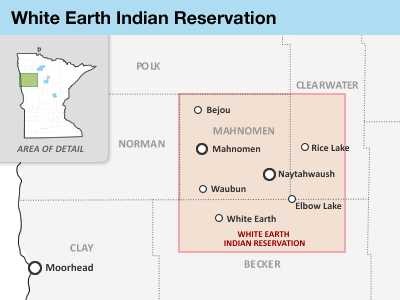
White Earth Indian Reservation, Minn. — Unhappy with the way criminal cases are handled on the White Earth Indian Reservation, tribal officials are seeking more control over law enforcement and the courts.

Tribal officials say local counties don’t prosecute crimes on the reservation aggressively enough.

AN UNEASY RELATIONSHIP

Rape cases particularly are going unpunished on the White Earth reservation, Tribal Attorney Joe Plummer said. Tribal officials want those cases prosecuted to help break the cycle of teen pregnancy and poverty on the reservation.

“These are young girls, 14, 15, 16 years old being impregnated by older men, 21 and older,” Plummer said. “And these are not being prosecuted. I can’t remember when one was prosecuted.”

But county officials strongly disagree. They contend tribal members don’t cooperate with investigators.

The tribe’s dissatisfaction over how criminal cases are handled on the reservation is just one example of the tension between White Earth and Mahnomen County over land, taxes and crime.

“I can’t remember when [a rape case] was prosecuted.”
– Tribal Attorney Joe Plummer

A review of Mahnomen County court records from 2008 to 2009 appears to confirm Plummer’s complaint about the lack of prosecution for criminal sexual conduct cases. But it’s unclear if all of the records from those years are entered in the public database.

When it comes to fighting crime on the White Earth Reservation, counties control the system. The tribe can investigate crimes, but county prosecutors decide who gets charged with a crime.

The two sides often disagree on how cases are handled. It’s one of many areas where the tribe and the county don’t see eye to eye.

COUNTY ATTORNEY: VICTIMS DON’T COOPERATE

Mahnomen County Attorney Julie Bruggeman said she’s not the problem. She said crime victims don’t cooperate with her office.

She also questions whether tribal officials really want justice for all the people accused of a crime. Bruggeman accused tribal officials of wanting to pick and choose who is prosecuted based on tribal connections.

Continue reading

Podcast with Fletcher on Tribal Law and Order Act

Here.

Painter-Thorne Article Criticizing Federal Jurisdiction over Sexual Assault on American Indian Women

Suzianne Painter-Thorne has posted her article “Tangled Up in Knots: How Continued Federal Jurisdiction Over Sexual Predators on Indian Reservations Hobbles Effective Law Enforcement to the Detriment of Indian Women” on SSRN. Here is the abstract:

An Indian woman is two-and-a-half times more likely than any other American woman to be sexually assaulted in her lifetime. Nevertheless, because of a confusing tangle of jurisdictional rules, she is four times less likely to see her assailant arrested. She is even less likely to see him stand trial. Because jurisdiction over most sexual assaults is vested in the federal government, Indian tribes are not allowed to arrest or prosecute most of the suspects who commit sexual assaults on tribal lands. Consequently, tribal lands have become safe havens for sexual predators, who can commit their offenses with impunity and with little fear of prosecution.

This article proposes that federal jurisdiction prevents effective law enforcement on Indian reservations and leaves Indian women at a greater risk of sexual assault. While the recently passed Tribal Law and Order Act seeks to improve reservation law enforcement, it fails to provide meaningful reform because it perpetuates the current law enforcement scheme that leaves Indian women vulnerable to sexual assault. Remote federal officials are not in the best position – geographically, politically, or culturally – to police reservation lands. Instead, Congress needs to reassess tribal jurisdiction, permitting tribes to arrest and prosecute suspects who commit sexual assaults on tribal lands. For too long, tribes have been left powerless to defend their own people against predators who enter reservation lands and commit unspeakable violence against tribal citizens. At the heart of sovereignty is the responsibility of government to protect its citizens. It is time to permit tribes to rise to this responsibility.

Ms. Magazine Blog Profile of Tribal Law and Order Act!!!!

From Ms. blog (thanks to A.T.!):

As a Native feminist without apology, I’m thrilled that the Tribal Law and Order Act of 2010 has been passed to protect Native women from violence. I have fellow Native woman warrior and feminist to thank for coining that exact phrase, and in fact, the bill itself: my shero Ms. Sarah Deer.

Sarah and I first met through Facebook, then face-to-face at the Tribal Policy and Law Institute of America in St. Paul, MN. It was Indigenous feminist love at first sight.

A Mvskoke (Creek) from Kansas, Sarah is a Tribal Law Professor at William Mitchell College of Law and served on the advisory committee (while undergoing chemotherapy for breast cancer) for Amnesty International’s 2007 report “Maze of Injustice: The Failure to Protect Indigenous Women from Violence“–the fire behind getting the Tribal Law and Order Act of 2010 passed.

It’s been a whirlwind three years–from the Amnesty report to the bill signing just days ago–but as Sarah says here it’s really been 500+ years in the making. And since women are the life-givers, matriarchs, and center of our communities, we all have a responsibility to keep fighting.

JY: How are you feeling right now?

SD: I’m feeling exhausted and exhilarated. We–the five or six of us women who were connected in making this happen–kept saying to each other outside the White House, “This is so surreal!”

JY: When did it become real for you?

SD: It became very real when Lisa Marie Iyotte–a Lakota woman from the Rosebud Sioux tribe in South Dakota who is a rape survivor–spoke [at the bill’s signing] and said unequivocally, “If the Tribal Law and Order Act had existed 16 years ago, my story would have been very different.”

JY: Watching Lisa Marie I couldn’t help but cry myself. I’m always reminded that when I feel emotional or show my feelings publicly, it’s a sign that I’ve survived the attempts to beat the feelings out of me as an Indigenous person.

Continue reading