Here.
H/t Pechanga.
Here. The text:
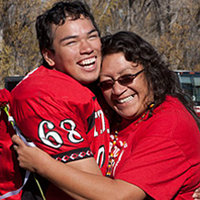 What’s new in voter suppression land today? South Dakota is trying to prevent Eileen Janis — and hundreds of other citizens — from voting.
Eileen grew up on the Pine Ridge Indian Reservation and does suicide prevention work. She registered to vote for the first time in 1984. “I always vote because my mom told me to,” she says.
But when she went to cast her ballot in the historic 2008 election, she found that she had been illegally removed from the voter rolls. Though she had been convicted of a felony, her sentence to probation meant that she had not lost the right to cast a ballot. “I went [to vote] with my son who had just turned 18. As soon as I tried to vote I was told no because I was a felon.”
The illegal denial of Eileen’s voting rights is part of South Dakota’s long and troubling history of violating the civil rights of Native Americans. Native Americans are highly over-represented in the criminal justice system, so denying voting rights to people on probation has an unfair and disproportionate impact on Native American voters.
The ACLU sued on behalf of Eileen and other Native Americans wrongfully purged from the rolls. We won, and South Dakota was ordered to make sure that people on probation were allowed to cast their ballots.
But the South Dakota legislature is now considering a bill that would strip Eileen and anyone else convicted of a felony of the right to vote, even if they never serve jail time and are living in their communities.
Measures designed to suppress the vote have been sweeping the nation, and South Dakota appears to be jumping on the bandwagon — but not if we can help it.
The Voting Rights Act gives the US Department of Justice (DOJ) the power to ensure that voting laws do not discriminate. Tell the DOJ to protect the right to vote in South Dakota and across the nation. And urge Congress to pass the Democracy Restoration Act, which would let Eileen — and all Americans with past convictions who are living in their communities — vote in federal elections.
Learn more about voter suppression: Sign up for breaking news alerts, follow us on Twitter, and like us on Facebook.
Here is the order granting the City $1000 from the plaintiffs:
DCT Order on Taxation of Costs
The City had asked for almost $20,000. An excerpt:
Under the unusual facts ofthis case, the Court in its discretion awards a portion of the costs to the Defendant in the amount of $1,000.00 against Plaintiff Pearl Cottier and awards no costs against Rebecca Three Stars as she is a poor person who brought an action on behalf of other Native American voters with no possibility ofmonetary gain for herself. Pearl Cottier may well have trouble paying her bills, but she is not a poor person. She, too, stood to gain nothing financially from this lawsuit brought in South Dakota on behalf of not only herself and other Native American voters in Martin, but also all Native Americans voters in South Dakota from a precedent point of view. Ms. Cottier is required to pay $1,000.00 in costs to the Defendants.
Here. An excerpt:
Native Americans have never had an easy time getting to vote in South Dakota. In 1977, the state attorney general dismissed the Voting Rights Act as an “absurdity” and advised state officials to ignore the federal law. The state didn’t allow Native Americans into polling places until the 1940s, though federal law had given them the right to vote in 1924. In 2004, a judge stopped poll watchers from following Native Americans out of voting places and taking down their license-plate numbers.
Through the years, Native Americans in South Dakota have filed more than 20 lawsuits over their right to vote.
This month, members of the Oglala Sioux Tribe went to court. In the upcoming presidential balloting, tribal members will have only six days of early voting, when the rest of the state has 46 days to cast early ballots in the primary and general elections.
Filed in federal court this month, the lawsuit contends the disparity is discriminatory, and amounts to “a denial of the right to vote.” One civic group has branded the state’s practice “a back door poll tax.”
The complaint in the suit is here.
Here:
Here is a news article on the issue. An excerpt:
State Rep. Kevin Killer, whose district represents the Pine Ridge Indian Reservation, said people do use the language services.
“We do have fluent Lakota speakers that do vote, and their preference is to have an interpreter there,” said Killer, D-Pine Ridge. “It’s better to err on the side of caution rather than make an assumption that nobody speaks Lakota.”
Fewer than 6,000 of the 120,000 members of Sioux tribes, who often identify themselves as Lakota, speak the language or its less common but closely related Dakota dialects. The average age of a Lakota speaker is 60, according to the Lakota Language Consortium.
But tribal schools such as Oglala Lakota College, Sinte Gleska University and Sitting Bull College have been reintroducing Lakota to a new generation through the schools’ language immersion programs, Killer said.
“So they’re going to be, at some point, hopefully fluent speakers,” he said.
Poll workers on Todd County’s Rosebud Indian Reservation have had to publish ballots in both English and Lakota and reprogram the AutoMark voting machines for each election, said Tripp County Auditor Kathleen Flakus, who also supervises the neighboring county.
Read more at the Washington Examiner: http://washingtonexaminer.com/news/2011/10/election-language-help-waived-sd-counties#ixzz1bKYV4wKo
Here is the order in United States v. Sandoval County (D. N.M.):
An excerpt:
In enacting § 203 of the Voting Rights Act (VRA), 42 U.S.C. § 1973aa—1a, Congress intended that “language minority populations have substantive access to the ballot.” H.R. Rep. No. 655, 102d Cong., 2d Sess. at 5 (1992), reprinted in 1992 U.S.C.C.A.N. 766, 769. In the case of historically unwritten Native American languages, a jurisdiction covered under § 203 “must furnish oral instruction, assistance, or other information relating to registration and voting.” 42 U.S.C. § 1973aa-1a(c). As relevant here, the United States initiated this action against Sandoval County, New Mexico, its Board of County Commissioners, and its County Clerk (collectively “Sandoval County”) in December 1988, alleging a violation of § 203 of the VRA. The action arose from the lack of election practices and procedures in Sandoval County designed to enfranchise Native Americans who speak historically unwritten languages. Presently before the Court is the parties “Joint Motion for and Memorandum in Support of Order Entering Limited Consent Decree.” Doc. #231. Therein, the United States and Sandoval County agree that after two decades the latter has not yet come into sufficient compliance with the VRA. So they once again ask us to extend federal court oversight of this matter in the modified form of a consent decree we originally entered on September 9, 1994. We previously extended that decree, as amended, through additional election cycles on November 5, 2004, November 28, 2007, and March 3, 2009. This time the parties ask us to extend the decree, which most recently expired on April 15, 2011, through another federal election cycle, or until March 15, 2013. Specifically, the parties ask us to authorize the appointment of (1) the county attorney (in the county clerk’s stead) to supervise the county’s Native American Voting Rights Program (NAVRP) and (2) federal election observers to monitor elections at Native American polling places in the county. Doc. #231 at 7, ¶ 18. For reasons we explain, we grant the extension. The parties are forewarned, however, that the time for Sandoval County to come into compliance with the VRA is now. We will grant no further extension of the consent decree in this case absent an extended evidentiary hearing, at which all named Defendants will appear, to determine the precise extent to which Sandoval County has complied with its legal obligations under the VRA. In the absence of substantial compliance, we will further order Sandoval County, or more precisely its duly elected officials, to show cause why they should not be held in contempt of court for failure to abide by our decree and comply with the VRA. See United States v. McKinley Cnty., 941 F. Supp. 1062, 1065 (D.N.M. 1996) (three-judge panel) (per curiam) (“Entry of a consent decree is a discretionary exercise of judicial power punishable by contempt.”).
A federal court denied an American Indian prisoner habeas claim recently on grounds that he could not support his Batson argument with any evidence. Batson being the case that requires a jury of one’s peers. As anyone in Indian country knows, rarely if ever (I posit virtually never) will an American Indian being prosecuted in federal court be tried by a jury that includes even one other American Indian (articles by Doyle/Eid and Washburn).
In this order (US v Bordeaux), the court rejects claims that American Indians even in South Dakota have a Batson claim:
There can be little doubt that Native Americans constitute a distinctive group in South Dakota. The record is undeveloped as to the second prong although there was at least one Native American in the venire; the removal of juror F.C. was the subject of Bordeaux’s Batson challenge. But even if Bordeaux could establish that the representation of Native Americans in the venire was not fair and reasonable, he has failed to show that Native Americans are systematically excluded. The District of South Dakota’s Plan for the Random Selection of Grand and Petit Jurors calls for potential jurors to be called exclusively from a list of registered voters provided by the South Dakota Secretary of State. See Docket No. 7-1. The Eighth Circuit has consistently upheld the use of voter registration lists to select jury pools. Morin, 338 F.3d at 844; Sanchez, 156 F.3d at 879. Bordeaux has presented no evidence whatsoever that Native Americans living in South Dakota face obstacles in the voter registration process. Although Bordeaux argues the lack of Native Americans in the jury pool proves his case, simple statistical disparities between the number of Native Americans represented in the general population and jury pools do not by themselves establish systematic exclusion. Sanchez, 156 F.3d at 879.
There is some evidence in the continuing cases in South Dakota of Voting Rights Act violations (see Laughlin McDonald’s fine American Indians and the Fight for Equal Voting Rights, ch. 5). Maybe the ACLU Voting Rights Project and the South Dakota public/appellate defenders should get together. Ah, they probably already are.
The Eighth Circuit’s 7-4 en banc decision in Cottier v. City of Martin, S.D. will stand. Order list here.
 Turtle Talk
You must be logged in to post a comment.