ICT’s Baby Veronica Coverage: The Brown Family Perspective

Here.

This much is clear: If one did not know that this small family was at the center of one of the most important Indian law cases in the last 30 years, the Browns would seem like any other family at 6 o’clock in America. Two tired parents, a three-year-old with endless energy, dinner on the stove, dogs yapping, geese squawking and a house in the middle of remodeling. In military-speak, they are squared away.


Onondaga Nation v. New York Petition for Cert

Here:

Onondaga Petition for a Writ of Certiorari

Question Presented: Whether the court of appeals’ ruling that equitable considerations bar the Onondaga Nation’s claim for a declaratory judgment for violations of the Trade and Intercourse Act, three federal treaties, and the United States Constitution contravenes the fundamental right to a remedy, international legal norms, principles of federal equity and this Court’s decisions in County of Oneida v. Oneida Indian Nation of New York State, 470 U.S. 266 (1985) and City of Sherrill v. Oneida Indian Nation, 544 U.S. 197 (2005).


Eastern Band of Cherokee Indians Issues Four Year Sentence in DV Case

Here

Russell McKinley Wolfe, 35, was convicted on Nov. 16, 2012, in the Cherokee Court for Domestic Violence Assault on a Female, Violation of a Domestic Violence Protective Order, Driving While Impaired, and Injuring Public Property. He was sentenced to four years imprisonment. The sentence, issued by the Honorable Kirk G. Saunooke, Cherokee Court Judge, was one of the longest sentences ever issued by the Cherokee Court and comes after the enactment of the Tribal Law and Order Act which authorized criminal sentences of greater than one year in tribal courts.

Since the sentence was handed down in Wolfe’s case, the Office of the Tribal Prosecutor, in conjunction with the Cherokee Court and Cherokee Police Department, worked together with the Federal Bureau of Prisons to authorize Wolfe’s sentence to be served in a Federal Detention Facility with the Bureau of Prisons.

SCOTUSblog Oral Argument Recap of Adoptive Couple v. Baby Girl

Here.

[Blatt’s]  line of argument fell flat with at least three Justices – Scalia, Ginsburg, and Sotomayor – who throughout the argument generally regarded the case as covered by the plain language, even if not the purpose, of ICWA.  Justice Elena Kagan’s vote was less certain, but she also seemed to at least be leaning that way:  she pressed both Blatt and Deputy Solicitor General Ed Kneedler, representing the federal government as an amicus, to explain why, if Father is a “parent” for purposes of ICWA, he wouldn’t also be able to rely on the protections of Sections 1912(d) and (f).  What, she asked Blatt, is the point of labeling Father as a “parent” if he doesn’t have any rights as such?  Returning to this topic again later, Justice Kagan suggested that the Adoptive Couple’s construction of the law would effectively create two classes of parents under the statute – those with the protections provided in subsections (d) and (f), and those without.  If Congress intended to do so, she queried, why didn’t it say so more explicitly?

At least three other Justices – the Chief Justice and Justices Breyer and Alito – seemed inclined to agree with Blatt and interpret ICWA more narrowly, particularly given what they clearly regarded as Baby Girl’s somewhat tenuous link to the Indian Tribe in question, the Cherokee Nation.  Thus, the Chief Justice expressed some astonishment that “one drop of blood” could “trigger[] all these rights” under ICWA; both he and Justice Alito also tried to test the limits of the position taken by Charles Rothfeld, representing the Father, by asking him about a scenario in which the Tribe would allow virtually anyone to join the Tribe, regardless of whether the would-be members had any actual Indian ancestry.  On this point, Justice Scalia chimed in to suggest that the hypothetical was a “null set” because there are federal criteria, including some blood relationship, that must be met for a Tribe to receive federal recognition.  Rothfeld countered that in this case Father has significant ties to the Cherokee Nation, but in any event this is an issue that Congress or the executive branch can address.
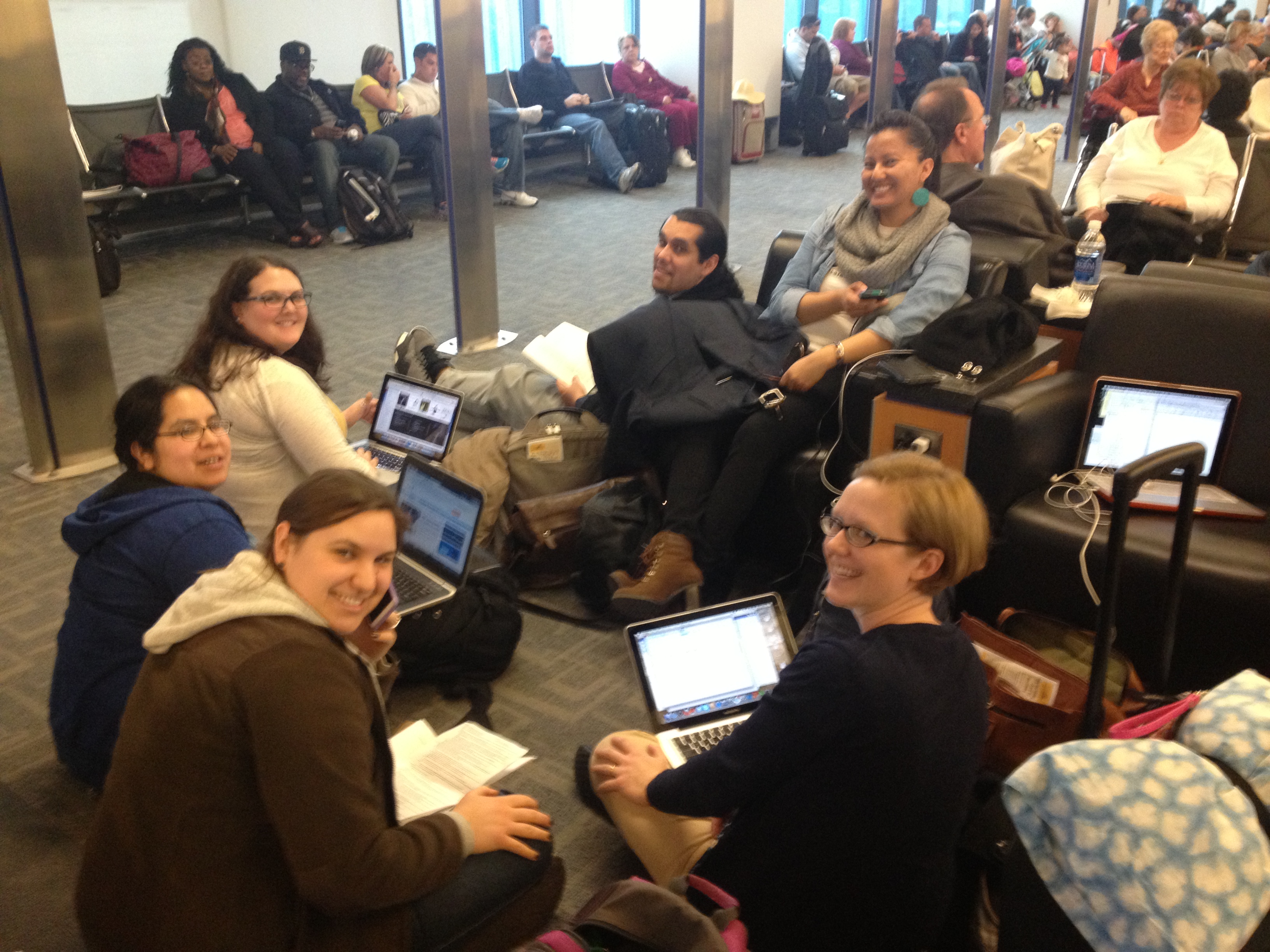
Trying to Get to Fed Bar

File this under very bored travel posts.

MSU Law students Emily, Angie, Sarah, John, Tamera and Nellie (taking the photo), and Kate Fort waiting. And waiting. And waiting.

photok

ESPN’s Coverage of Louisville Basketball Win: “Schimmels Lead Cards to Final Four”

Article here.

Shoni, a junior, had a game-high 24 points Tuesday and was named the regional’s most outstanding player. Jude, a sophomore, had 15 points.

Maybe there will be a movie about them someday. There has already been a documentary, “Off the Rez,” which details how Shoni and her siblings moved with their mother, Ceci Moses, off the Umatilla Indian Reservation in Oregon to Portland, where Moses took a job as a high school girls basketball coach.

The Schimmel sisters have become heroes especially to Native Americans nationwide, and this Final Four spotlight on them and Louisville will be a huge emotional point of pride for their many supporters.

Appellant’s Brief in Thlopthlocco Tribal Town v. Stidham

This case involves the authority of the Muscogee (Creek) Nation courts’ authority to hear internal government disputes of the Thlopthlocco Tribal Town.

Lower court materials and order of dismissal here.

Appellant’s Brief to the 10th Circuit here.

Meanwhile, Over at Another Blog

I am periodically posting about teaching, writing, ICWA, and the Baby Veronica case over at The Faculty Lounge. I put up my second post today.

MSU ILPC Event on April 4th: Careers in Indian Law

We’re hosting three ILPC alums to talk about their experiences after law school. Please join us at 1pm in the Castle Board Room at the MSU College of Law. Snacks and drinks provided. Careerevent