Mayor Bernero Uses Offensive Language When Referring to Opponents of Lansing Casino Proposal

From the LSJ:

LANSING — Lansing Mayor Virg Bernero is under fire this morning from a pair of Michigan Indian tribes and a tribal lobbyist who said the mayor made a series of racially insensitive remarks about Native Americans at a fundraiser last week.

The Nottawaseppi Huron Band of Potawatomi and Saginaw Chippewa Indian Tribes, who have come out in strong opposition to a proposed Indian casino in Lansing, said Bernero “repeatedly used profanity and racial slurs in describing the (casino) controversy.”


2010 American Indian Census Data Released

From the Washington Post (AP):

FLAGSTAFF, Ariz. — Almost half of American Indians and Alaska Natives identify with multiple races, representing a group that grew by 39 percent over a decade, according to U.S. Census data released Wednesday.

Of the 5.2 million people counted as Natives in 2010, nearly 2.3 million reported being Native in combination with one or more of six other race categories, showcasing a growing diversity among Natives. Those who added black, white or both as a personal identifier made up 84 percent of the multi-racial group.

***

Census Director Robert Groves said the bureau has projected that the overall Native population will increase to 6.8 million in 2030 and about 8.6 million in 2050. Both multiracial Natives and Natives alone grew at a rate higher from 2000 to 2010 than the U.S. population at large.

***
—The majority of Natives live in 10 states: Arizona, California, Florida, Michigan, New Mexico, New York, North Carolina, Oklahoma, Texas and Washington.

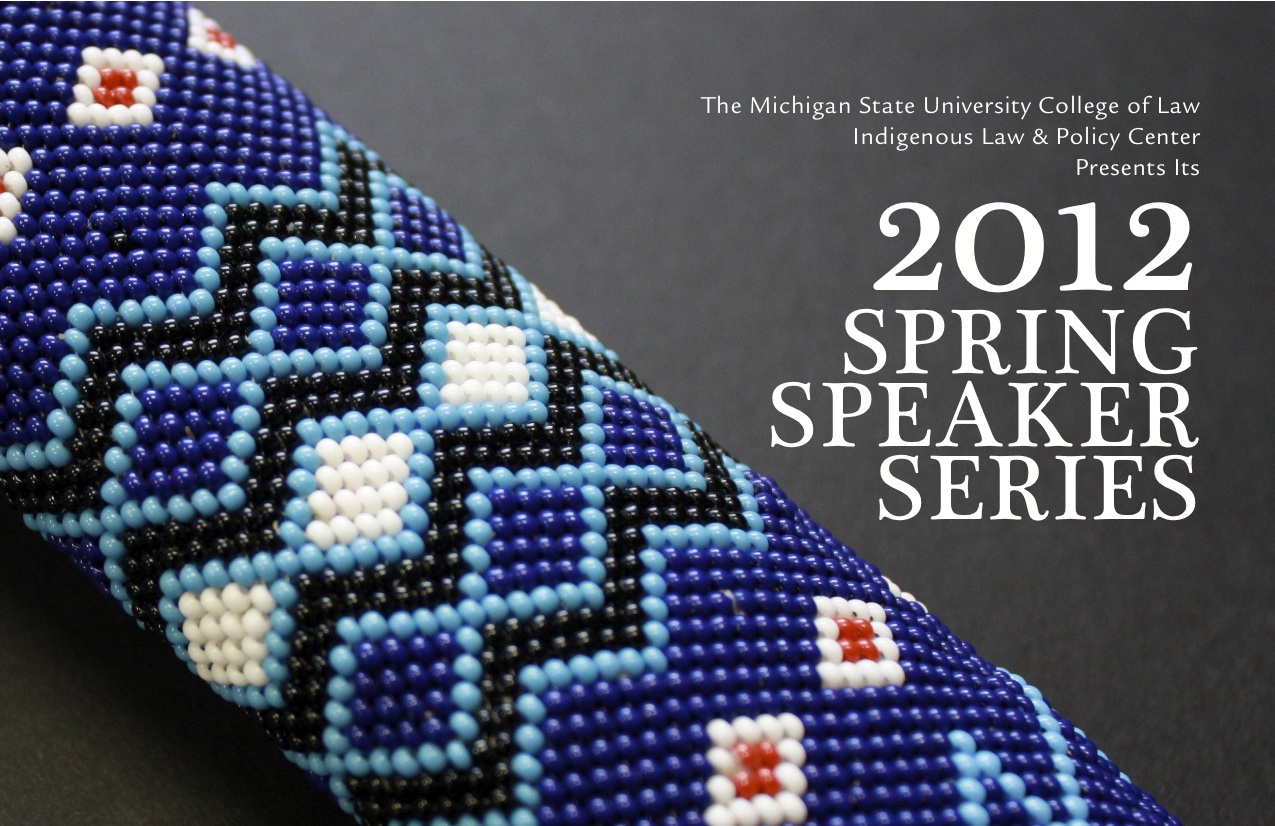
Spring Speakers Series Postcard

We made the announcement earlier, but here is our beautiful postcard with a picture of bead work by Rose Petoskey.

ICWA and the Media

There has been a lot of ICWA talk in national and local news this week due to a case we linked to here. I spoke with a person at the CNN In America blog (nothing up there yet) just about the general provisions of ICWA, and what struck me in that conversation was how most people today still know virtually nothing about this law.

This same week we had two cases argued at the Michigan Supreme Court on notice compliance. We’re having a meeting about enacting a state ICWA law here in Michigan. We received a link to this newsletter about ICWA compliance and monitoring at the trial court level in Minnesota. Sometimes it feels like ICWA is everywhere, if a person knows where to look for it. And yet most national media coverage of the Act is usually so biased and ignorant there’s no way the coverage doesn’t gin up serious opposition to the Act (the recent exception to this was NPR’s excellent three part series on ICWA and foster care in South Dakota). And thus one, relatively minor, conundrum–talk to the media about the Act in the hopes of gaining a semblance of balance, or ignore the media in a case that is putting a child in the middle of that very media storm?

The case garnering this attention is difficult to get a handle on, fact-wise, and we’re hesitant to add more commentary or links here, as we can’t believe this level of attention is good for the child. It certainly isn’t good attention for the Act, given the adoptive parents’ full-out assault on it. There’s a reason these cases are usually, or ought to be, anonymous. Regardless, we publish the Cherokee Nation’s statement here to one media outlet, since it points out it has called on the court for both a gag order, and to release the final order (something we’d certainly feel more comfortable commenting on, rather than inconsistent media accounts):

Chrissi Ross Nimmo, the Assistant Attorney General who represented the Cherokee Nation in this case, gave FOX23 this statement:
“As a matter of law and policy, the Cherokee Nation’s attorney general’s office generally does not comment on juvenile cases due to their sensitive nature and confidential information. In an effort to quell the undue outside attention to this sensitive affair, the Cherokee Nation attorney general’s office filed a motion for a gag order in this case Wednesday afternoon, along with a motion to release the judge’s final order to the public. I ask that all parties involved in the matter respect the confidential nature of these juvenile court proceedings. The Cherokee Nation has 115 Indian Child Welfare employees and nine assistant attorneys general who work tirelessly to fight for the rights of Cherokee children and their parents, not only within our 14-county jurisdiction, but in tribal, state and federal courts across the nation. The Indian Child Welfare Act was written to help keep Native American children with their families whenever possible – a concept embraced wholeheartedly by the Cherokee Nation.”
Thanks, The Root!

Sherrilyn Ifill mentioned Turtle Talk as one of the best (if not THE best — that honor went to Darren Hutchinson’s Dissenting Justice) legal blogs of the year. Thanks for the recognition!

DOI Reaffirms Federal Recognition Status of the Tejon Indian Tribe

From the press release:

The Tejon Indian Tribe first requested confirmation of its status in 2006. Due to an administrative error, the Bureau of Indian Affairs (BIA) failed for several years to place the Tejon Indian Tribe on the list of federally recognized tribes that the BIA is required to publish annually. That list, entitled “Indian Entities Recognized and Eligible to Receive Services from the United States Bureau of Indian Affairs,” was last published in the Federal Register on October 1, 2010 at 75 FR 60810, and the list was supplemented on October 27, 2010 at 75 FR 66124.
In his letter to the Tejon Indian Tribe, the Assistant Secretary stated that “[u]pon review of the facts and history of this matter, including prior Assistant Secretaries’ decisions, I herby reaffirm the federal relationship between the United States and the Tejon Indian Tribe, thus concluding the long and unfortunate omission of the Tejon Indian Tribe from the list of federally recognized tribes.”

The 2011 Fourth Quarter in DOI Federal Press Releases

December, 2011

LEHAnncsTwoGamingDecisions122011PR

LEHNames AtkinsonIEEDDirPR

12-01-11 Tribal Consultation Policy Release kk

November, 2011

11-30-11 TRUST REFORM

Tribal Leasing Release

BlackNamesRiceOTSDepBurDir111811PR

October, 2011

10-27-11JOINT WH ONDCPASIADRGSSAFETY102711PR

FINALCobellRCDPR

LEHCongratsOJSRecipientsOfUSAGAward102011PR

Echo HawkStatementBaker102011FN

BlackNamesPintoNROD101911PR

Echo Hawk Statement 101711

LEHAnncsIEEDTechAsstGrantsTo30Tribes101111PR

LEHHaskellPrezPR10-7-11

Cobell6thConsultPRnd10-06-11

MooreNamesRoesselADD-N100311PR

AUSA Positions in Michigan and Wisconsin

From the State Bar of Michigan blog:

The Department of Justice has just posted the following positions in or adjacent to Michigan, noting that due to temporary funding restrictions, all the posts may not all be filled:

KBIC Proposed Gaming Facility in Marquette County Approved by Department of Interior; Cayuga Request Dismissed

From the press release (though the embedded links with additional information aren’t yet working):

The Keweenaw Bay Indian Community is located in Baraga County, Mich., and has approximately 3,310 members. It has more than 6,000 acres of existing trust lands on its reservation in the state’s Upper Peninsula. The tribe has been operating and regulating a class III gaming facility in Marquette County, about 90 miles from its headquarters, since at least 2000. The tribe is proposing to relocate this existing facility to a new location within Marquette County, on an 80-acre parcel at the site of the former Marquette County Airport. The new site is 18 miles closer to the tribe’s reservation than its existing facility. Under a 2000 settlement agreement with the state of Michigan, the tribe has agreed to close its existing off-reservation gaming facility if its proposal receives final approval and it begins gaming activities on the new site.

The Indian Gaming Regulatory Act (IGRA) prohibits Indian gaming on lands acquired in trust after the law’s enactment in 1988, unless one of three explicitly crafted exceptions applies. The Keweenaw Bay Indian Community submitted its application under IGRA’s “Secretarial Determination” exception, which requires the Secretary to determine the proposed gaming establishment is in the best interest of the tribe and its citizens, and would not be detrimental to the surrounding community. The governor of Michigan must concur in this determination before the land can be acquired in trust for the tribe for gaming.

Interior also dismissed an application by the Cayuga Indian Nation, stating it was incomplete. Here is press coverage of that decision. Senator Schumer’s quote is particularly disheartening:

Schumer acknowledged that the battle over the Cayuga application could continue if the Cayugas submit a new application.

“I fought tooth and nail to have the Interior Department block this application, and am pleased that the federal government has heeded our call,” he said. “I’ll continue to stand side-by-side with homeowners, businesses, and county government leaders to oppose further attempts to take land into trust without the consent of Seneca and Cayuga counties.”

The Cayugas started the trust application process in 2005. The 125 acres it sought to place into federal trust includes part of the nation’s ancestral homeland around the north end of Cayuga Lake.

Documents are also available here