Tana Fitpatrick published “Federal Gatekeeping and Hollow Sovereignty: A Historical
Statutory Analysis of Tribal Access to Legal Representation” in the Sovereignty Symposium XXXVII (2025). It seems like a really good paper. Wish I knew about it earlier.
Author: Matthew L.M. Fletcher
Fourth Circuit Rejects Rule 19 Argument in Employment Suit against Eastern Band Cherokee Casino
Here is the opinion in Peterson v. Harrah’s NC Casino Company LLC.
Briefs:
Lower court materials here.
Minnesota SCT Rejects Equal Protection Challenge to ICWA for Lack of Standing
Sam Deloria Talk on Intergovernmental Relations TODAY
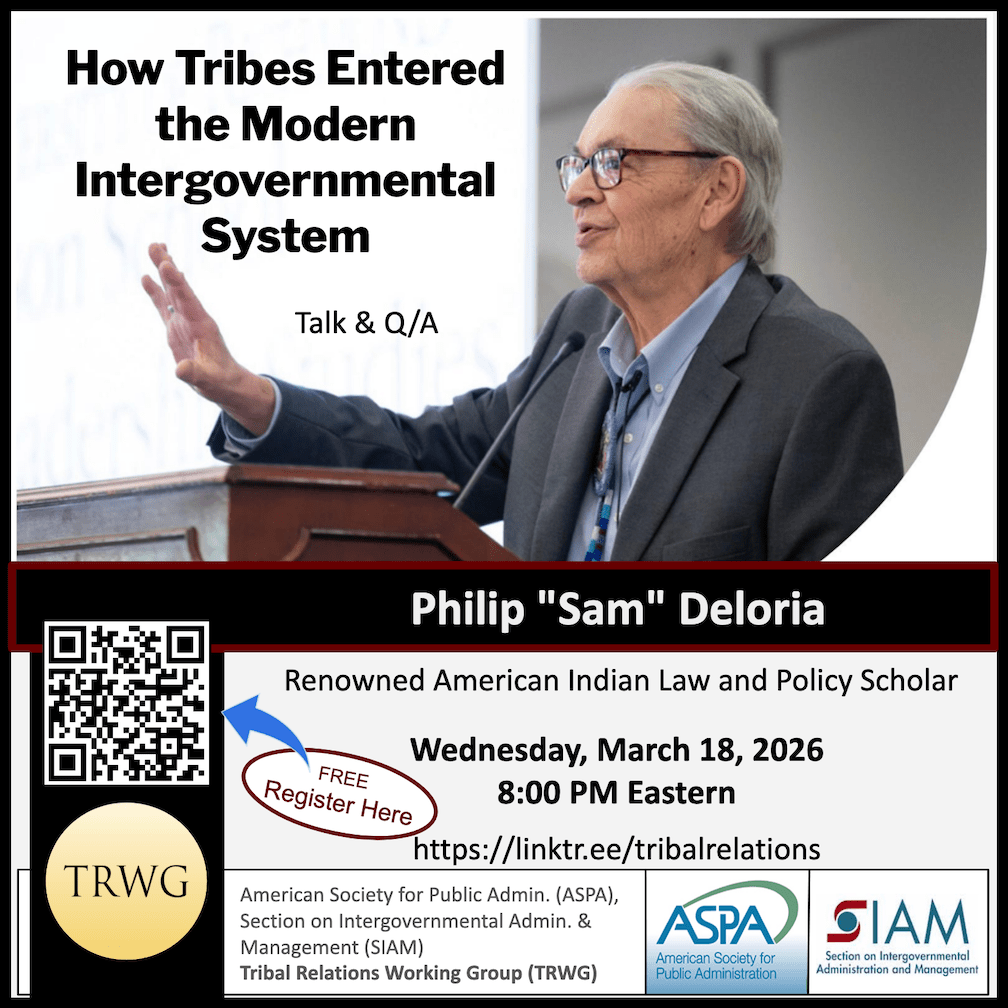
“How Tribes Entered the Modern Intergovernmental System”A talk & Q/A with renowned American Indian law and policy scholar
Philip “Sam” Deloria
Wednesday, March 18, 2026
8:00 PM Eastern (free, open to the public)
REGISTER HERE: https://linktr.ee/tribalrelations
Sponsored by:
The American Society for Public Administration (ASPA), Section on Intergovernmental Admin. & Management (SIAM), Tribal Relations Working Group (TRWG)
Co-sponsors:
Society of American Indian Government Employees (SAIGE)
National Academy of Public Administration (NAPA), Standing Panel on Intergovernmental Systems (IGS)

Tenth Circuit Confirms Disestablishment of Citizens Potawatomi Reservation
Here are the materials in Wahpekeche v. Pettigrew:

Michigan Supreme Court Materials in Enviro and Tribal Challenges to Enbridge Line 5
Here are the materials in For Love of Water v. Michigan Public Service Commission:
Oral argument link:
https://youtu.be/bNRSAJCxap8?si=a76bpgyBDGBEf6FV
Briefs:
Here are the materials in Little Traverse Bay Bands of Odawa Indians v. Michigan Public Service Commission:
Oral argument link: https://youtu.be/H8Y6RHgY9hM?si=wtafDSX7nuzeP3vs
Briefs:
Alaska Superior Court Holds that State Courts Cannot Authorize Search Warrants for Tribal Property
Here are the materials in State of Alaska v. Hayward (Alaska Super. Ct.):

2026 MLaw Indian Law Workshop Series: Aaron Mills and Neoshia Roemer


Meghanlata Gupta on History and Tradition in Federal Indian Law
Meghanlata Gupta has posted “‘In Keeping with the Constitution’s Original Design’: History and Tradition in Federal Indian Law”, forthcoming in the Public Land and Resources Law Review, on SSRN.
Highly recommended!!
Here is the abstract:
This Article examines the Supreme Court’s use of history and tradition in federal Indian law. In recent years, the Court has increasingly relied on Founding-era practices and historical traditions to determine constitutional meaning in areas such as firearm regulation, substantive due process, and religious liberty. At the same time, while the Founding-era record contains substantial evidence that Native nations were understood and treated as independent, sovereign political communities, this evidence has not yet been fully incorporated into the Supreme Court’s Indian law jurisprudence. Examining decisions from Oliphant to Castro-Huerta, this Article describes the Court’s approaches to historical analysis in Indian law cases and identifies areas where deeper engagement with the historical record could inform the doctrine. By centering Indian law within the broader history-and-tradition framework, this Article argues that more consistent applications of history support the robust conception of tribal sovereignty contemplated at the Founding.

Stephanie Safdi on Tribal Water Governance Beyond Indian Country
Stephanie Safdi has posted “Indigenous Water Governance and the Clean Water Act” on SSRN. Here is the abstract:
Cultural lifeways for many Indigenous communities in the United States are intimately tied to water. Nationally, the Clean Water Act of 1972 is the principal framework for regulation of water quality. The core purpose of the Act is to ensure water quality—and, by extension, water quantity—sufficient to protect designated uses, including but extending beyond familiar fishable, swimmable, and drinkable uses. Though uses protected under the Act can be seen as expressions of social and ecological values, the cultural dimensions of these water uses have generally been underappreciated.
This paper excavates requirements and possibilities for Indigenous water governance under the Clean Water Act, centering on the work of the Act’s water quality standards provisions. Previous scholarship in this area has focused on Indigenous water governance within Tribal territorial jurisdiction—particularly through Tribal promulgation of on-reservation water quality standards under Treatment-as-a-State authority or federal gap-filling standards for Indian country. This paper extends this scholarship by looking to Indigenous water governance beyond Indian country. Doing so is imperative, as Tribal cultural, ceremonial, and subsistence practices involving water remain rooted in ancestral territories over which Tribes often do not exercise formal regulatory governance and which are increasingly imperiled by conflicts over water allocation under conditions of mounting scarcity. The failure to formally recognize Tribal cultural uses of ancestral waterways, both practically and in the law, continues to marginalize Tribes and Tribal water uses in decision-making over the nation’s waterways.
In this paper, I posit that the Clean Water Act contains important mechanisms to advance the exercise of Indigenous cultural sovereignty over ancestral waterways beyond the jurisdictional bounds of Indian country. These mechanisms include calibration of water quality standards to protect Tribes’ off-reservation reserved rights to aquatic resources and designation of Tribal cultural uses as uses to be protected through state and federal water quality standards for Tribes’ ancestral waterways, including through instream flow standards and other functional flow controls. Though these mechanisms are underappreciated aspects of Clean Water Act administration, there are strong arguments that protecting Tribal reserved rights and cultural uses is legally required in water quality standard-setting, as well as ethically and ecologically imperative. These also function as much-needed pathways toward meaningful co-governance of water resources and exercise of Traditional Ecological Knowledge in regulation of ancestral waterways in furtherance of cultural and ecological continuity.
 Turtle Talk
You must be logged in to post a comment.