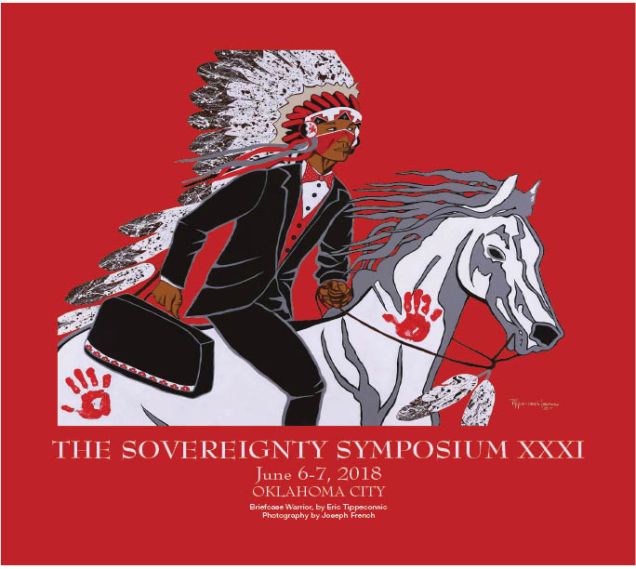
Invitation to the Sovereignty Symposium 2018

Here:

2018 Sovereign Symposium

Sovereignty Symposium 2018

Presented by
The Oklahoma Supreme Court
and
The Sovereignty Symposium, Inc.

When
Wednesday, June 6, 2018 7:30 AM  –  Thursday, June 7, 2018 5:30 PM
Central Time

Where
Skirvin Hilton Hotel in Oklahoma City
1 Park Avenue, Oklahoma City, Oklahoma 73102, USA USA

Dress Code
Business Attire

View Event Summary

View Event Agenda

Register for Event

Compensation-Based Class Action against Eastern Band Cherokee Casino Materials

Here are the materials so far in Clark v. Harrah’s NC Casino Company LLC (W.D. N.C.):

1 Complaint

34-1 Motion to Dismiss

39 Opposition

43 Reply

53 Magistrate Report

54 Defendants’ Limited Objections

55 Clark Objections

National Indian Law Library Bulletin (5/11/2018)

Here:

The National Indian Law Library added new content to the Indian Law Bulletins on 5/11/18.

Tribal Courts Bulletin
http://www.narf.org/nill/bulletins/tribal/2018.html
People of the Sault Ste. Marie Tribe of Chippewa Indians v. Sorrell (Exclusion Order)
People of the Sault Ste. Marie Tribe of Chippewa Indians v. Nickaboine (Exclusion Order)

Law Review & Bar Journal Bulletin
http://www.narf.org/nill/bulletins/lawreviews/2018.html

  • To sue and be sued: Capacity and immunity of American Indian nations.
  • The unseen harm: U.S.-Indian relations and tribal sovereignty.
  • If you are not at the table, then you are probably on the menu: Indigenous peoples’ participatory status at the United Nations.
  • The new World Bank safeguard standard for Indigenous peoples: Where do we start?

Federal Courts Bulletin
http://www.narf.org/nill/bulletins/federal/2018.html
Cachil Dehe Band of Wintun Indians of Colusa Indian Community v. Zinke (Land into Trust)
Oviatt v. Reynolds (Indian Civil Rights Act; Tribal Officials)

State Courts Bulletin
http://www.narf.org/nill/bulletins/state/2018.html
Harjo v. Arkansas Department of Human Services (Indian Child Welfare Act – Application of)

News Bulletin
http://www.narf.org/nill/bulletins/news/currentnews.html
In the Intergovernmental section, we feature an article about the Bureau of Indian Affairs nominee.

Regulatory Bulletin
http://www.narf.org/nill/bulletins/regulatory/2018.html
We feature a notice of the Department of the Interior related to adding land to the reservation of the Muscogee (Creek) Nation.

U.S. Legislation Bulletin
http://www.narf.org/nill/bulletins/legislation/115_uslegislation.html
The following bills were added:
S.2804: A bill to provide for the reform and continuation of agricultural and other programs of the Department of Agriculture for Indian Country.

Senate Judiciary Committee Minority Report on Judicial Nominations

Here:

judiciary-dems-final-judges-report-5.10.18-

University of Michigan President Accepts Recommendations on Burt Lake UM Biological Station

Here is the letter, along with the report:

Burt Lake Letter and Report

This is a big deal. Chi-miigwetch to Joe Gone and John Petoskey for leading the way.


Ninth Circuit Briefs in Stillaguamish Tribe v. State of Washington [Apparent/Actual Authority to Waive Tribal Immunity]

Here:

State Opening Brief

Tribe Answer Brief

Reply

Oral argument video here.

Lower court materials here.

The Guardian: “Canada sued over years of alleged experimentation on indigenous people”

Here.

High Country News: “The crisis of murdered and missing Indigenous women”

Here.

Chinook Nation Federal Recognition Arguments Were Today; Here are the Briefs . . .

in Chinook Indian Nation v. Zinke (W.D. Wash.):

32 us motion to dismiss

37 chinook response

41 reply

Complaint here.

Grant Christensen on ICRA and Banishment

Grant Christensen has posted “Civil Rights Notes: American Indians and Banishment, Jury Trials, and the Doctrine of Lenity,” forthcoming in the William & Mary Bill of Rights Journal.

The syllabus:

Indian defendants appearing before tribal courts are not protected by the Bill of Rights. Instead, Congress enacted the Indian Civil Rights Act in 1968 to extend some, but not all, constitutional protections unto Indian reservations. Fifty years later and there continues to be extensive litigation surrounding ICRA.

This paper looks at all of the ICRA cases decided in 2017 to attempt to evaluate the merits of ICRA’s protections of tribal rights. The picture is decidedly mixed. From these cases the paper calls for three changes that directly respond to trends in civil rights litigation. 1) The paper suggests that courts expand the understanding of habeas jurisdiction to extend when an individual has been banished. It argues that banishment is a form of confinement and a restriction of liberty – albeit one where the jail cell is large, essentially the world minus the reservation. 2) Tribes must adopt codes that provide for a trial by jury and rules for determining who constitutes the jury and how it may be empaneled. While ICRA provides for a trial by jury, tribal courts have an affirmative duty to inform defendants of their right to request a jury trial. It is a violation of ICRA if the tribe does not make provisions for a jury when requested. 3) Finally tribal court judgments, when used in other forums, may be ambiguous because tribal law and tribal procedures are distinct from those followed by states or the federal system. Accordingly, any ambiguity that arises in response to a tribal court judgment should be resolved with a reference to the doctrine of lenity.