Here:
Summer Intern Position within the Office of General Counsel ANNOUNCEMENT PDF
Here:
2014-01-16 Petition for Panel Rehearing with a Suggestion for Rehearing …
2014-01-22 NHBPI Motion for leave to file amicus brief -rehearing
2014-01-23 NHBPI Amicus Curiae Brief in Support of St of MI Pet
2014-01-23 Order Granting Motion for Leave to file Amicus Brief NHBPI
Panel materials are here.
Here are the materials in King Mountain Tobacco Co. v. Alcohol and Tobacco Tax and Trade Bureau (E.D. Wash.):
149 DCT Order Granting US Motion
An excerpt:
The Court finds no exemption from federal excise taxes on manufactured tobacco products under the General Allotment Act because the finished tobacco products are not derived directly from the land. The Court finds no exemption under either Article II or III of the Yakama Treaty of 1855 because neither Article contains express exemptive language applicable to the manufacture of tobacco products. Finally, the Court finds no exemption under Section 4225 of the Internal Revenue Code because the exemption for Indian handicrafts on its face does not apply to excise taxes for the manufacture of tobacco products. Therefore, the United States is entitled to summary judgment on all claims.
Here are the materials in Big Eagle v. United States (D. S.D.):
An excerpt:
Big Eagle now has filed a motion to vacate, set aside, or correct sentence under 28 U.S.C. § 2255 in this case. CIV Doc. 1. Big Eagle in his motion raised five grounds, all of which contended that his trial counsel provided ineffective assistance to him. CIV Doc. 1 at 5-6. Big Eagle filed a Memorandum of Law supporting the § 2255 motion. CIV Doc. 2. This Court screened the case and ordered the Government to file a response. CIV Doc. 7. The Government resisted the motion, CIV Doc. 17, and filed an affidavit signed by Big Eagle’s trial counsel disputing Big Eagle’s contentions. CIV Doc. 17-2. Big Eagle filed a reply thereafter. CIV Doc. 20. For the reasons explained herein, this Court denies Big Eagle’s § 2255 motion.
Earlier, related materials here.
Matthew L.M. Fletcher, Kathryn E. Fort, and Dr. Nicholas J. Reo have published “Tribal Disruption and Indian Claims” in Michigan Law Review’s First Impressions. PDF. Here is a taste:
Legal claims are inherently disruptive. Plaintiffs’ suits invariably seek to unsettle the status quo. On occasion, the remedies to legal claims can be so disruptive-that is, impossible to enforce or implement in a fair and equitable manner-that courts simply will not issue them. In the area of federal Indian law, American Indian tribal claims not only disrupt the status quo but may even disrupt so-called settled expectations of those affected by the claims.[1] The U.S. Court of Appeals for the Second Circuit has dismissed a round of Indian land claims at the pleading stage, including Onondaga Nation v. New York,[2] because it considered the claims so disruptive.
We agree that Indian legal claims are inherently disruptive and may implicate the centuries-old settled expectations of state and local governments and non-Indians. It is empirically and categorically false, however, that the remedies tribal interests seek are impossible to enforce or implement in a fair or equitable manner. Every year in cases against state governments and their political subdivisions, Indian tribes settle long-standing claims that at their outset, often appear intractable, if not downright impossible, to remedy. The recent settlements of claims by the Oneida Indian Nation of New York,[3] the Saginaw Chippewa Indian Tribe,[4] and five Michigan Anishinaabe tribes[5] demonstrate the falsehood of the idea that Indian claims are too disruptive to be remedied. These negotiated settlements powerfully illustrate that the disruption produced by Indian claims has an important function: forcing federal, state, and tribal governments to creatively seek solutions to difficult governance issues in Indian country.
Part I of this Essay describes recent common law, which dismisses Indian claims on the grounds that they are too disruptive. Part II briefly surveys the history of the relationship between Indians and the United States. Part III describes recent settlements between tribal and local governments. Part IV presents our theory of tribal disruption based on notions of ecological disturbance, studied in ecology and related fields. We argue that ecological disturbance in linked social-ecological systems offers a useful analog to the disruptive nature of Indian claims. These claims can be compared to disturbances in rivers, forests, or other ecosystems. Floods, forest fires, and windstorms break down existing structures, allowing space for reorganization, diversification, and new growth. Tribal claims similarly clear out a legal space for creative and improved governance institutions.
Here.
Judge Theresa Pouley, Ted Quasala, Dorothy Alther

Judge Pouley, Carole Goldberg, Addie Rolnick, and Affie Ellis

Angela Riley introduction
Troy Eid introduction
Bob Clinton and Tom Gede
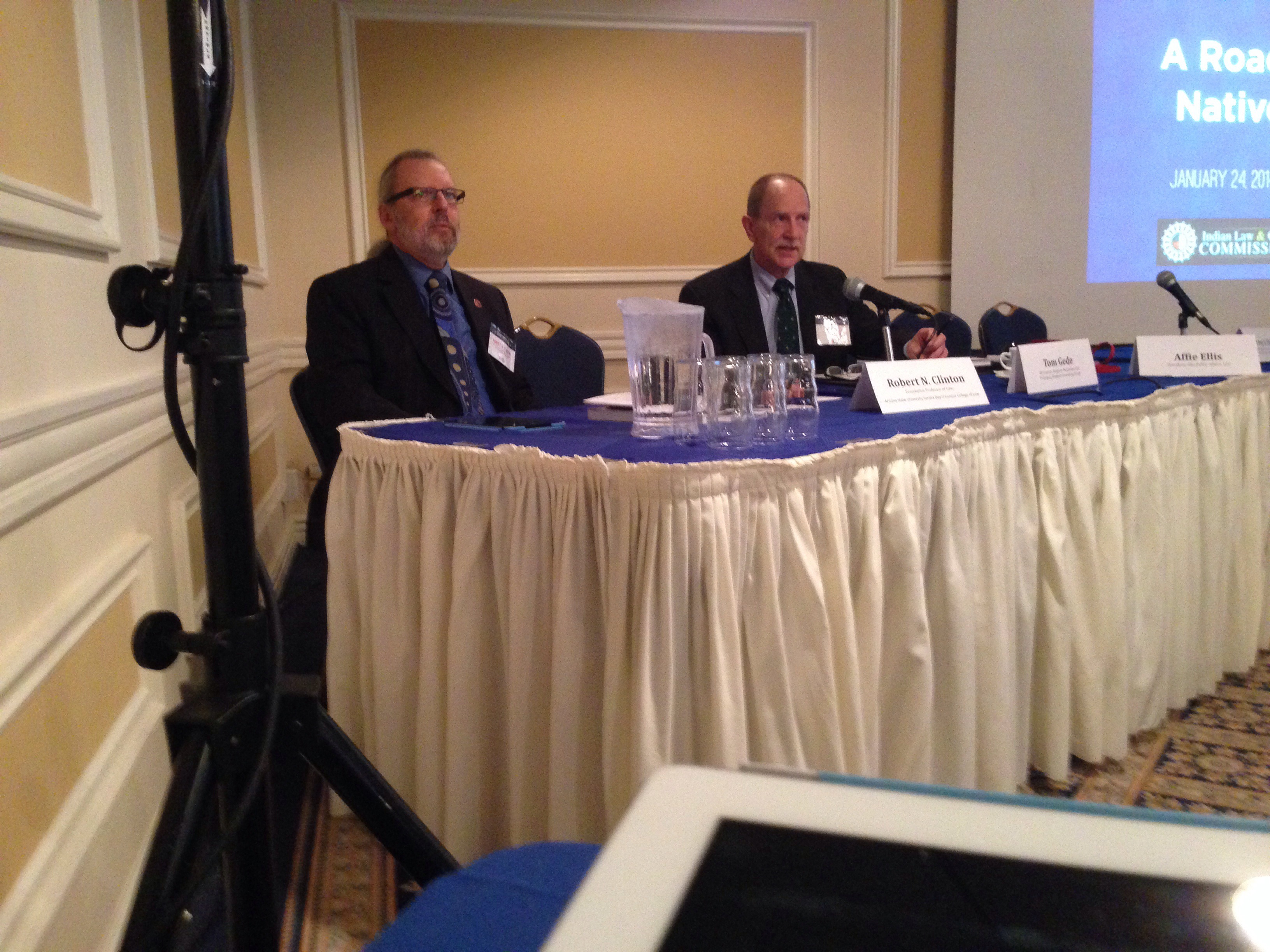
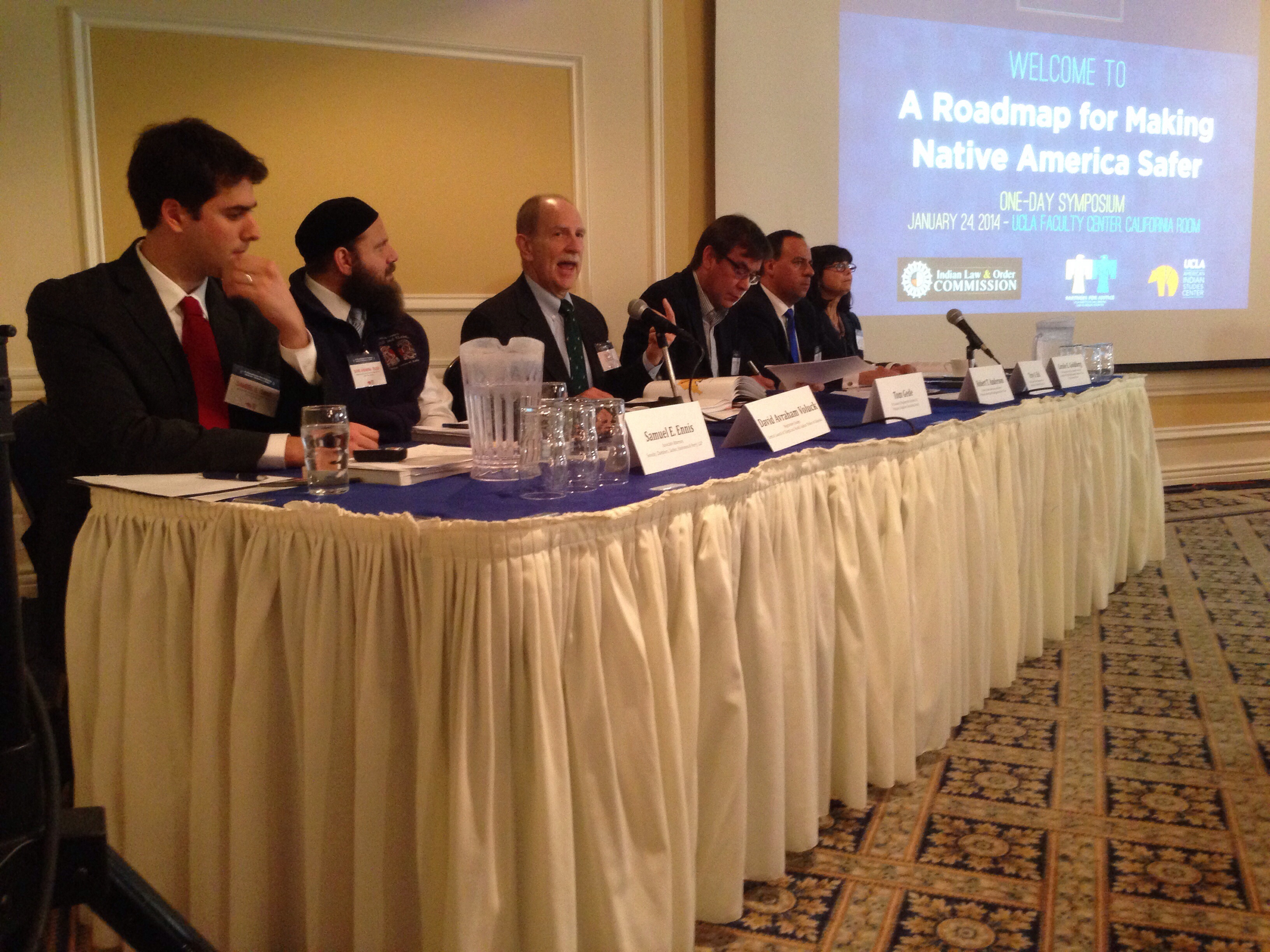
First panel — Clinton, Gede, Affie Ellis, and Eid

Second panel — Samuel Ennis, David Voluck, Gede, Bob Anderson, Eid, and Carole Goldberg
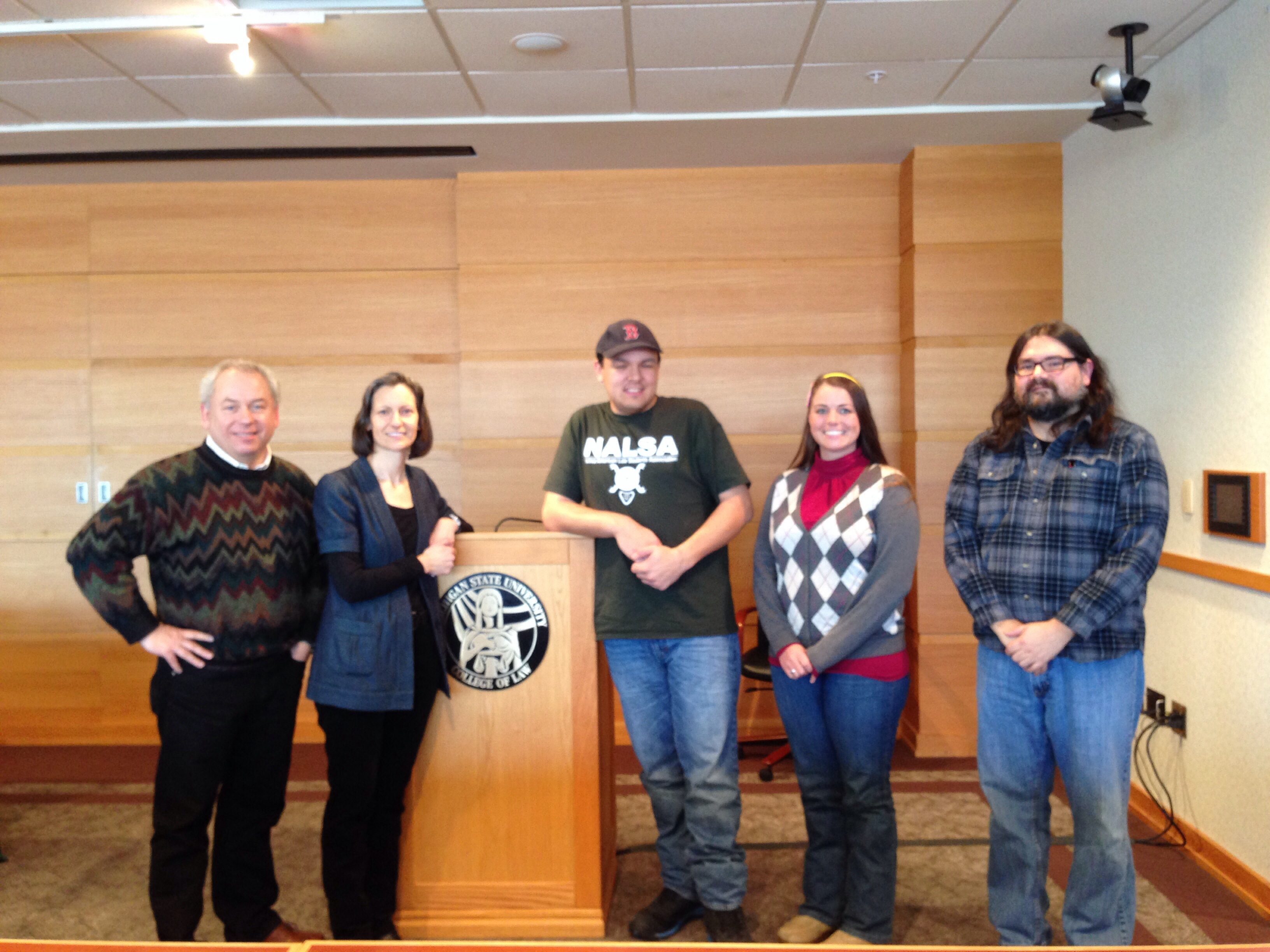
Bruce, Allison Dussias, the commentator, Chris and Chantal, ILPC students, and me
Here are the materials in Yellowbear v. Lampert:
An excerpt:
Andrew Yellowbear will probably spend the rest of his life in prison. Time he must serve for murdering his daughter. With that much lying behind and still before him, Mr. Yellowbear has found sustenance in his faith. No one doubts the sincerity of his religious beliefs or that they are the reason he seeks access to his prison’s sweat lodge — a house of prayer and meditation the prison has supplied for those who share his Native American religious tradition. Yet the prison refuses to open the doors of that sweat lodge to Mr. Yellowbear alone, and so we have this litigation. While those convicted of crime in our society lawfully forfeit a great many civil liberties, Congress has (repeatedly) instructed that the sincere exercise of religion should not be among them — at least in the absence of a compelling reason. In this record we can find no reason like that.


You must be logged in to post a comment.