Press Release: Blackfeet Nation Ratifies Water Compact

It took 35 years for the Blackfeet Nation to control its own water

Terri Hansen • May 10, 2017

In what the Blackfeet Nation is calling their most important development in a century, a majority of tribal members approved the Blackfeet Water Compact and Blackfeet Water Rights Settlement Act with Montana and the federal government, by a vote of 1,894 to 631.

Harry Barnes, Chairman of the Blackfeet Tribal Business Council, called it a “historic day for the Blackfeet people,” and well worth the time that Blackfeet staff and leaders had put into the effort the past four decades.

“My faith in the wisdom of the people’s vote has come to reality,” he said in a statement.

The history of the struggle between the tribes in Montana, and the State of Montana, over water rights began in the 1970s, when the federal government filed court water rights cases on behalf of all Montana tribes.

Montana filed competing water rights cases in state court. The U.S. and the tribes challenged Montana’s assertion that it had jurisdiction over Indian water rights on the reservation. What ensued was a history of court battles, meetings and negotiations that eventually led to the compact agreed to by Montana and the federal government. The last step was an April 20 vote by the Blackfeet membership.

The compact confirms the Tribe’s water quantity and rights, the Tribe’s jurisdiction and its authority to manage those rights on the reservation. Montana’s legislature ratified it in 2009, Congress approved the bill, and it was signed by President Barack Obama in January 2017.

The compact provides $422 million in federal funding for water-related projects on the reservation. Montana contributed an additional $49 million. The money will become available to the Tribe over a number of years.

“The funding will pay for such projects as installing municipal water systems to all communities on the reservation,” Jerry Lunak, the Blackfeet Water Resources Director told Indian Country Media Network. “We expect upgrades to existing irrigation systems on the reservation, and cost sharing for tribal members and others to upgrade irrigation on tribal and allotted lands.”

The main community on the Blackfeet Reservation is Browning, Montana. It happens to be the eastern entrance to Glacier National Park, with its incredible landscapes, alpine meadows, crystal-clear lakes and the glaciated mountain range—plus hordes of visitors. The park had about three million visitors last year, and although Browning hosts just one of four entrances, this presents opportunity for the Blackfeet Nation.

In a bid to attract those tourists to Blackfeet country, another project is slated to further develop and upgrade several campgrounds on the reservation. The settlement will also provide funding to upgrade their recreational lakes and improve their fisheries.

These projects mean jobs and benefits for tribal members on the rural reservation.

“The benefits of the water compact will be seen for generations to come,” Barnes said.
Register Now for Upcoming Free Webinar on Tribal Healing to Wellness Courts

Download(PDF): Announcement

Link: Registration

NCJFCJ’s Tribal Healing to Wellness Courts: Key Components & Standards is Thursday, May 25, 2017, at 3PM ET.

Line 5 Water Protectors Symposium Friday, May 19th, 2017

Download(PDF): Flyer

For Immediate Release:
Grand Traverse Band of Ottawa and Chippewa Indians to Host
‘Line 5 Water Protectors Symposium’ on May 19th

April 19, 2017

Peshawbestown, MI- The Grand Traverse Band of Ottawa and Chippewa Indians will be hosting a ‘Line 5 Water Protectors Symposium’ on May 19th at the Leelanau Sands Casino in Peshawbestown, MI. The event will bring together a number of Tribal Leaders, First Nation Chiefs, State Legislators, nonprofits, youth and business leaders who have been fighting the 64-year-old Great Lakes oil pipeline in recent years. The event is intended to spark public action; attendees will receive a calendar of upcoming Line 5 events and a list of recommended actions. Doors will open at 5:30pm, and the program will begin at 6:30pm. The event is free and open to all.

Line 5 moves 23 million gallons of crude oil through twin pipelines that sits on the bottom of the Straits of Mackinac for 4.5 miles. University of Michigan scientists have called the Straits “the worst possible place for an oil spill”. Public calls for the decommissioning of the pipeline have been increasing since 2010 when Enbridge, the same company that operates Line 5, allowed the second-largest inland oil spill in US history from their Line 6b in the Kalamazoo River in 2010. The Grand Traverse Band’s Tribal Council passed a resolution calling on the State of Michigan to decommission Line 5 in 2015.

Michigan’s Pipeline Safety Advisory Board will be releasing its long awaited “Alternatives Analysis” and “Risk Analysis” reports in June, which the State will use as a guide to take action on the pipeline. In 2015, Michigan Attorney General Bill Schuette said that the pipeline’s “days are numbered” and that the State probably would not allow its construction were approval sought today.

What: Line 5 Water Protectors Symposium, hosted by the Grand Traverse Band
When: Friday, May 19th, Doors at 5:30, Program starts at 6:30
Where: Leelanau Sands Casino Showroom, 2521 N West Bay Shore Dr, Peshawbestown, MI
Cost: Free, Open to All
Contact: Desmond Berry, Department Manager, Grand Traverse Band Natural Resources Department 231-534-7363

Agenda

Friday, May 19, 2017
Leelanau Sands Casino – Showroom
5:30-6:30 p.m. Doors Open for Local Environmental Group Information Booth Displays
6:35 p.m. Program begins:

– Welcome and Introductions by GTB Tribal Chairman Thurlow “Sam” McClellan
– Water Ceremony- Anishinabek Kwewok
– Youth Speaker(s) Kristen Berry, Sonny Haworth and Annie Lively
– First Nation Representative- Canada
– Sault Ste. Marie Band of Chippewa Indians Tribal Chairman, Aaron Payment
– Bad River Band of Lake Superior Chippewa Tribe Tribal Chairman, Robert Blanchard
– Grand Traverse Band of Ottawa & Chippewa Indians Tribal Councilor, Percy Bird
– Michigan State Senator, Rick Jones (R-24th District)
– Michigan State Representative, Yousef Rabhi (D-Ann Arbor)
– Great Lakes Business Network, Jim Lively & Workshop Brewing Company Owner, Pete Kirkwood
– Michigan League of Conservation Voters, Eric Keller
– Michigan Environmental Council, Kate Madigan
– Water Protectors Legal Collective, Holly T. Bird
– Executive Director FLOW, Liz Kirkwood
– Executive Director Spark the Change, Kevin Gilbert
– Michigan Canoe Cold Water Rescue Team Founder, Lee Sprague

Webinar: Working in Tribal Communities to Protect Victims and Communities from Firearms in DV Cases

May 22, 2017 – 11:00am PT, 12:00pm MT, 1:00pm CT, 2:00pm ET

Tribal communities face a variety of unique obstacles to removing firearms from individuals who are prohibited from having them due to civil protection orders (CPOs) or criminal convictions for domestic violence.  Yet the CPO and criminal processes provide many opportunities for professionals to learn about and respond effectively to abusers’ access to firearms using existing laws.  The NCJFCJ and our partners have gathered examples of strategies from around the country to help Tribal and other communities take full advantage of these intervention opportunities so that they can better protect victims and others from firearms violence. 
NCJFCJ, in partnership with the Office on Violence Against Women, is leading a Firearms Pilot Site Initiative (FPSI) that will provide training and technical assistance on these strategies and practices.  The project is a collaboration with the National Indigenous Women’s Resource Center (NIWRC) and other national TA providers (AEquitas, BWJP, CCI, the IACP, and Ujima), as well as expert practitioners from around the country. The FPSI will work with selected sites to assist them in developing interdisciplinary efforts to improve local implementation of firearms prohibitions in civil and criminal domestic violence contexts.
This webinar will discuss challenges and strategies pertinent to Tribal communities that are involved in efforts to effectively implement firearms restrictions in domestic violence cases.  It will also introduce professionals and communities to the FPSI, which soon will be selecting sites for in-depth technical assistance, training, and other support.  The NCJFCJ and its partners will assist selected sites in assessing their implementation efforts and challenges, identifying gaps, and developing partnerships among community stakeholders, including federal partners, to design and implement practices that will enhance victim and community safety.  

Presented by:
Carolina LaPorte, Senior Native Affairs Advisor, National Indigenous Women’s Resource Center
Nancy Hart, JD, Senior Program Attorney, National Council of Juvenile and Family Court Judges
Darren Mitchell, JD, National Council of Juvenile and Family Court Judges Consultant


Link to register for webinar: here

Closed Captioning will be provided. The webinar will be 60 minutes long and will be recorded and made available to individuals who cannot participate in the live webinar. If you have further questions regarding this event, please contact Alicia Lord at alord@ncjfcj.org.

NAICJA 2017 Conference RFP

The National American Indian Court Judges Association (NAICJA) invites presentation proposals for the 48th Annual National Tribal Judicial and Court Personnel Conference which will be held October 10-13, 2017, at the beautiful Isleta Resort & Casino in Albuquerque, NM. NAICJA’s Annual Conference offers innovative and timely tribal justice information through high quality presentations by national experts.

The theme of this year’s conference is, “Tribal Justice: Building and Strengthening Relationships and Partnerships.” NAICJA is featuring topics that highlight ways in which American Indian, Alaska Native, Native Hawaiian and First Nations justice systems are building and strengthening relationships between tribes, states, federal agencies, and organizations including the philanthropic sector. We are especially interested in presentations that focus on collaboration and partnerships, tribal sovereignty, international frameworks for understanding indigenous principles and topics, promising Indian child welfare practices, court security, and other areas of interest to court clerks and court personnel.

Full details available here:  NAICJA 2017 Presentation RFP Final.


This is your opportunity to share your expertise and display your creativity by developing an original program for presentation. Proposals specifically tailored to meet the needs of the 300-person NAICJA audience are strongly preferred. Proposals are due on or before Monday, May 1, 2017 at 9:00 a.m. (MST).

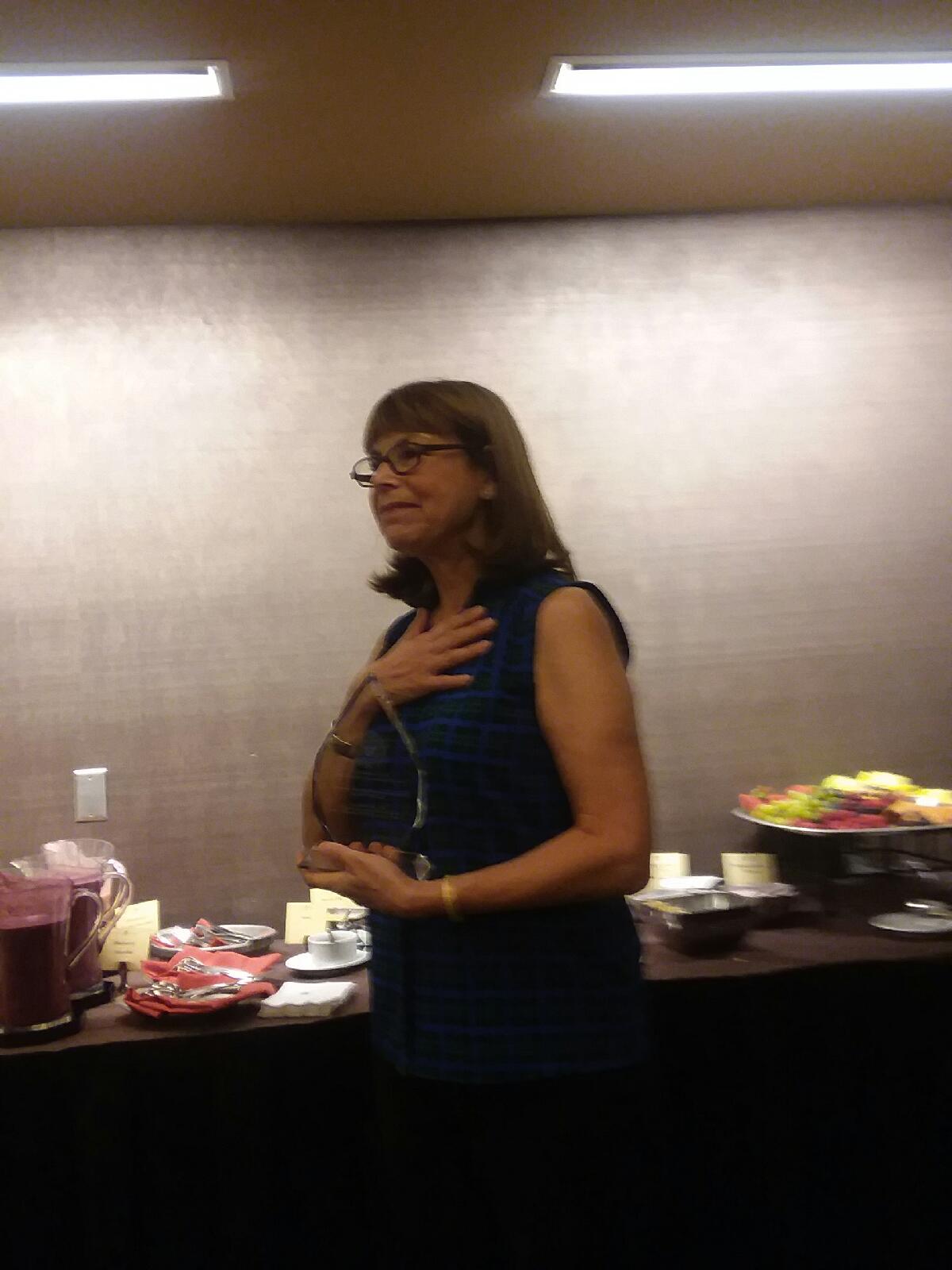
Carole Goldberg Receiving an Honorary Award at UCLA’s Alumni Breakfast at Fed Bar

Heather Dawn Thompson Awarded Bush Fellowship

Here’s the press release from Greenberg Traurig:

Greenberg Traurig’s Heather Dawn Thompson Awarded
Prestigious Bush Fellowship

DENVER – Apr. 3, 2017 – Heather Dawn Thompson, an attorney in the American Indian Law Practice of international law firm Greenberg Traurig, LLP, was recently awarded a Bush Fellowship for her extraordinary leadership in Indian Country. The Fellowship provides an educational grant to pursue the training and experiences Fellows need to become more effective leaders in their community.

Thompson, a member of the Cheyenne River Sioux Tribe, will focus her Bush Fellowship on “self-sufficiency,” for Tribal governments. Thompson wants to better engage the private sector with the Great Plains Tribes in their efforts to build their strength and self-determination. She is experienced in Indian law and economic development nationwide; and, in result, has witnessed economic independence bring freedom to invest in language, culture, and service to tribal citizens. She also believes strong leadership requires the wisdom that the Lakota language and values provide. She will use her Bush Fellowship to pursue corporate and tribal finance, combining it with a focus on traditional Lakota values of leadership and self-sufficiency.

“We are honored to have someone with Heather’s knowledge of Indian country, Native American Law, and tribal economic development serving our clients and also always seeking to learn more to benefit tribes in the Great Plains and beyond,” said Jennifer H. Weddle, co-chair of the American Indian Law Practice. “Her exceptional background and leadership provides valuable perspective to our clients.”

Thompson was selected from nearly 650 applicants, from across Minnesota, North Dakota, South Dakota, and the 23 Native nations that share the same geography. Fellows determine what they need to become a more effective leader and receive the fellowship grant to make it happen.

Thompson is from South Dakota, where she served as an Assistant U.S. Attorney for the U.S. Attorney’s Office in South Dakota’s Indian Country Section prior to joining Greenberg Traurig. She also previously served as the Director of Government Affairs for the National Congress of American Indians (NCAI), the nation’s oldest and largest inter-tribal organization. In addition, she is Past President of both the South Dakota Indian Country Bar Association and the National Native American Bar Association.

She focuses her practice at Greenberg Traurig on American Indian law, federal Indian policy and advocacy, tribal sovereignty, tribal economic development, and tribal nation building. Thompson works with individual tribes, tribal and Indian-owned businesses, intertribal associations, and businesses seeking to partner with tribal corporations. Thompson was published recently, writing an article on “Doing Business with Native American Tribal Corporations.”

Webinar: Protecting Victims and Communities from Firearms in Domestic Violence Cases

Protecting Victims and Communities from Firearms in Domestic Violence Cases: Collaborative Strategies

April 26, 2017 – 11:00am PT, 12:00pm MT, 1:00pm CT, 2:00pm ET

Is your community doing all it can to prevent firearms-related violence perpetrated by abusers in DV cases? Are you encountering challenges to implementing existing state, tribal, & federal firearms restrictions? Learn about strategies for effective implementation at all stages of civil & criminal DV cases, as well as a new national project, the Firearms Pilot Site Initiative, through which the NCJFCJ & other national experts will provide communities with in-depth TA, training, & other support.

Link to register for webinar: here

*A similar webinar with information specific for tribal communities will be held May 22, but people from all communities are encouraged to attend whichever one is most convenient.

Closed captioning will be provided. The webinar will be 60 minutes long and will be recorded and made available to individuals who cannot participate in the live webinar. If you have further questions regarding this event, please contact Alicia Lord at alord@ncjfcj.org.


Breaking Ground at Standing Rock: The Dakota Access Pipeline and Environmental Justice

Download(PDF): Flyer

ABA Environmental Justice Committee’s upcoming teleconference “BREAKING GROUND AT STANDING ROCK: The Dakota Access Pipeline and Environmental Justice” is taking place on April 13, 3:00PM- 4:00PM (EST).