Top 10 American Indian Law Articles by 2013 SSRN Downloads

“American Indian law” excludes a lot of great work on the Indigenous peoples of Canada, Australia, New Zealand, and other nations. And counting only 2013 downloads prejudices recent postings. Oh, and this count is from Dec. 20, 2013. Oh well.

‘Whatever Tribal Precedent There May Be’: The (Un)Availability of Tribal Law
Law Library Journal (Forthcoming), Univ. of Wisconsin Legal Studies Research Paper No. 1227
Bonnie J. Shucha
University of Wisconsin Law School
Date Posted: August 13, 2013
Last Revised: November 12, 2013
Accepted Paper Series
306 downloads

The Savage Constitution
Duke Law Journal, Forthcoming
Gregory Ablavsky
University of Pennsylvania Law School
Date Posted: March 09, 2013
Last Revised: April 19, 2013
Accepted Paper Series
191 downloads

Lawyering for Groups: The Case of American Indian Tribal Attorneys
Fordham Law Review, Vol. 81, No. 3085, 2013, U Denver Legal Studies Research Paper No. 13-24
Kristen A. Carpenter and Eli Wald
University of Colorado Law School and University of Denver Sturm College of Law
Date Posted: April 22, 2013
Last Revised: May 01, 2013
Accepted Paper Series
188 downloads

The Vanishing Indian Returns: Tribes, Popular Originalism, and the Supreme Court
St. Louis University Law Journal, Vol. 57, No. 297, 2013, MSU Legal Studies Research Paper No. 11-06
Kathryn Fort
Michigan State University – College of Law
Date Posted: March 21, 2013
Last Revised: April 27, 2013
Accepted Paper Series
123 downloads

The Jurisgenerative Moment in Indigenous Human Rights
California Law Review, Vol. 102, 2014
Kristen A. Carpenter and Angela Riley
University of Colorado Law School and University of California, Los Angeles (UCLA)
Date Posted: March 18, 2013
Last Revised: March 19, 2013
Accepted Paper Series
114 downloads

The Right to Counsel for Indians Accused of Crime: A Tribal and Congressional Imperative
Michigan Journal of Race & Law, Vol. 18, p. 317, Spring 2013
Barbara Creel
University of New Mexico School of Law
Date Posted: May 17, 2013
Accepted Paper Series
113 downloads

Hot Pursuit into Indian Country: What Are the Limits?
University of Utah College of Law Research Paper No. 8
Alexander Tallchief Skibine
University of Utah – S.J. Quinney College of Law
Date Posted: January 14, 2013
Last Revised: March 26, 2013
Working Paper Series
108 downloads

Wolves, Lone and Pack: Ojibwe Treaty Rights and the Wisconsin Wolf Hunt
Jason Sanders
University of Wisconsin Law School
Date Posted: November 03, 2013
Working Paper Series
104 downloads

Creeping Normalcy: Fractionation of Indian Land Ownership
GMU Working Paper in Economics No. 13-28, PERC Research Paper No. 13-9
Jacob W Russ and Thomas Stratmann
George Mason University and George Mason University – Buchanan Center Political Economy
Date Posted: November 13, 2013
Last Revised: December 07, 2013
Working Paper Series
103 downloads

Examining Tribal Environmental Law
Elizabeth Ann Kronk Warner
University of Kansas – School of Law
Date Posted: September 08, 2013
Working Paper Series
101 downloads

Beyond Uniqueness: Reimagining Tribal Courts’ Jurisdiction
California Law Review, Vol. 101, December 2013, UC Davis Legal Studies Research Paper No. 350
Katherine J. Florey
University of California, Davis
Date Posted: February 27, 2013
Last Revised: August 26, 2013
Accepted Paper Series
101 downloads

Well, that’s the top 10 (well, 11 since there was a tie at 101 downloads). Here are a few that didn’t quite make the cut:
Continue reading →

Katherine Florey on Tribal Court Jurisdiction

Katherine Florey has published “Beyond Uniqueness: Reimagining Tribal Courts’ Jurisdiction” (PDF) in the California Law Review. The abstract:

If there is one point about tribal status that the Supreme Court has stressed for decades, if not centuries, it is the notion that tribes as political entities are utterly one of a kind. This is to some extent reasonable; tribes, unlike other governments, have suffered the painful history of colonial conquest, making some distinctive treatment eminently justifiable. But recent developments have demonstrated that, for many tribes, uniqueness has its disadvantages. In the past few decades, the Supreme Court has undertaken a near-complete dismantling of tribal civil jurisdiction over nonmembers. Under current law, tribes have virtually no authority to permit nonmembers to be haled into tribal courts-even when nonmembers have significant ties to the tribe and have come onto the reservation for personal gain. Tribal uniqueness has thus come to include tribes’ singular inability to exercise jurisdiction over nonmembers, despite the reality that people and commerce move freely across tribal and nontribal land. 

This is a mistake. Tribal court jurisdiction has much in common with broader notions of personal jurisdiction, and the Court’s failure to recognize this commonality limits and distorts its analysis. Indeed, no good reason exists why current personal jurisdiction doctrines could not be adapted to encompass the issues that tribal court jurisdiction presents; that is true even if one concedes various premises of the Court’s opinions, such as the idea that it is inherently burdensome in most cases for nonmembers to defend in tribal court. Personal jurisdiction doctrine is perfectly suited to addressing the often-complex fact patterns that characterize modern disputes involving Indian country because minimum contacts analysis allows courts to take a nuanced, flexible view of the degree of connection between the defendant and the forum. For these reasons, this Article argues that limitations on tribal court jurisdiction over nonmembers should be recharacterized as limits on personal jurisdiction. This would both harmonize tribal courts’ jurisdiction with that of federal and state courts, and do a better job than current doctrine in balancing the legitimate interests of both tribes and nonmember defendants.

Wisconsin Tribes Lose Effort to Undo Ban on Night Hunting of White Tail Deer

Here are the materials in Lac Courte Oreilles Band of Lake Superior Chippewa Indians v. State of Wisconsin (W.D. Wis.):

336 Tribal Trial Brief

337 Wisconsin Trial Brief

373 Tribal Post Trial Brief

375 Wisconsin Post Trial Brief

376 Tribal Reply

377 DCT Order Denying Tribal Motion

Prior order here.

NAICJA 2014 Symposium Request for Proposals

2014 National Tribal Judicial and Court Clerks’ Conference and

 Request for Presentation Proposals

The National American Indian Court Judges Association (NAICJA) invites presentation proposals for the 44th Annual National Tribal Judicial and Court Clerks’ Conference which will be held on October 8-10, 2014 at the Cherokee Nation’s Hard Rock Hotel and Casino in Tulsa, Oklahoma.  NAICJA’s Annual Conference offers innovative and timely information through high quality presentations by knowledgeable speakers. In 2014, the theme of the conference is “Celebrating Tribal Justice Innovations and Success.” NAICJA is presenting topics that highlight the broad spectrum of innovative and creative American Indian, Alaska Native, Native Hawaiian and First Nation tribal justice system approaches utilized in addressing crime and resolving disputes.  For tribal court clerks, NAICJA is providing information on best court administration practices and emerging court technology necessary to support the tribal justice system.

This is your opportunity to share your expertise and display your creativity by developing an original program for presentation.  Proposals specifically tailored to meet the needs of the NAICJA audience are strongly preferred. Proposals are due on or before February 28, 2014.

More details here:

NAICJA 2014 Presentation RFP

WaPo: BIA/IHS Fail to Pay Contract Support Costs

Here.

An excerpt:

At issue are contract support costs that are spelled out in the agreements, under which the government pays tribes to run education, public safety and health programs on reservations. The support costs — which include items like travel expenses, legal and accounting fees, insurance costs and worker’s compensation fees — typically account for 20 percent of the value of the contract, according to Lloyd Miller, a lawyer who represented the tribes at the Supreme Court.

Application for Exemption for American Indians and Alaska Natives and Other Individuals who are Eligible to Receive Services from an Indian Health Care Provider

Here.

Wisconsin Law Review Publishes Jason Sanders’ “Wolves, Lone and Pack: Ojibwe Treaty Rights and the Wisconsin Wolf Hunt”

Jason Sanders has published “Wolves, Lone and Pack: Ojibwe Treaty Rights and the Wisconsin Wolf Hunt” in the Wisconsin Law Review.

Here is the abstract:

In 2012, Wisconsin authorized the first state hunt of gray wolves. Wisconsin’s interest in wolf depredation is legitimate: the growth in wolf population has exponentially increased human-wolf conflicts and state expense. Yet, Wisconsin shares these wolves; 83 percent of gray wolves reside on Ojibwe reservations or on territory ceded by the Ojibwe, where the Tribes still have resource rights. The Tribes vehemently oppose the wolf hunt. The Ojibwe maintain a strong cultural kinship with wolves and have traditionally prohibited wolf hunting. The Tribes named wolves a “tribally protected species,” asserting a right to protect all the wolves shared with Wisconsin. Historically, the Tribes and the State cooperatively managed shared resources. However, the State initiated the wolf hunt despite tribal protestations, instigating the first break from cooperative management in decades. Both sovereigns have legitimate and conflicting interests and appear to risk their first major treaty rights litigation in decades.

This Comment analyzes the extent of each sovereign’s wolf rights in light of biological research and existing Indian law precedents. The first issue is the scope of the State’s obligation to respect the Tribes’ sovereign rights to protect and perpetuate reservation wolf packs. The second issue is the extent of the Tribes’ rights to protect ceded-territory wolves away from reservations. This Comment argues that the Tribes can protect and perpetuate reservation wolves as a component of inherent sovereignty. Wisconsin must implement a wolf policy that respects that sovereignty, including a hunt-free “buffer zone” of some wolf territory directly adjoining the reservation. However, the Tribes’ claim to protect all shared wolves is untenable, as tribal rights over wolves away from the reservation are much weaker. But the Tribes have rights correlated to those wolves and are entitled, at minimum, to a policy that ensures species survival; additionally, the Tribes can consider other options to protect wolves. Ultimately, this Comment proposes that both sovereigns can and should resolve this conflict through negotiation, continuing the tradition of cooperative management, and avoiding lengthy and expensive litigation.

Nick Reo and myself have a short response to the paper coming out in the online version of the Wisconsin Law Review soon.

New Scholarship on Fracking Near Indian Country

Heather Williams and Hillary M. Hoffman have posted “Fracking Near Indian Country: The Federal Trust Relationship, Tribal Sovereignty, and the Right to Clean Water,” forthcoming in the Wyoming Law Review, on SSRN.

Here is the abstract:

The tortured history of the federal and state governments’ relationships with Native American tribes has created a legal structure in which Native American people are, quite frequently, the recipients of non-native waste generated off of native lands. Traditionally, this has taken the form of solid waste, but in recent years, it has grown to include nuclear waste and wastewater generated by hydraulic fracturing, otherwise known as “flowback fluids”, or “produced water.”

Over the last two years, produced water from four different hydraulic fracturing operations was found being discharged onto dry land and into “streambeds covered in white crystals,” on the Wind River Reservation in central Wyoming. In addition to the open dumping of these fluids, there was also visible oil and foam sheen. Pollution events like these are the result of a regulatory exemption under the Resource Conservation and Recovery Act (“RCRA”), commonly referred to as the “livestock loophole.” The livestock loophole, created in 1979, allows oil and gas operations to discharge hazardous waste fluids generated from fracking operations onto reservation land if they are consumed by livestock and wildlife, or used for agricultural purposes. The EPA, which regulates RCRA and has a fiduciary responsibility toward Indian Tribes, has not set maximum levels for many compounds used in the drilling process, and uses antiquated data to regulate toxics that have been capped. Further, industrial “trade secrets” prohibit the disclosure of additional toxics in drilling fluids under intellectual property laws, making it impossible to regulate pollution limits for surface waters under the Clean Water Act’s National Pollution Discharge Elimination System (NPDES).

The policy behind the livestock loophole is complex. Reports of gushing streams of toxic fracking fluids on reservation land reek of environmental injustice, yet tribes, as sovereign governments, are willing, able, and informed participants in the solicitation, installation, and placement of non-native waste on their own tribal lands.

Several questions arise out of the issues faced by the Wind River tribes: Is the federal policy to dump fracking fluids in Indian country consistent with its federal trust obligation, and its requirement under RCRA to protect human health and safety from toxic compounds? Is the livestock loophole’s policy to feed fracking fluids to livestock, wildlife, and agriculture a legitimate beneficial use under the Prior Appropriation doctrine? Should the EPA be forced to conduct up-to-date studies on the compounds in produced water, and their effects on living organisms, including humans? This Article will answer those questions and explore the bounds of tribal sovereignty and the federal trust responsibility in the context of produced water from fracking operations.

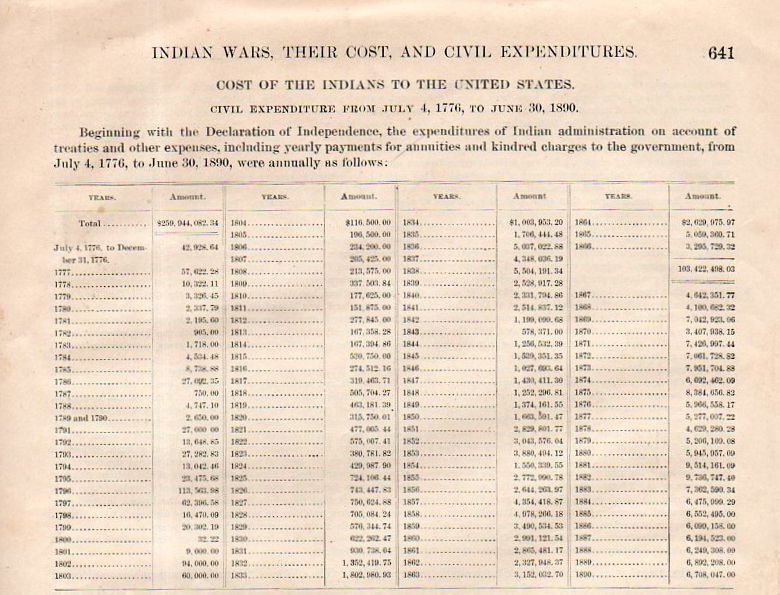
Slate Vault: 1894 Federal Report — “How Much Have We Spent on Native Americans?”

Here:

CostsOfIndiansFinal2.jpg.CROP.original-original

The 693 page report is here.

“Tribes Win Big on Major Water Dispute in Nevada”

Here.

An excerpt:

Indian Tribes in eastern Nevada received a great victory in a long-standing fight to protect their sacred lands and water from being drained and converted into a barren dust bowl by Las Vegas and the Southern Nevada Water Authority (SNWA).

Since the late 1980s, Las Vegas water officials have pushed plans to import groundwater from across eastern Nevada to supply future growth and provide a backup supply to the Las Vegas Valley, which gets 90 percent of its drinking water from an overtaxed and drought-stricken Colorado River. Water authority officials hope to deliver water to the valley from as far north as Great Basin National Park through a network of pumps and pipelines stretching more than 300 miles and costing as much as $15 billion. The attorney for SNWA has aptly called this the “largest water case in Nevada’s history”.

On December 10, 2013 the Seventh Judicial Court of Nevada in Ely reversed the Nevada State Engineer’s decision to grant SNWA virtually all of the groundwater in eastern Nevada water basins (about 84,000 acre feet annually). The Court ruled that the amount of water awarded had to be reduced and recalculated. Importantly, the Court also agreed with the Tribes that the monitoring and mitigation approved by the State Engineer had to be revised to include more participants and have more detailed standards to protect against environmental damage from draining groundwater from the basins.