Here.
TT analysis to follow shortly.
Here.
TT analysis to follow shortly.
Ugh.
Here.
John Echohawk, Jaqueline Pata, and Terry Cross have a scathing op-ed on Politico here.
An excerpt:
Poke beneath the basic facts, though, and you will find the ugly underbelly of the American adoption business. All across this country – but especially in states that are home to multiple Native American Tribes – unethical adoption attorneys are purposely circumventing the federal law that is meant to protect Native American children. Even worse are the continuing attempts by some adoption lawyers to take advantage of active duty service members in the process of being deployed to combat, or in active deployments.
Brown’s case is a sad example of both of these disturbing trends. At its very heart, this case is about a father’s deep desire to raise his daughter, named Veronica. Veronica’s mother and Brown were engaged when she was conceived, but her mother broke off the engagement while Brown was serving in the Army and stationed at Fort Sill, Okla. Unbeknownst to Brown, his fiancé began the process of placing her child up for adoption.
In the final months of pregnancy, the mother cut off all communication with Brown and worked closely with an agency and attorney to place the child with a non-Indian couple from South Carolina, the Capobiancos. Brown was not informed of Veronica’s birth on September 15, 2009. Instead, Veronica was placed with the Capobiancos three days after her birth in Oklahoma, and they relocated her to South Carolina shortly thereafter.
Four months later, the day before Brown’s scheduled deployment to Iraq, the couple’s lawyer (who was also the lawyer for the adoption agency) finally served Brown with notice of their intent to adopt Veronica. The notice was served to Brown in the parking lot of a mall.
Lots of internet traffic on this case:
Faculty Lounge (Kate Fort’s Posting)
Constitutional Law Prof Blog (context relating to Indian boarding schools)
SCOTUSblog (argument preview, concluding with a note that the plain language favors tribal interests but Indians fare worse in SCT than prisoners)
Tulalip News (Q&A with Cherokee counsel)
Here is the unpublished opinion in City of Duluth v. Fond du Lac Band of Lake Superior Chippewa (Minn. App.).
An excerpt (the full article text is available on the Cherokee Nation website):
Nimmo was born in Tahlequah, Oklahoma, the capital of Cherokee Nation. She was raised in Warner, Oklahoma, which, she likes to say, is probably the only town in the country with a college and no stoplight. “It’s that small,” she said. She has a master’s in business administration from Northeastern State University in Tahlequah and a law degree from the University of Tulsa College of Law.
The Cherokee Nation’s attorney general’s office is midsized “by Oklahoma standards,” 10 attorneys. Nine are tribal citizens and one is an “honorary” Cherokee. They are prosecutors in Cherokee court and in-house counsel to Cherokee Nation by advising its departments, handling contracts and appeals before administrative boards, among other duties.
Nimmo joined the attorney general’s office right out of law school in 2008. “I was in the top five percent of my class and did some internships at some big law firms in Tulsa,” she recalled. “I quickly realized that was not what I wanted to do when I graduated. Part of it was I wanted to be in a courtroom. I also didn’t want to do solo. This is a great place to work. As an attorney, I’m salaried and don’t do billable hours. Why would you ever leave that?
“Indian law is a tight knit group of attorneys. Whether you work in-house for a tribe or represent a tribe, every Indian law decision in an appellate court can affect all tribes.”
Today, the Ninth Circuit withdrew an opinion affirming a conviction in United States v. Alvirez. The Alvirez materials are here. The Zepeda materials are here. The federal government has until April 18 to file an en banc petition. A third decision that may be implicated as well is United States v. PMB (materials here).
The issue in Zepeda is here:
The panel held that a Certificate of Enrollment in an Indian tribe, entered into evidence through the parties’ stipulation, is insufficient evidence for a rational juror to find beyond a reasonable doubt that a defendant is an Indian for purposes of § 1153, where the government offers no evidence that the defendant’s bloodline is derived from a federally recognized tribe.
I’ll be giving a talk titled “Tribal Sovereignty in the 21st Century: On VAWA, Same-Sex Marriage, and Modern Tribal Controversies” this Thursday at Dewing Hall, Room 103, at Kalamazoo College. Please join us.
Featuring “Steve” Matthew Fletcher. Here.
An excerpt:
Thorpe: What is likely to be the next step in this process and when might it take place?
Fletcher: The next step is to litigate the Section 9 question; that is, whether it applies at all because of MILCSA and, if so, whether it forecloses the fee to trust application. I was surprised that Judge Jonker shut down Sault Tribe this early in the process, but it really hurts the tribe. Had Sault Tribe put in their application, the federal government is a party. And especially if Interior took the land into trust, suddenly the United States is a defendant, and they’re much more difficult to defeat than a mere Indian tribe. And no one is better suited to know the implications of an injunction at this early date than Judge Jonker, with all his experience litigating against the United States in Indian gaming cases.
Thorpe: If you were a betting man, what would you say are the odds of the Lansing casino ever being built, at least be the current proposed ownership team?
Fletcher: Flip a coin. Sault Tribe, because of its advantageous position as a result of MILCSA, has the best chance of any tribe. But the Section 9 problem may shut it all down. Moreover, all it takes is one rider in an Interior appropriations bill to undercut that provision.
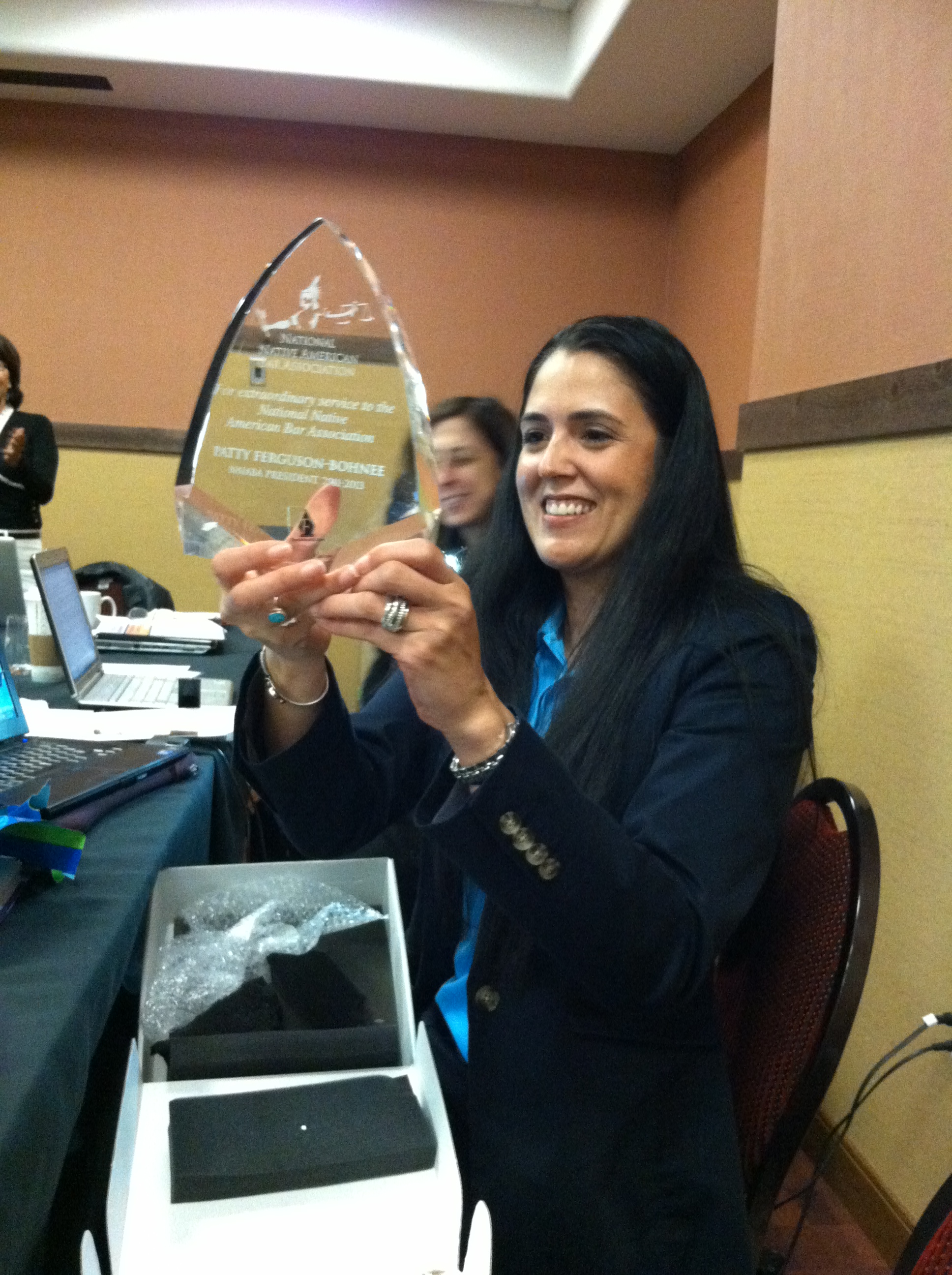
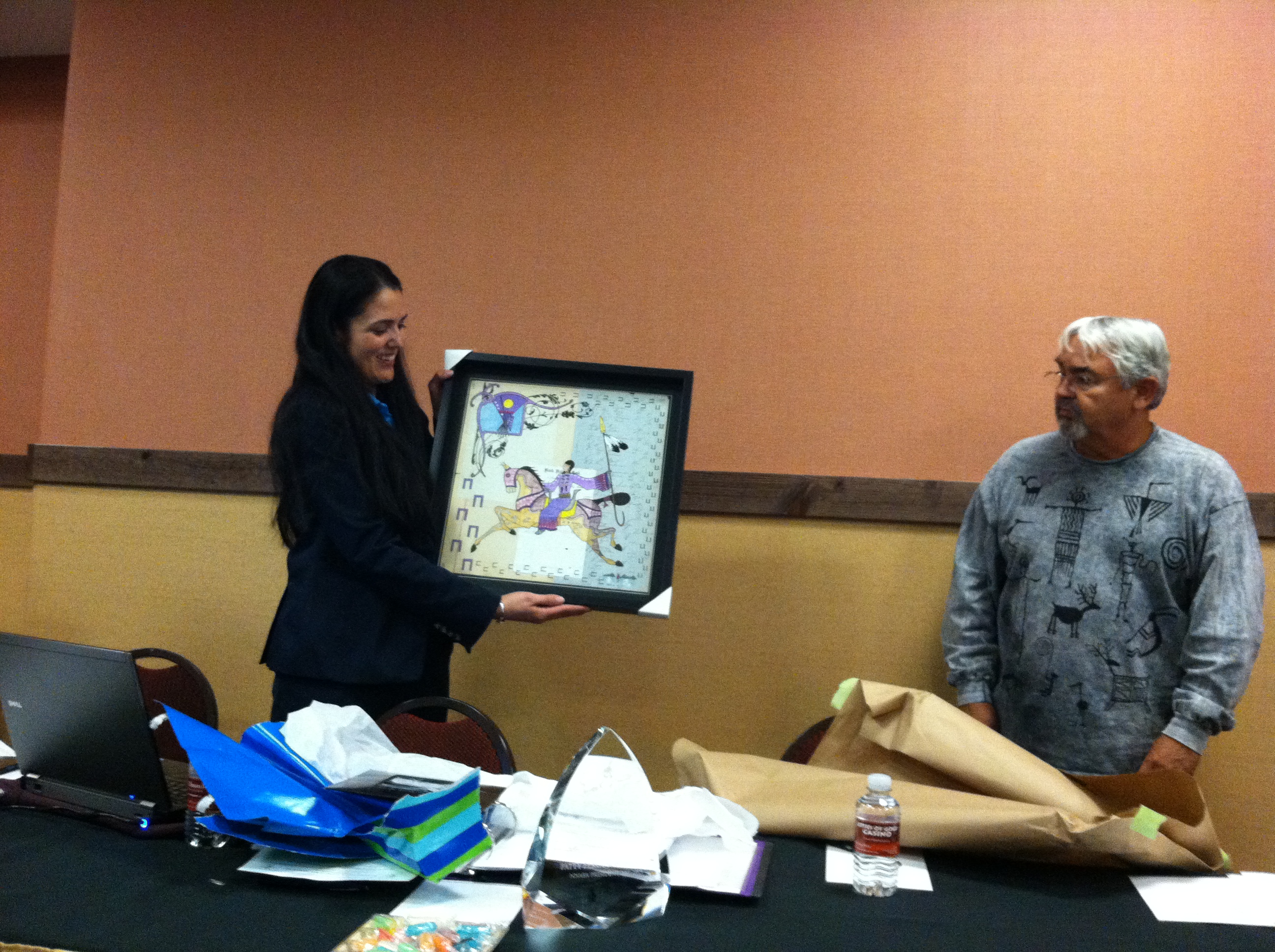
1. A smiling NNABA Board, including several Past Presidents (Baca, Nash, Weathers, Echo Hawk)



You must be logged in to post a comment.