Unpublished California ICWA Case on Determining Child’s Tribe

Here.

Grandmother argued child is Native Hawaiian and registered with OHA. Mother argued child is affiliated with Mooretown Rancheria. Mooretown Rancheria argued same. Lower and appellate courts held under a significant contacts discussion child is affiliated with Mooretown, and registration with OHA doesn’t disturb the Mooretown affiliation for the application of ICWA.

Side note–Looks like California law doesn’t list the preference of the parent in the significant contacts determination. Cal. Welf. & Inst. Code 224.1(2). The updated Guidelines and proposed Regs both list preference of the parent first as allowable considerations. (B.4 (C)(1) & 23.109(c)(1)(i). Regardless, the outcome in this case is consistent with both.

Article on Yesterday’s Public Hearing on Proposed ICWA Regulations

Here, via NICWA.

“That’s been the plan from the beginning,” Bradley Goodsky told a mostly sympathetic audience at Mystic Lake Casino on Wednesday. “It’s like [child protection] has a crystal ball and we’re doomed to fail.”

Goodsky was one of the speakers to address federal administrators who are considering making it more difficult for social workers to put Indian children in foster care. The Bureau of Indian Affairs is proposing new rules that it says will strengthen the Indian Child Welfare Act, the 1978 law passed by Congress to stop the “often unwarranted” breakup of Indian families.

The act provides guidelines to child protection agencies and juvenile courts that set a high standard for placing Indian children into foster care, and it gives tribes a say in those cases. The proposed changes would raise that bar even higher, by requiring that child protection and the courts first determine if a child is Indian, and then only remove that child from a home where there is “present or impending risk of serious bodily injury or death.”Kevin Washburn, the U.S. Interior Department assistant secretary who leads the BIA, is touring the country with other agency officials to hear from tribes and the public about the proposals.

“Guidelines are great,” Washburn told the group at the casino in Prior Lake. “We need things that are legally enforceable.”

Do you have your written comments in yet? They are due May 19.

ICWA Placement Preferences Case out of Oklahoma

A disturbing case that is also a prime example of why ICWA Regulations are needed in addition to the new Guidelines (submit comments by MAY 19!)

Opinion here.

The court reads a best interest determination into the good cause to deviate from placement preferences, and skates alarmingly close to the existing Indian family exception reasoning.

ICWA Qualified Expert Witness (primarily) Case Out of Alaska

Here.

Footnote 7 discusses the old and new Guidelines with regards to QEWs, though the court relied primarily on the old Guidelines (the professional person who is an expert professional). The specific qualifications of the QEW in this case is discussed at pages 17-20.

Court held no due process violations and that termination was affirmed.

ICWA Notice Case out of Alabama

Here.

Moreover, the record indicates that the tribe [Stockbridge-Munsee] received the inquiry form from DHR on November 7, 2014, less than a week before the juvenile court conducted the November 13, 2014, termination hearing. Section 1912(a) dictates that no termination of parental rights proceeding pertaining to an Indian child may be conducted until at least 10 days after an Indian tribe has received the noticed required in that section.
***
Therefore, we reverse the juvenile court’s judgment insofar as it terminated the mother’s parental rights to the child, and we remand the cause for the juvenile court to comply with the provisions of the ICWA . . .

Written Comments on BIA Proposed ICWA Regulations Due May 19

Written comments on the proposed ICWA federal rule are due by May 19. In order for this process to be effective, Tribes need to speak up as do individuals who have strong feelings about ICWA or have been impacted by ICWA compliance or lack of compliance. It matters how many written comments are received.

In order to assist, NICWA has put together several resources such as sample talking points and a sample comment letter. The NICWA resource page is available here.

Comments can be submitted via email, mail, or hand delivery.

Email: comments@bia.gov.
Include ‘‘ICWA’’ in the subject line of the message.

Mail or hand-delivery:
Ms. Elizabeth Appel, Office of Regulatory Affairs & Collaborative Action—Indian Affairs,
U.S. Department of the Interior, 1849 C Street NW., MS 364, Washington, DC 20240

(202) 273–4680

Previous coverage here.


Seattle U.’s VAWA Panel

CAM02623

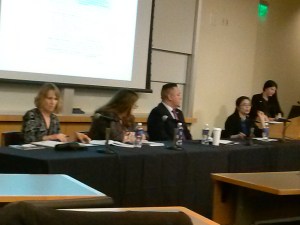
Here’s a picture from Seattle University School of Law’s very inspiring VAWA Panel tonight. Left to right, the panelists were Molly Cohan, Sharon Jones Hayden, Alfred Urbina, and Ye-Ting Woo. Most of the handouts are here.

Among the many things I learned is that the one of the Pascua Yaqui Tribe’s first VAWA cases involved a same-sex couple. It was originally thought that this case might turn out to be the first tribal VAWA case to go through the federal habeas process and to eventually reach the Supreme Court, but the jury was uncertain as to whether the victim and defendant were in an intimate relationship as required by VAWA and so the defendant was acquitted. Given that the defendant and victim lived together and had a sexual relationship, this skepticism is troubling and, sadly, may reflect unconscious homophobia. There are still many positives, however. Despite the acquittal, the case helps shed light on a hidden problem–same-sex domestic violence is still a little-known and rarely mentioned phenomenon. Kudos to Pascua Yaqui for bringing the case. The prosecutorial response on its own was undoubtedly meaningful to the victim. And, given the jury’s acquittal, the case stands as a strong example of a tribal jury’s impartial treatment of a non-member.

There was also an important discussion of the holes in VAWA, including the lack of tribes’ ability under VAWA to prosecute crimes against children as well as stranger rape. Many of the more serious recent domestic violence crimes committed by nonmembers at both Tulalip and Pascua Yaqui involved crimes against children, but tribes cannot prosecute crimes against children under VAWA, so they must depend on the federal government (or the state in Public Law states) for prosecution of these crimes.

NICWA Federal Listening Session on ICWA Compliance

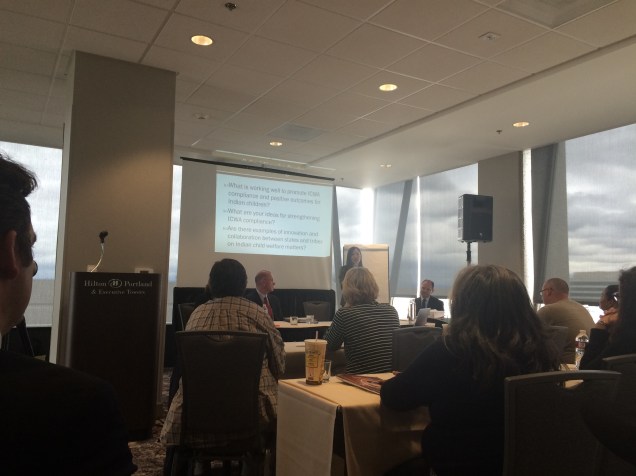
Sarah Kastelic (NICWA), Sam Hirsch (DOJ), JooYeun Chang (Children’s Bureau), and Kevin Washburn (Interior).


NICWA Presentation on Transitions for Foster Youth

Adrea Korthase (ILPC Alum, Oregon DHS) and the incomparable Nadja Jones (Oregon DHS) on ways to provide seamless transitions to youth aging out of foster care. 


NICWA Conference Presentation and Legal Professionals Reception 

Kate Fort and Victoria Sweet (ILPC Alum, NCJFCJ) on tribal strategies in state ICWA cases.  

The Legal Professionals Reception co-hosted by ILPC, TICA, and Tilden McCoy & Dilweg.