Here is the order in State of Washington v. Towessnute:
Here are a couple contemporaneous newspaper accounts:
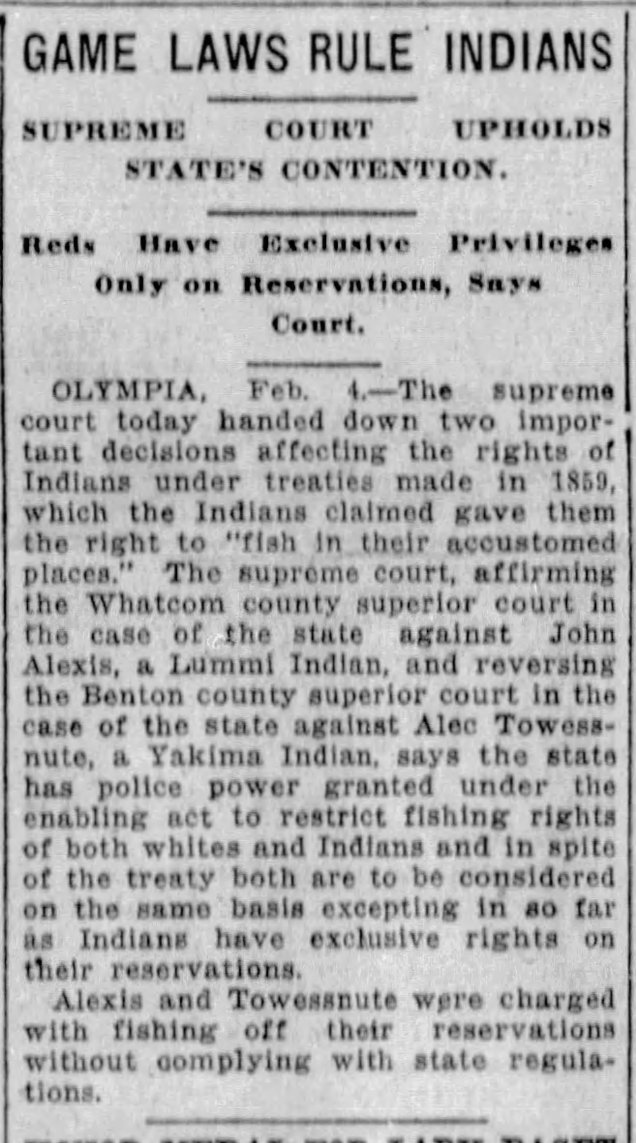
The Spokesman Review, Sat., Feb. 5, 1916
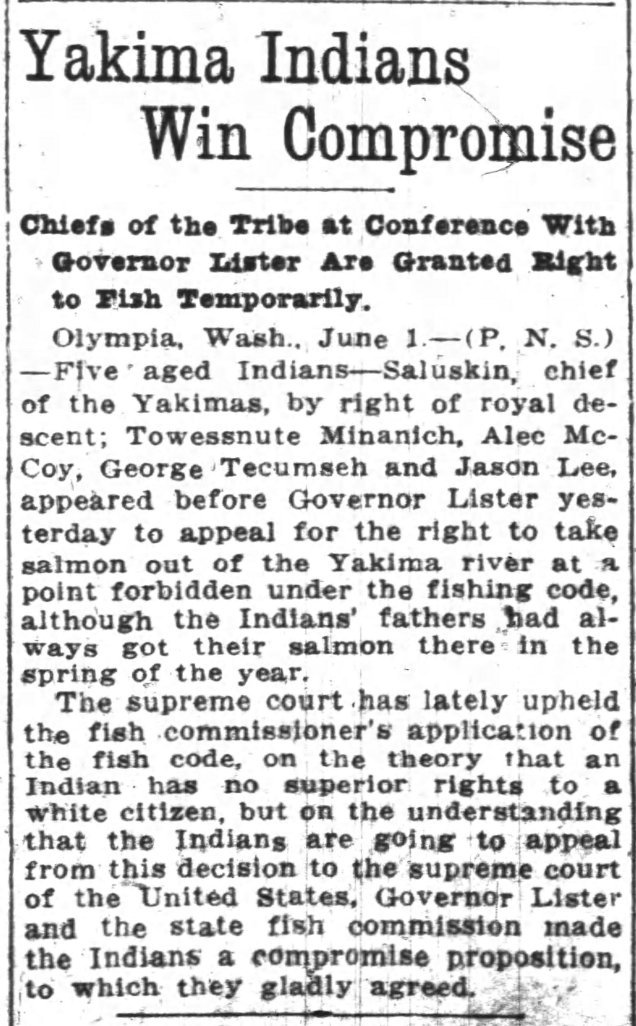
Here is the order in State of Washington v. Towessnute:
Here are a couple contemporaneous newspaper accounts:
The Spokesman Review, Sat., Feb. 5, 1916
Here is “Supreme Court upholds American Indian treaty promises, orders Oklahoma to follow federal law,” in The Conversation.
Other commentaries —
Bob Miller on VOA.
Ronald Mann on SCOTUSblog.
Ian Millhiser on VOX.
Here.
A wildly overblown headline, but here you go anyway.
Here’s another one, from CNBC: “Supreme Court says eastern half of Oklahoma is Native American land.”
And WSJ: “American Indian Lands Include Eastern Oklahoma, Supreme Court Rules.”
And NPR gets in on the action: “Supreme Court Rules That About Half Of Oklahoma Is Native American Land.”
Here is the opinion in United States v. Many White Horses.
Briefs here.
Here is the opinion in United States v. Dowty.
Here is the opinion. An excerpt:
This case presents the question whether the State of Washington may exercise criminal jurisdiction over members of the Confederated Tribes and Bands of the Yakama Nation who commit crimes on reservation land. To answer that question, we must interpret a 2014 Washington State Proclamation that retroceded—that is, gave back—“in part,” civil and criminal jurisdiction over the Yakama Nation to the United States, but retained criminal jurisdiction over matters “involving non-Indian defendants and non-Indian victims.” If “and,” as used in that sentence, is conjunctive, then the State retained jurisdiction only over criminal cases in which no party—suspects or victims—is an Indian. If, by contrast, “and” is disjunctive and should be read as “or,” then the State retained jurisdiction if any party is a non-Indian. We conclude, based on the entire context of the Proclamation, that “and” is disjunctive and must be read as “or.” We therefore affirm the district court.
Here is the cert petition in United States v. Cooley:
Question presented:
Whether the lower courts erred in suppressing evidence on the theory that a police officer of an Indian tribe lacked authority to temporarily detain and search respondent, a non-Indian, on a public right-of-way within a reservation based on a potential violation of state or federal law.
Lower court materials here.
Update:
 Turtle Talk
You must be logged in to post a comment.