Keweenaw Bay Indian Community stands 500 strong at Eagle Mine Court of Appeals Hearing (PDF)
For Release: June 5, 2014
Contact: Donald Shalifoe, Sr., Tribal President
Phone: 906-353-6623
Baraga, MI — About 500 members of the Keweenaw Bay Indian Community (KBIC) 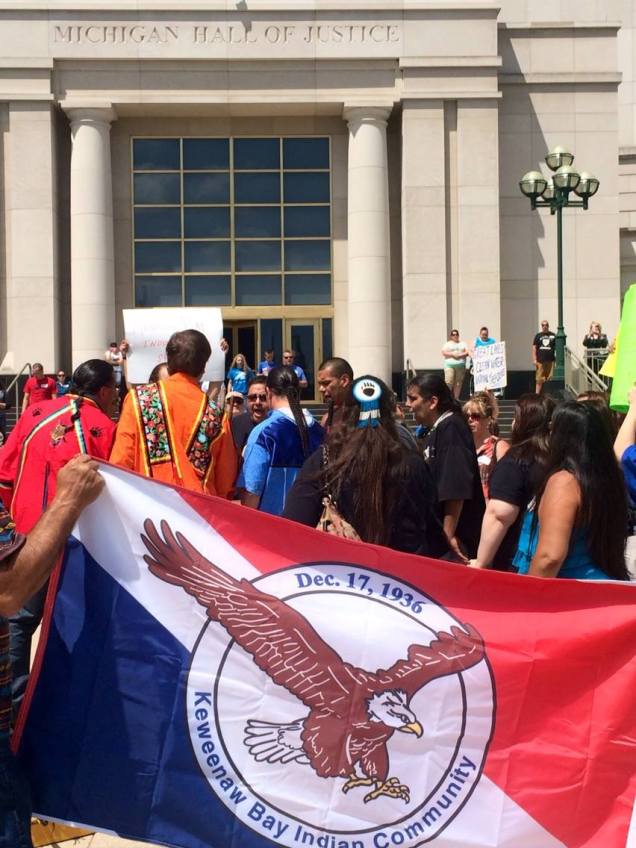 stood united around the importance of keeping their waters clean from contamination associated with sulfide mining on June 3, 2014 at the Michigan Court of Appeals. Oral arguments were heard involving the Eagle Mine, Michigan’s first permitted sulfide mine in the Upper Peninsula.
“This is the first time in our generation that the community as a whole came together to fight for true sovereignty and engage in spontaneous government participation. The goal of the new moving-forward Tribal Council is to bring transparency and involvement to the Anishinaabeg (the people),” said Donald Shalifoe, Sr., KBIC’s Ogimaa (Chief).
Many tribal members carpooled and traveled about eight hours to line up for the 10:00 a.m. Lansing hearing. KBIC’s remarkable presence overwhelmed the Michigan Hall of Justice whose staff reported it was their largest turn out ever for a court hearing.
Tribal leaders and elders observed the hearing from within the court room, while hundreds watched and listened to the proceedings in an overflow video conferencing room. Traditional drumming and singing resounded outside the building following the hearing.
KBIC’s Vice President Carole LaPointe remarked “it was a very educational experience for our membership and youth.”
The Anishinaabeg band has opposed the Eagle Mine development, located on Treaty of 1842 ceded homeland, since it was first permitted by the Michigan Department of Environmental Quality (MDEQ) in 2006.
Unsettled concerns involve the mining regulatory process, improper permitting and inadequate assessment of impacts to the area environment, cultural resources and water quality, including groundwater contamination and the potential for perpetual acid mine drainage upstream from Lake Superior.
Tribal member Jeffery Loman said “the hearing today is another testimony to the fact that inadequate regulation and collusion between industry and government results in endless litigation.”
One aspect of the evolving case questions what qualifies as a “place of worship” under Michigan’s sulfide mining statute. An initial ruling by Michigan Administrative Law Judge Richard Patterson recommended mitigation of impacts to an Anishinaabeg sacred place, Migi zii wa sin (Eagle Rock), but the MDEQ made a final permit decision asserting only built structures are places of worship.
Discriminatory enforcement of Michigan law has led to substantial degradation to KBIC’s sacred site. This includes obtrusive mine facilities and a decline access ramp into the base of Eagle Rock, non-stop noise and activity, and hindered traditional access and use. Spiritually significant high places like Eagle Rock are used in solitude by the Anishinaabeg for multi-day fasting, vision quest and ceremony.
Despite the passage of the American Indian Religious Freedom Act of 1978, Native people still struggle to protect their remaining sacred places in the face of extractive development agendas. “It is a shame that the United States of America, proudly founded upon values of religious freedom, has trouble guaranteeing this right to all of its nation’s first people,” said tribal member Jessica Koski.
KBIC anticipates a decision from the Michigan Court of Appeals within six months. The Eagle Mine’s timeframe for production start-up is the end of 2014. “While the court deliberates, it is important to remember that regardless of the outcome, we are in the right for standing up for the Yellow Dog Plains. We hope the court understands their decision will have long lasting implications for this place, as well as other areas that are slated for mining,” said Emily Whittaker of Big Bay, Michigan who gathered alongside KBIC and other locally affected residents.
The Michigan Court of Appeals ruling will be an important precedent for additional sulfide mining proposals threatening Michigan’s Upper Peninsula and waters of the Great Lakes.
###


 Turtle Talk
You must be logged in to post a comment.