Motions to reconsider here.
ICWA
Unpublished California ICWA Case on Determining Child’s Tribe
Here.
Grandmother argued child is Native Hawaiian and registered with OHA. Mother argued child is affiliated with Mooretown Rancheria. Mooretown Rancheria argued same. Lower and appellate courts held under a significant contacts discussion child is affiliated with Mooretown, and registration with OHA doesn’t disturb the Mooretown affiliation for the application of ICWA.
Side note–Looks like California law doesn’t list the preference of the parent in the significant contacts determination. Cal. Welf. & Inst. Code 224.1(2). The updated Guidelines and proposed Regs both list preference of the parent first as allowable considerations. (B.4 (C)(1) & 23.109(c)(1)(i). Regardless, the outcome in this case is consistent with both.
Article on Yesterday’s Public Hearing on Proposed ICWA Regulations
Here, via NICWA.
“That’s been the plan from the beginning,” Bradley Goodsky told a mostly sympathetic audience at Mystic Lake Casino on Wednesday. “It’s like [child protection] has a crystal ball and we’re doomed to fail.”
Goodsky was one of the speakers to address federal administrators who are considering making it more difficult for social workers to put Indian children in foster care. The Bureau of Indian Affairs is proposing new rules that it says will strengthen the Indian Child Welfare Act, the 1978 law passed by Congress to stop the “often unwarranted” breakup of Indian families.
The act provides guidelines to child protection agencies and juvenile courts that set a high standard for placing Indian children into foster care, and it gives tribes a say in those cases. The proposed changes would raise that bar even higher, by requiring that child protection and the courts first determine if a child is Indian, and then only remove that child from a home where there is “present or impending risk of serious bodily injury or death.”Kevin Washburn, the U.S. Interior Department assistant secretary who leads the BIA, is touring the country with other agency officials to hear from tribes and the public about the proposals.
“Guidelines are great,” Washburn told the group at the casino in Prior Lake. “We need things that are legally enforceable.”
Do you have your written comments in yet? They are due May 19.
ICWA Placement Preferences Case out of Oklahoma
A disturbing case that is also a prime example of why ICWA Regulations are needed in addition to the new Guidelines (submit comments by MAY 19!)
Opinion here.
The court reads a best interest determination into the good cause to deviate from placement preferences, and skates alarmingly close to the existing Indian family exception reasoning.
ICWA Qualified Expert Witness (primarily) Case Out of Alaska
Here.
Footnote 7 discusses the old and new Guidelines with regards to QEWs, though the court relied primarily on the old Guidelines (the professional person who is an expert professional). The specific qualifications of the QEW in this case is discussed at pages 17-20.
Court held no due process violations and that termination was affirmed.
ICWA Notice Case out of Alabama
Here.
Moreover, the record indicates that the tribe [Stockbridge-Munsee] received the inquiry form from DHR on November 7, 2014, less than a week before the juvenile court conducted the November 13, 2014, termination hearing. Section 1912(a) dictates that no termination of parental rights proceeding pertaining to an Indian child may be conducted until at least 10 days after an Indian tribe has received the noticed required in that section.
***
Therefore, we reverse the juvenile court’s judgment insofar as it terminated the mother’s parental rights to the child, and we remand the cause for the juvenile court to comply with the provisions of the ICWA . . .
Written Comments on BIA Proposed ICWA Regulations Due May 19
Written comments on the proposed ICWA federal rule are due by May 19. In order for this process to be effective, Tribes need to speak up as do individuals who have strong feelings about ICWA or have been impacted by ICWA compliance or lack of compliance. It matters how many written comments are received.
In order to assist, NICWA has put together several resources such as sample talking points and a sample comment letter. The NICWA resource page is available here.
Comments can be submitted via email, mail, or hand delivery.
Email: comments@bia.gov.
Include ‘‘ICWA’’ in the subject line of the message.
—
Mail or hand-delivery:
Ms. Elizabeth Appel, Office of Regulatory Affairs & Collaborative Action—Indian Affairs,
U.S. Department of the Interior, 1849 C Street NW., MS 364, Washington, DC 20240
(202) 273–4680
Previous coverage here.
Motions to Reconsider in Oglala Sioux Tribe v. Van Hunnik
Here:
Davis Brief in Support (April 2015)
Davis Motion to Reconsider (April 2015)
DSS Brief in Support (April 2015)
DSS Joinder in Arguments of other Defendants (April 2015)
DSS Motion to Reconsider (April 2015)
Vargo Brief in Support (April 2015)
Vargo Brief in Support Revised (April 2015)
The order at issue is here.
Minnesota Court of Appeals Decides ICWA Notice Appeal
Here is the unpublished opinion in In re Welfare of Child A.N.T. (Minn. App.):
An excerpt:
The district court properly inquired into whether ICWA applies here. After extensive testimony, the district court’s reopening of the ICWA issue, and dozens of tribal notifications, including one to the United States Bureau of Indian Affairs, no evidence was located to suggest that daughter is eligible for membership in any Indian tribe. Mother, through her mother, provided scant information pertaining only to practices and purported Native American heritage, but nothing concerning tribal membership or eligibility for membership. OCCS, despite extensive and documented efforts, was unable to verify that daughter is an Indian Child as defined by ICWA.
We have held that a district court does not err when it declines to apply ICWA where “there is no evidence that the children are eligible for membership in any Indian tribe.” In re Welfare of Children of M.L.A., 730 N.W.2d 54, 59 (Minn.App.2007). Further, in In re Matter of Baby Boy Doe, 849 P.2d 925, 931 (Idaho 1993), cert. denied 510 U.S. 860, 114 S.Ct. 173 (1993), the Idaho Supreme Court held that “[t]he party asserting the applicability of ICWA has the burden of producing the necessary evidence for the trial court to make” the determination of whether ICWA applies.
Mother failed to meet her burden of production concerning the application of ICWA. Therefore, the district court did not err in concluding that ICWA does not apply here.
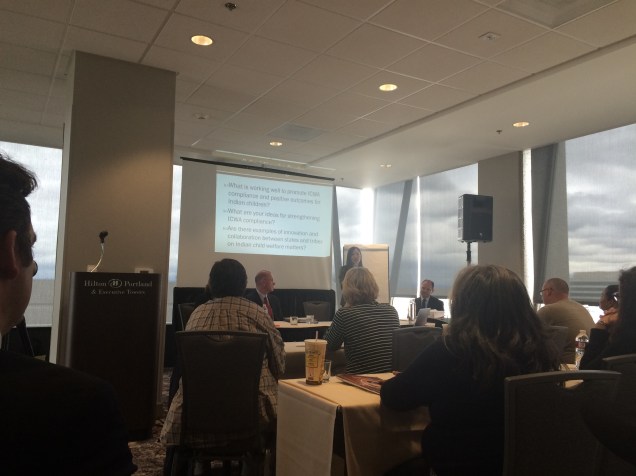
NICWA Federal Listening Session on ICWA Compliance
Sarah Kastelic (NICWA), Sam Hirsch (DOJ), JooYeun Chang (Children’s Bureau), and Kevin Washburn (Interior).
 Turtle Talk
You must be logged in to post a comment.