Here are the updated materials in Oglala Sioux Tribe v. Van Hunnik (D.S.D.):
112 DCT Order Granting Motion to Seal
Related post here.
Here are the updated materials in Oglala Sioux Tribe v. Van Hunnik (D.S.D.):
112 DCT Order Granting Motion to Seal
Related post here.
Here:

Background:
In June 2008, the Minto Tribal Court took emergency custody of an infant girl. After numerous hearings in which the parents participated, the Minto Tribal Court terminated the parental rights of the girl’s mother and father, Mr. Parks, and granted permanent custody of the child to the Simmonds who are relatives of the child’s mother. Mr. Parks did not appeal the decision in the Minto Tribal Court, but instead filed a series of lawsuits in federal and state court claiming, among other things, that the tribal court has no jurisdiction over him and that the Minto Tribal Court’s traditional practices and procedures violated his right to due process. Based on these arguments, Mr. Parks claimed that the tribal court termination order was not entitled to full faith and credit under the Indian Child Welfare Act (ICWA). The Simmonds argued that the termination order is entitled to full faith and credit, and they moved to dismiss the state court action, but this motion was denied by the superior court in November 2010.
The Simmonds petitioned the Alaska Supreme Court for review. The petition was granted, and the case was remanded to the superior court for it to make specific factual findings and legal conclusions. The superior court issued findings and concluded in part that tribal courts may not have jurisdiction over nonmembers and also suggested that the Minto Tribal Court’s traditional practices and procedures violated Mr. Parks’s right to due process. The Simmonds filed another petition for review with the Alaska Supreme Court asking that numerous aspects of this decision be reversed.
The State of Alaska intervened in the case and argued vigorously against the Minto Tribal Court’s jurisdiction and the use of the Tribal Court’s traditional law and processes. Attorney General Geraghty himself published an opinion piece on the case. These actions are consistent with the State’s 2004 Renkes Opinion and subsequent lawsuits in which the State has refused to recognize the authority of tribal courts over member children, including State v. Native Village of Tanana, Kaltag Tribal Council v. Jackson, and the ongoing State v. Central Council of Tlingit & Haida Indian Tribes of Alaska.
The Alaska Supreme Court’s Decision:
In its opinion today, the Alaska Supreme Court affirmed that the Minto Tribal Court’s decision is entitled to full faith and credit by Alaska courts. The Court affirmed that the Minto Tribal Court’s judgment on the custody of the child implicates interests that are at the core of tribal sovereignty and self-determination, and the Court rejected the State’s jurisdictional arguments to the contrary. In addition, the Court’s opinion is notable because it adopts the longstanding exhaustion of tribal remedies doctrine, which requires litigants to make use of tribal appellate courts before challenging tribal court decisions in federal or state courts.
NARF Staff Attorney Erin Dougherty described the Court’s analysis of full faith and credit and the tribal exhaustion doctrine as “a direct rebuke of the State of Alaska’s arguments, which sought to treat the decisions of tribal courts differently simply because they are Tribes. These arguments have no foundation in federal law and do a great disservice to the relationships between Tribes and the State of Alaska.” NARF Staff Attorney Natalie Landreth agreed, noting that “the Court’s decision today is entirely consistent with federal and state law.”
In this case, the Native Village of Minto did what it and the 228 other Tribes in Alaska have done since time immemorial—protect and care for their member children in times of need. The Native American Rights Fund calls on Governor Sean Parnell and Attorney General Geraghty to cease the State’s repeated efforts to oppose tribal courts and instead, work with Tribes to better protect all of Alaska’s children.
Here is the opinion in Simmonds v. Parks.
We posted briefs here.
Brief in Support of First Motion (July 2014)
Statement of Undisputed Facts (First Motion)
As a result of the fact that (a) Defendants allowed no testimony at 48-hour hearings, (b) Defendants allowed no cross-examination at 48-hour hearings, (c) often the only questions asked of the parents in a 48-hour hearing were for purposes of identification and to see if they understood their rights, and (d) Defendants never conducted the inquiries required by 25 U.S.C. § 1922, Defendants’ 48-hour hearings were completed rather quickly. Judging from the length of the transcripts that were produced, the average length of time it took to complete a 48-hour hearing, Plaintiffs estimate, was under four minutes. A number of these hearings appear to have been completed in about sixty seconds.
The brief goes on to describe the many, many individual hearings where children were kept in DSS care for 45 or 60 days with absolutely to no evidence or testimony as to why.
Here are new pleadings in Oglala Sioux Tribe v. Van Hunnik (D.S.D.):
100 Oglala Sioux Tribe Reply Brief
An excerpt:
Plaintiffs possess a document that strongly suggests that Judge Davis is concealing information prejudicial to his case. If Plaintiffs are correct, then the Court will need to determine whether that document and the brief that Plaintiffs are filing under seal should be unsealed, whether any sanctions against Judge Davis are warranted, and whether Judge Davis should be ordered to disclose any other incriminating evidence that he may be concealing. For now, Plaintiffs will respond to Judge Davis’s brief as if the injurious evidence that Plaintiffs have in their possession does not exist and will await the Court’s ruling on that matter.
101 Oglala Sioux Tribe Motion To File Under Seal
OST’s second motion to compel is here.
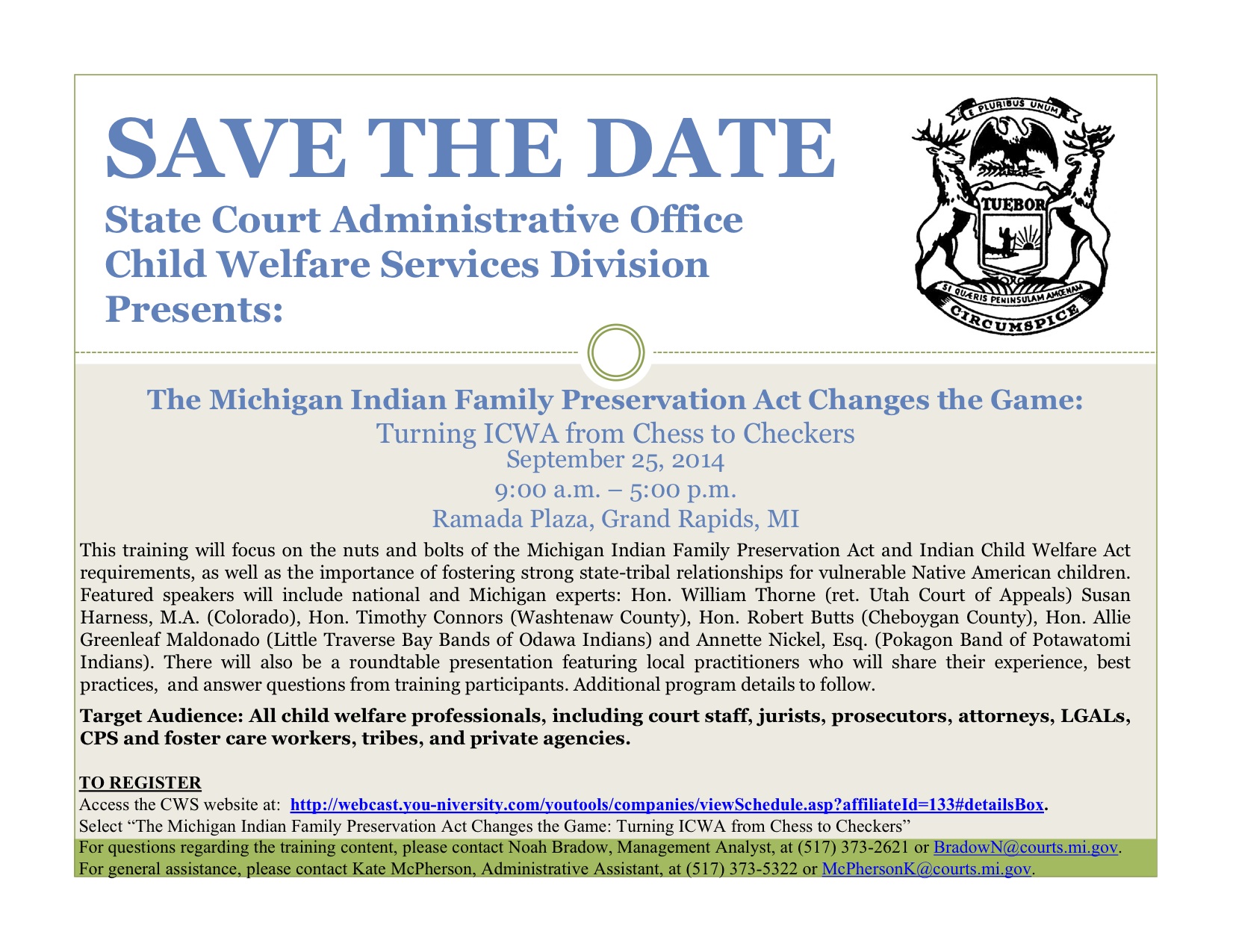
Here.
2014 Advisory Committee Comment
With respect to [Rule 34.03] subdivision 1(j) and (l), in cases where the application of the Indian Child Welfare Act (ICWA) is unclear, such as when it is not yet known whether the child is or is not an Indian child, it is advisable to proceed pursuant to the requirements of the ICWA unless or until a determination is otherwise made in order to fulfill the Congressional purposes of the ICWA, to ensure that the child’s Indian tribe is involved, and to avoid invalidation of the action pursuant to 25 U.S.C. § 1914 and Rule 46.03.”
A court can’t go back and apply heightened standards after the fact. Makes more sense to do so from the beginning. No child is hurt by applying higher standards to their case, even if it ends up ICWA ultimately does not apply.
Thanks to AS.
Here:
98 Plaintiffs Motion to Compel
An excerpt:
The only information that Interrogatory No. 11 seeks to discover is whether Judge Davis discussed any 48-hour procedures with other judges on the Seventh Judicial Circuit. It is difficult to imagine an interrogatory more related to Plaintiffs’ burden of proof than Interrogatory No. 11. See Disc. Op. at *6 (“In this case, in order to be successful, plaintiffs must prove the defendants engaged in policies, practices and customs which violate the plaintiffs’ constitutional rights.”).
Materials on prior motion to compel is here.
Decision (a rare published ICWA decision for CA).
The children were eligible for membership at Cherokee Nation of Oklahoma. The trial court ordered DHHS to help enroll the children as active efforts. DHHS appealed. The appellate court found that both ICWA and California state law limited the definition of Indian child (member, or bio child of a member and eligible), and if the children did not fit in that definition, the laws did not apply. As such, the rules were beyond the scope of the Judicial Counsel to pass.
The rules:
Rule 5.482(c) states, “If after notice has been provided as required by federal and state law a tribe responds indicating that the child is eligible for membership if certain steps are followed, the court must proceed as if the child is an Indian child and direct the appropriate individual or agency to provide active efforts under rule 5.484(c) to secure tribal membership for the child.”
Rule 5.484(c) states, “In addition to any other required findings to place an Indian child with someone other than a parent or Indian custodian, or to terminate parental rights, the court must find that active efforts have been made, in any proceeding listed in rule 5.480, to provide remedial services and rehabilitative programs designed to prevent the breakup of the Indian family, and must find that these efforts were unsuccessful.
“(1) The court must consider whether active efforts were made in a manner consistent with the prevailing social and cultural conditions and way of life of the Indian child’s tribe.(2) Efforts to provide services must include pursuit of any steps necessary to secure tribal membership for a child if the child is eligible for membership in a given tribe, as well as attempts to use the available resources of extended family members, the tribe, tribal and other Indian social service agencies, and individual Indian caregivers.”
Here is the petition in Marcussen v. Sebelius:
Marcussen v Sebelius Cert Petition
Questions Presented:
1) Whether the Rooker Feldman doctrine should be overruled for denying all judicial relief by removing the subject matter jurisdiction of the federal courts to hear any civil action brought against federally mandated statutes enforced in the state courts.
2) Whether Congress has the authority to adopt laws intended to be primarily or exclusively enforced in the state courts.
 Turtle Talk
You must be logged in to post a comment.