Mark Killenbeck on the History of the Commerce Clause

Mark Killenbeck, author of several excellent legal histories, including one on M’Culloch v. Maryland and another on the Tenth Amendment, has posted his short history of the Interstate Commerce Clause, “A Prudent Regard to Our Own Good? The Commerce Clause, in Nation and States.”

Here is the abstract:

This lecture was delivered on May 23, 2012, as part of the Supreme Court Historical Society’s annual Leon Silverman Lecture Series. My goal was to discern what key founders envisioned when they crafted and approved the Commerce Clause and explore how it has been interpreted and applied by the Court. I take as my starting point themes struck by James Madison in his Vices of the Political system of the U. States, in which he noted a “want of concert in matters where the common interest requires it,” a flaw “strongly illustrated in the state of our commercial affairs,” to the point that “the national dignity, interest, and revenue [have] suffered from this cause.” Madison’s lament was not, however, about the need to guard against an overbearing federal government. Rather, he was concerned about the corrosive effects of a “a mistaken confidence” in “the justice, the good faith, the honor, the sound policy, of . . . several legislative assemblies” whose actions were marked by “caprice, jealousy, and diversity of opinions.” Madison also counseled against excessive reliance on interpretations grounded solely in the drafting and ratification debates, speaking of the need to “liquidate and ascertain” meaning over time, recognizing, as did Chief Justice John Marshall, that the Constitution was “intended to endure for ages to come, and consequently, to be adapted to the various crises of human affairs.” A close and careful reading of both Madison and Marshall – in particular, Marshall’s opinion for the Court in Gibbons v. Ogden (1824) – suggests, accordingly, that sharp departures from the original understanding of the Commerce Clause occurred long before Wickard v. Filburn (1942), and that there is substantial support for an expansive reading of the nature and scope of the commerce power in the words and intentions of the founders.

 

Judge Matthew Martin on the Origins of Westernized Tribal Jurisprudence

EBCI Judge J. Matthew Martin continues his interesting scholarly work in the legal histories of tribal justice systems with “Chief Justice John Martin and the Origins of Westernized Tribal Jurisprudence,” recently published in the Elon Law Review.

From the article:

Judge John Martin created the modern Tribal Court. This template, still in use today, envisions a Court based on notions of jurisprudence easily recognizable to western eyes, yet leavened with aspects of Tribal culture and tradition. The model comprises a Court system that is familiar and dedicated not only to sovereignty, but also to defiance. The significance of the beginnings of the modern Tribal Court has been consistently underestimated, particularly by the Supreme Court of the United States. John Martin’s crucial role in it has largely been forgotten.

The Atlantic on the Evolution of the Anglo-American Legal System (and Reasons Why Tribes Should Think of Another Way)

Here.

An excerpt:

Taxpayers clearly pay too much for too little justice. Changing to a truth-seeking system might be a remedy. This would require, at a minimum: outlawing the concealing of evidence; re-training academics to teach law students techniques of finding the truth instead of mugging up a million ways to defeat it; dismantling the professional cartel by training judges separately from lawyers; appointing six times as many judges, on the basis of rigorous examinations, and giving them back control of the process; compelling lawyers and judges to take an oath to tell the truth; having lay jurors and trial and appellate judges sit together to render their verdicts and levy penalties (if any) together.

Justice Russell Fox said the public knows that “justice marches with the truth.” It’s high time we tried to reunite the two.

On This Day in History: 1924 Citizenship Act

Here.

Be it enacted by the Senate and House of Representatives of the United States of America in Congress assembled, That all noncitizen Indians born within the territorial limits of the United States be, and they are hereby, declared to be citizens of the United States: Provided, That the granting of such citizenship shall not in any manner impair or otherwise affect the right of any Indian to tribal or other property.

Racialized Ivory Soap Ad from 1889

I came across this very offensive ad yesterday in the course of microfilm research.  It’s from the Daily Argus Leader and was published in 1889. 

ivory ad

ICT Profile of Fletcher’s New Book: “The Eagle Returns”

Here. An excerpt:

The Eagle Returns: The Legal History of the Grand Traverse Band of Ottawa  and Chippewa Indians (Michigan State University Press, 2012) is a  governmental, legal and political history of the tribe. The volume focuses on  their status as a treaty tribe and as the first tribe to be recognized—or,  perhaps more accurately, re-recognized—by the federal government under the  Bureau of Indian Affairs’s administrative recognition process.

“It is the story of survival against the arrival and savage intervention of  several European nations—and the United States—in the affairs and property of  the Anishinaabek of the Grand Traverse Bay region,” Fletcher writes in his  introduction. Professor of law and director of the Indigenous Law & Policy  Center at Michigan State University College of Law, Fletcher also runs Turtle  Talk, the Indigenous Law & Policy Center’s legal blog and an unrivaled  source of court documents pertaining to Indian casework and law.

In The Eagle Returns, Fletcher takes on the guise of storyteller,  and that role is reflected in the chapter headings: “The Story of the 1836  Treaty of Washington,” “The Story of the 1855 Treaty of Detroit” and “The Story  of the Dispossession of the Grand Traverse Band Land Base” are just some of the  entries.

Although the chapter titles are specific to the Grand Traverse Band, in a  more general sense they could serve as a template for any number of indigenous  nations. The book is a reminder that so many of them have followed the same  post-European settlement trajectory of cultural and economic erosion, genocide,  dispossession and poverty, up to the brink of legal extinction—only to survive  through resilience and resourcefulness to emerge strong and prosperous in the  latter part of the 20th century.

The Eagle Returns is not just a legal history. It is also filled  with details about the material lives of the pre-treaty Anishinaabek peoples. At  one point Fletcher writes deftly of their renowned birchbark canoes: They were “the finest canoes in the northern hemisphere, capable of carrying over a ton of  people and equipment for two-year treks, creating an ability to travel over all  of the Great Lakes and their major tributaries.”

Other compelling passages detail episodes like the negotiations between the  Anishinaabek leaders, who were called ogemuk, and Henry Schoolcraft,  the Indian Commissioner for the United States and “an ardent land speculator  prone to fits of deep ethnocentrism.” On March 28, 1836, Schoolcraft signed off  on the Treaty of Washington, whereby the tribes ceded an area of 13,837,207  acres—more than one-third of Michigan’s land area. The treaty provided for  permanent reservations and prohibited the ethnic cleansing of Michigan Indians.  But within months the Senate rewrote it to limit the reservations to five years  and provide an option to remove Indian communities to the south and west.

“The Senate added the carrot of $200,000 to the bands that chose to remove to  these lands in exchange for their reservations lands,” Fletcher writes. The  president agreed to the amended treaty on May 27, 1836, but the Anishinaabek  were not notified of the changes until July.

Still other chapters detail the further dispossession of the Grand Traverse  Band and its “administrative termination” beginning in the 1870s. The story  brightens with the band’s re–recognition on May 27, 1980; its famous victorious  battle for treaty rights to hunt, fish and gather on public lands; its  successful gaming enter-prises; and the modernization of the tribe’s ancient law  and justice systems.

Fletcher says that he intends The Eagle Returns to serve as a  reference for policymakers, lawyers and Indian people and for an educated  general audience. But for the author, the book is also a considerable labor of  love.

“It is written for the people of the Grand Traverse Band,” writes the author, “who have not had the benefit of drawing upon one source for the bulk of their  legal and political history.”

Read more: http://indiancountrytodaymedianetwork.com/2012/05/06/a-history-of-the-chippewa-and-ottawa-by-one-of-their-own-111388#ixzz1uHEDbdZr

Coverage of the 44th Annual Dakota Conference in the Argus Leader

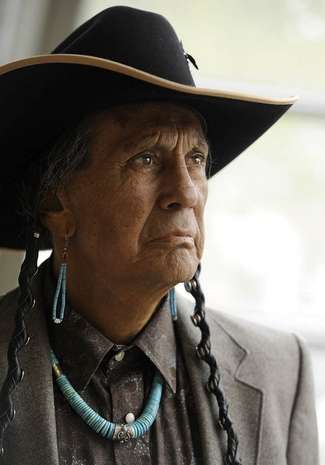
Here are some links to articles on, and photos of, the 44th Annual Dakota Conference that was held this weekend at Augustana College.  The theme was Wounded Knee 1973.  Unsurprisingly, Russell Means’ comments and keynote address got the most coverage.  The highlight for me was a panel on Native Women’s role in Wounded Knee, which included presentations by Professor Elizabeth Castle, Marcella Gilbert, and Danyelle Means.  I also really enoyed a talk by Professor Emerita Elizabeth Cook-Lynn and a talk and poetry reading by Allison Hedge Coke and Renee Sans Souci.  Finally, a panel discussion by Dennis Banks, Clyde Bellecourt, and Senator James Abourezk was very illuminating, as was a talk by journalist Kevin McKiernan, who covered the occupation from the inside for NPR. 

Articles

http://www.argusleader.com/apps/pbcs.dll/article?AID=2012304280008

http://www.argusleader.com/viewart/20120429/NEWS/304290038/Means-lashes-out-during-look-back-AIM

http://www.argusleader.com/apps/pbcs.dll/article?AID=2012304280010

Photos
http://www.argusleader.com/apps/pbcs.dll/gallery?Site=df&Date=20120427&Category=news&ArtNo=204270804&Ref=ph&Item=0&odyssey=mod|mostpopphotos

Image


Thelda Perdue to Lecture on Indian Lands and the SCT at the Supreme Court Historical Society

Here.

Details from the site:

November 14, 2012 | 6:00 PM
The History of Native American Lands
and the Supreme Court
Professor Theda Perdue
University of North Carolina, Chapel Hill

Kirsten Carlson on “Priceless Property” (Black Hills)

Kirsten Matoy Carlson has posted “Priceless Property,” forthcoming from the Georgia State University Law Review, on SSRN. Highly recommended!

Here is the abstract:

In 2011, the poorest Indians in the United States refused to accept over $1 billion dollars from the United States government. They reiterated their long held belief that money – even $1.3 billion dollars – could not compensate them for the taking of their beloved Black Hills. A closer look at the formation of the Sioux claim to the Black Hills helps us to understand why the Sioux Nation has repeatedly rejected over $1 billion dollars in compensation for land taken by the United States over 100 years ago. This article seeks to understand why the Sioux view the Black Hills as priceless by studying the formation of the Black Hills claim. It constructs a new, richer approach to understanding dispute formation by combining narrative analysis with the sociolegal framework for explaining dispute formation. The article argues that narratives enrich the naming, claiming, and blaming stages of dispute creation and illustrates the usefulness of this new approach through a case study of the Black Hills claim. It uses the autobiographical work of an ordinary Sioux woman to provide a narrative lens to the creation of the Sioux claim to the Black Hills. American Indian Stories by Zitkala-Sa presents a narrative of Sioux life around the time of the claims emergence. By contextualizing and humanizing the claim, my analysis provides insights into why the Sioux claim to the Black Hills emerged into a legal dispute and helps to explain why the Black Hills remain priceless property to the Sioux Nation today.

44th Annual Dakota Conference Happening April 27 & 28

The theme is Wounded Knee 1973: 40 years later. The conference will be April 27-28 and is a project of the Center for Western Studies at Augustana College in Sioux Falls, SD. The program is here. Here’s the link for registration.