Here is the unpublished opinion in In re Whisler.
Another Conditional Affirmance in an ICWA Case in Michigan
Here is the unpublished opinion in In re Whisler.
Here is the unpublished opinion in In re Whisler.
From Lansing City Pulse:
By any measure the career of John D. Voelker was a phenomenal success. He was a successful author, having written the bestseller “Anatomy of a Murder” (later made into a movie directed by Otto Preminger and starring James Stewart, Lee Remick and George C. Scott) and he was a member of the Michigan Supreme Court. But something was gnawing at him.
As a younger man, he had heard a story about an Indian woman who had, against all odds, taken on the white power structure of the Upper Peninsula’s mining industry while seeking what she thought was compensation owed to her family.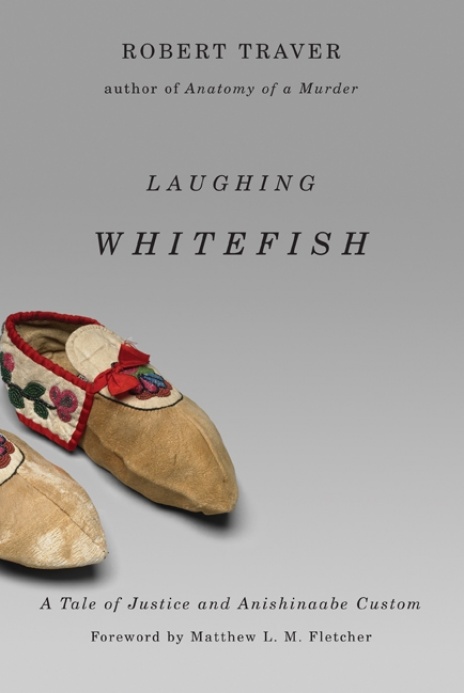
Voelker had always wanted to do a fictional treatment of this real-life case, but the success of “Anatomy” and his job as a justice had kept him too busy.
In an address to the Michigan Historical Society in 1970 he said his “neglected Indian story receded even further into the background.”
In a brash move, Voelker decided he was fed up and had enough of the “baying dogs of success” — he quit his job.
In his letter of resignation to Gov. G. Mennen Williams he wrote, “While other men can write my legal opinions (although I would debate that) they can scarcely write my books. I am sorry.”
Voelker, who wrote under the pen name Robert Traver, retreated to the Upper Peninsula, where he would spend two winters writing his Indian story. “Laughing Whitefish” was published in 1965, but soon went out of print.
Now, Michigan State University, working with the Voelker family, has reprinted the book with an introduction written by MSU College of Law Professor Matthew Fletcher, who heads the Indigenous Law and Policy Center.
In describing his book, Voelker always said it was “a basic story … rather simple” and “it was about iron ore, Indians and the infidelity to one’s own promises.”
The book tells the story of a young Indian woman, Charlotte Kawbawgam (her real name was Kobogum), who seeks compensation for her father. He had been promised a “wee fractional interest” after leading a group of mining executives to the world’s largest deposit of iron ore. Kawbawgam hires lawyer Willy Post, a newcomer to Marquette.
Here is the news coverage from Sault Evening News.
Here:
The petition of the day is:
Michigan v. U.S. Army Corps of Engineers
Docket: 11-541
Issue(s): (1) Whether a request for multiple types of preliminary injunctive relief requires a balancing of harms with respect to each form of relief requested; and (2) whether a party’s statement that it is “considering” implementing the relief requested in a motion for injunction is a ground for denying the injunction.Certiorari stage documents:
Here is the news coverage. An excerpt:
A deeply divided Saginaw Chippewa Tribal Council has voted to change the requirements to become a member of the Tribe.
In a 6 to 5 vote, the council voted to tighten the source of the Indian blood quantum requirement for members.
The Tribe’s constitution, adopted in 1986, requires that members be descended from a person on one of three lists compiled in the 19th century, or from a Tribal base role compiled in 1982, plus be at least one-quarter “Indian blood.”
The constitution does not, however, define what is meant by Indian blood.
Early version of the Tribe’s enrollment ordinance also left it largely undefined, and it was interpreted to mean descent from most North American indigenous people. The council then tightened that to define it as descent from a member of any federally recognized Tribe.
The newest version, adopted at a special session of the Tribal Council Oct. 26, specifies that only “Saginaw Chippewa Indian Tribe of Michigan” blood counts toward the one-quarter Indian blood.
“Tribal Council finds that the current definition of ‘Indian blood’ provided in (the enrollment ordinance) is overly broad and inconsistent with the constitution,” said the resolution adopting the revised law. “The Tribal Council finds that blood inherited from the Saginaw Chippewa Indian Tribe of Michigan is the only blood directly relevant to membership under the constitution of the Saginaw Chippewa Indian Tribe.”
Under the old law, for example, a child born to a Saginaw Chippewa Tribal member with one-fourth Indian blood and a full-blooded member of the federally recognized Navajo Nation would qualify for membership. By most reckonings, that child would have five-eighths Indian blood quantum.
Under the new law, that child would not qualify as a Saginaw Chippewa.
Here are the materials in Saginaw Chippewa Indian Tribe v. National Labor Relations Board (E.D. Mich.):
SCIT Motion for Preliminary Injunction
TT’s own Andrew Adams is co-counsel on this one.
Here:
Asian Carp Cert Pet_10 26 2011
Questions presented:
This multi-sovereign dispute involves the imminent invasion of Asian carp into the Great Lakes ecosystem. Although the Seventh Circuit Court of Appeals concluded that catastrophic harm has a “good” or “perhaps even a substantial” likelihood of occurring, Pet. App. 4a–5a, it affirmed the district court’s denial of even the plaintiffs’ most modest requests for injunctive relief. The Seventh Circuit’s opinion raises two questions for this Court’s review:
1. Whether a request for multiple types of preliminary-injunctive relief requires a balancing of harms with respect to each form of relief requested.
2. Whether a party’s statement that it is “considering” implementing the relief requested in a motion for injunction is a ground for denying the injunction.
Seventh Circuit decision here.
Here is the news coverage. An excerpt:
Lansing Mayor Virg Bernero said a casino in Lansing would have a “tremendous positive impact,” but some experts disagree.
On Friday, following reports that his administration is negotiating for a casino, Bernero issued a written statement saying his “administration strongly supports the concept of a casino in Lansing because it would have a tremendous positive impact on our local economy.”
But Matthew Fletcher, MSU professor of law and director of the indigenous law and policy center said building a casino in Lansing would siphon wealth from other communities rather than create new wealth.
“Michigan Indian gaming is what I would call zero-sum, it’s grown as much as it can,” Fletcher said. “If a casino generates let’s say $100 million, almost all of that is going to come from other communities.”
Fletcher said the Indian gaming industry leveled off about 10 years ago at the $10 billion mark. Even the three non-Indian casinos in Detroit started siphoning money from the Indian casinos. [MF edit: this supposed to be $1 billion, and limited to Michigan, but no biggie]
“There certainly will be positive economic impacts (for Lansing), there will be some growth,” Fletcher said. “The significance of it isn’t going to be a whole lot.”
And the radio show, on the MSU radio station (89 FM):
Ted O’Dell of the Lansing Jobs Coalition, tribal spokesman James Nye and MSU professor Matthew Fletcher discuss Indian casinos. Katherine Draper and Bruce Witwer of the Greater Lansing Housing Coalition speak about the Homeowner Education Resource Organization program. MSU theater senior Dennis Corsi previews his new theater company’s first production, “Bare,” which opens this weekend.
 Turtle Talk
You must be logged in to post a comment.