Here is the news coverage. Thanks to A.K.
And here is the Freep coverage, thanks to B.C.
Here is the news coverage. Thanks to A.K.
And here is the Freep coverage, thanks to B.C.
Here (and an article discussing Idaho’s proposed legislation is here, thanks to A.K.).
An excerpt:
When 750 Nez Perce, accompanied by 1,000 horses, fled the U.S. Cavalry on a 1,200-mile route through the mountains, valleys and rivers of Washington, Idaho and Montana in 1877, their path took them past the Heart of the Monster, from whence the Nez Perce, or Nimiipuu people, originated, and through their precious Bitterroot Mountains. Their route was treacherous but their determination to survive was unshakable.
Some 140 years later, the black heart of industrial society has come to torment the Nimiipuu, using that same route.
ExxonMobil and some other large oil-traffickers want to run massive trucks and machinery (imagine the Statue of Liberty on its side, with wheels) through Washington, Idaho and Montana, headed for the Athabasca tar sands in Alberta, Canada. Those gigantic specialized trucks will carry monstrous pieces of mining equipment imported from Korea up to the site of a massive project in Alberta, where oil is being extracted from a mammoth pit by blasting saturated sand with steam. It is already the largest and most destructive industrial project in history, and those trucks could be shuttling supplies up there for the next 50 years. No trucks have made the entire run to Alberta thus far, but ExxonMobil hopes to get the green light for the Heavy Haul soon.
Here.
An excerpt:
The director of the state Office of Indian Affairs was fired last month for being “insubordinate” and failing to meet expectations, Gov. Gary Herbert said Thursday, the first time the governor has publicly given a reason for the sudden termination.
Tribal leaders were frustrated at the governor’s explanation for firing Forrest Cuch during a Wednesday luncheon. At the afternoon meeting of the Utah Tribal Leaders Council, they drafted a resolution stating that the dismissal “demonstrates a manifest disregard and disrespect for the inherent sovereign authority of Native America Tribes,” and demanded an apology from the governor.
“There is no need to apologize,” Herbert said during his monthly KUED news conference Thursday. “Mr. Cuch knew what the expectations were and he did not reach them.”
Here is the press release:
The Tribal Council of the Saginaw Chippewa Indian Tribe has taken a firm position against the Bay Mills attempt to push their way into Vanderbilt MI with class three gaming. “We have a long history of supporting the intent of the Indian Gaming Regulatory Act in honoring “On Reservation” gaming provisions within that act” stated Tribal Chief Dennis V. Kequom Sr. For many years the Saginaw Chippewa Indian Tribe has teamed with others who are like minded on the issue of off reservation gaming.
The Saginaw Chippewa Indian Tribe is committed to educate the public and elected officials of the negative implications to “Off reservation” gaming. If Bay Mills is allowed to conduct “Off Reservation” gaming it would open the flood gates to unlimited casino development saturating an already stressed market. The Federal Government rejects casino compacts unless a tribe has trust land. Vanderbilt is not in trust according to the Department of the Interior. The Tribe will continue to closely monitor Bay Mills activities and continue with its efforts to inform the public at large about the negative implications of the Bay Mills Indian community and their efforts elsewhere in the State.
From the Freep (article here):
** UPDATE — March 22 — ** The writer of the article has released an apology. It can be found on the first two pages of Issue “68-08,” along with a message from the editor and several letters to the editor concerning the article. Here’s a link to the online copy.
The student newspaper, “Union Weekly” at Cal State Long Beach, published an article last week concerning a powwow which took place on campus. It really speaks for itself.
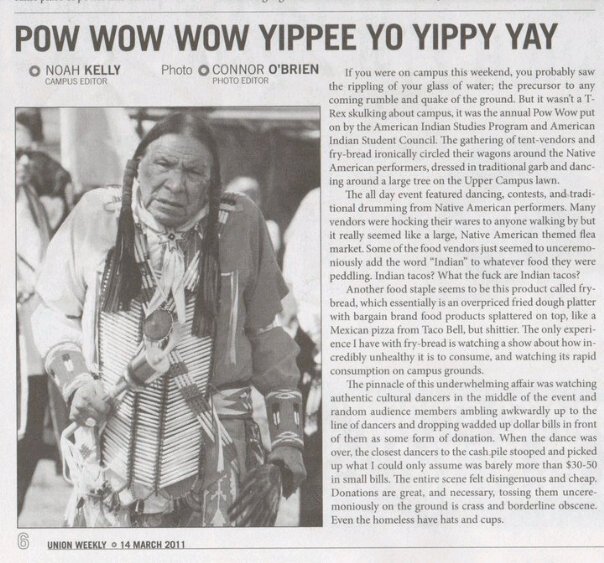
Here’s a link to the newspaper’s Facebook page.
Edited to Add: The WSJ is not the only publication in fits about modern Native art on display. The NYT review of the Brooklyn Museum’s display is equally muddled. It’d be nice if the art reviews were of the art, rather than criticizing it for not being old:
Also in this section is a blue-and-white carved wood piece called “Horse Head Effigy Stick,” by Butch Thunder Hawk, of the Hunkpapa Lakota. A casual viewer might mistake it for a war club, with a horse-head-shaped business end, used in the 19th century when intertribal warfare was a way of life. It turns out that it was made in 1998, which, if you think about it, raises puzzling — but here unanswered — questions. What is the relationship of this rather slick modern object to the historic artifacts? And what about the buffalo-horn ladle with a glossy cube pattern imitating the 20th-century Dutch illusionist M. C. Escher that Kevin Pourier, a member of the Oglala Lakota, created in 2009?
The display suggests that there is no important difference between the old and the new. But how can that be so? The Plains Indian culture that gave rise to these kinds of objects was practically destroyed by the United States government’s campaign to clear land for settlement by white people over a century ago.
Wouldn’t one relationship between the old and the new be to demonstrate that the culture was not actually destroyed by the United States government, hard as it might have tried?
The Wall Street Journal published an article about museum displays of Native art and artifacts today. It is accessible here. The article is odd, with a title (“Shows That Defy Stereotypes”) indicating the article might be positive, but is instead full of sideways insults. For example, the author writes about the Denver Art Museum’s attempt to include contemporary Native art in its installation, and a display of two different shirts:
One of Denver’s great masterpieces is a 1720s Eastern Sioux deerskin shirt embellished with painted abstract designs, possibly representing birds. The curators invite its comparison to a nearby 2010 fringed “war shirt” commissioned from Bently Spang, the suddenly ubiquitous Northern Cheyenne artist whose designs, which are meant to be seen, not worn, are also on view in Manhattan and Brooklyn.
The author does not seem to think the more contemporary shirt is at the same level as the old shirt, nor am I sure why she describes the artist who made it as “suddenly ubiquitous,” but the tone indicates the author doesn’t think he ought to be.
The National Center of American Indian Enterprise Development will be honoring Swinomish Chairman Brian Cladoobsy with its American Indian Tribal Leadership Award at its annual economic summit and trade fair in Las Vegas. Others honored include David Melton, Clara Pratte, Kurt Luger, U.S. Senator Max Baucus, Kathy Meyer, Karen Jensen, and several entities. The summit and trade fair takes place today through March 17. More information is here.
Thanks to M.O. for pointing this out.
From the ABAJ:
One of the notable trends in the legal ethics field over the past several years has been a gradual movement toward more uniformity in the substance and application of professional conduct rules.
There is little, if any, expectation that the states will fall into complete lockstep on how they apply ethics principles for lawyers and judges, or how they structure their disciplinary systems. But the ABA’s Model Rules of Professional Conduct and Model Code of Judicial Conduct have served as starting points for efforts to bring more uniformity to the field. The Model Rules, for instance, have been adopted in some form by every state except California.
But in Indian country — the lands occupied by more than 600 tribes recognized by the U.S. government as sovereign entities — that trend hasn’t caught on. And experts say it is unlikely that there will be much uniformity any time soon in the way that tribal courts address ethics and discipline issues for lawyers and judges.
“Tribes are all over the place on this,” says B.J. Jones, director of the Tribal Judicial Institute in the Northern Plains Indian Law Center at the University of North Dakota in Grand Forks. “A lot of them do use the ABA Model Rules,” says Jones, who serves as chief judge for the Sisseton-Wahpeton Oyate and chief justice for the Turtle Mountain Band of Chippewa Indians, and is admitted to practice in a number of tribal courts. But, he says, “It’s hard to gauge what the most prevailing form of discipline is.”
The somewhat random pattern of ethics rules for lawyers and judges in Indian country reflects the nature of general rules and procedures in tribal courts, says W. Gregory Guedel, who chairs the Native American Concerns Committee in the ABA Section of Individual Rights and Responsibilities, and other practitioners in the field.
“The thing that makes it both interesting, complex and a little maddening at times is that every tribe’s system is different,” says Guedel, chairs the Native American Legal Services Group at Foster Pepper in Seattle. “Some tribes have extremely well-developed legal codes and court procedures that are as intricate and broad as any non-tribal system. Other jurisdictions have just adopted the federal code or whatever is available because they won’t have the resources.”
Tribal jurisdictions vary greatly, says Paul Stenzel, an attorney in Shorewood, Wis., outside Milwaukee, who represents a number of tribes. “Some are handling a complete range of topics and cases that you would see in a state court, almost, with the exception of major felonies,” he says. “Smaller ones are doing very narrow dockets, maybe only hunting and fishing violations, maybe only adoptions or family law. And there’s everything in between.”
Increasingly, there are good reasons for tribal courts to firm up conduct codes for lawyers and judges, and to identify ethics issues on which a more uniform approach might be beneficial.
Some of that impetus should come from passage of the Tribal Law and Order Act of 2010 (PDF), which President Barack Obama signed into law on July 29. The act gives tribal courts and police more authority to deal with crimes committed in Indian country, and promises more federal money to help bolster tribal justice systems.
“The act gave a lot of people the thought that, ‘Let’s not stop there. Let’s continue and see what else we need to do,’ ” says Guedel. “There’s a lot of discussion in general about it.”
Economic considerations are another reason for tribal courts to take a harder look at their ethics rules for lawyers and judges. As some tribes have gained wealth — often in the form of casino revenue — their financial operations have become more complex and their commercial dealings with outside entities have grown.
“Private businesses are very afraid of the notion of a tribal court,” Guedel says. “Tribes have recognized that impression and have been trying to say, ‘This is a legitimate system. This is not just a kangaroo court.’ The adoption of the model codes in wide usage, which people understand inside and outside the tribal context, would be helpful in that regard. You would have a level playing field. A business that’s considering doing business with a particular tribe would say, ‘At least we’ve got an understandable way to resolve our differences.’ ”
Excerpts from The Oklahoman:
Three weeks ago, President Obama nominated Arvo Mikkanen for the position of U.S. district judge for the Northern District of Oklahoma. He is an extraordinarily qualified candidate. That is why I was disappointed to read that our two senators have announced their opposition to the nomination and are now asking that it be withdrawn. I was stunned to learn that our senators made these pronouncements before the paperwork detailing Arvo’s stellar 25-year legal career and service to the United States had been delivered to the Senate Judiciary Committee.
I am not a politician. I am a courtroom lawyer. I have tried many civil and criminal cases, including the prosecution of Timothy McVeigh and Terry Nichols. I may not fully understand the confirmation process and I am aware the senators maintain that the White House failed to follow some Washington customs. However, any system that fails to confirm Arvo Mikkanen’s nomination is a broken system.
Rarely have I seen a nominee of his equal in my 42-year career. I know his intellect, work ethic and attitude from my service with him as U.S. attorney.
Arvo graduated from Dartmouth College and Yale Law School. He was a law clerk for federal judges in Washington, D.C., and Texas. Thereafter, Arvo worked at Andrews Davis, one of the most prestigious law firms in Oklahoma, for about six years. While there, he worked as a civil trial lawyer in a wide variety of business law matters.
As an assistant U.S. attorney, Arvo has worked both in the criminal and civil divisions. He was and still is one of the most versatile attorneys in the office and is respected by his colleagues and judges alike. He frequently advises other Justice Department offices and federal, state and local law enforcement agencies, and has received praise from prosecutors from both political parties from across the country.
 Turtle Talk
You must be logged in to post a comment.