Environmental law and policy in the United States has historically ignored Native Nations as stakeholders or rights holders, thereby sidelining those Nations and forcing them to function as protestors rather than participants. This is a foundational error that tarnishes the otherwise well-intended policy underlying environmental protection of any sort. Both the international community and international rights associated with climate change must avoid these early missteps. There are additional benefits to treating Indigenous peoples as more than simply interest groups. In so many ways, Indigenous peoples represent the drivers and implementers of policy and contribute invaluable traditional ecological knowledge in understanding the interdependency and interconnectedness of the environment and communities. Across the globe, Indigenous peoples are on the front lines suffering from the effects of climate change, and they should have the opportunity to take a leading role in developing and protecting the newly identified U.N. Right to a Healthy Environment.
Native Hawaiians have been skeptical of corporate landowners’ alleged concerns over disaster preparedness and characterization of traditional water rights. They blame the prioritization of corporate water interests, the privatization of water, and the harms of colonialism for the severity of the fires. And they worry that Lahaina’s destruction could be used to furtively pass “unpopular laws and policies” that prioritize commercial uses and exacerbate political inequality. As Chandler-‘Īao’s box of water-permit applications illustrates, the Maui fires represent an inflection point for Hawaiian water law. But we did not arrive at this point overnight. Rather, the fires were the byproduct of a century of colonialism that imposed a resource-management regime that razed the environment and externalized its harms on kānaka maoli. Because of this legacy, Maui was “a ticking time bomb” for wildfires. When it is remembered that the ancient Hawaiian system of watershed management was sustainable before it was ravaged by colonialism, Maui’s current state is even more heart wrenching.
Elena A. Baylis has posted “Looted Cultural Objects,” forthcoming in the Columbia Law Review Forum, on SSRN. Here is the abstract:
In the United States, Europe, and elsewhere, museums are in possession of cultural objects that were unethically taken from their countries and communities of origin under the auspices of colonialism. For many years, the art world considered such holdings unexceptional. Now, a longstanding movement to decolonize museums is gaining momentum, and some museums are reconsidering their collections. Presently, whether to return such looted foreign cultural objects is typically a voluntary choice for individual museums to make, not a legal obligation. Modern treaties and statutes protecting cultural property apply only prospectively, to items stolen or illegally exported after their effective dates. But while the United States does not have a law concerning looted foreign cultural objects, it does have a statute governing the repatriation of Native American cultural items and human remains. The Native American Graves Protection and Restoration Act requires museums to return designated Native American cultural objects to their communities – even if they were obtained before the law went into effect. This statute offers a valuable model for repatriating foreign cultural objects that were taken from formerly colonized peoples.
The Supreme Court recently applied the narrow and relatively new anticommandeering doctrine for the first time to federal Indian Affairs legislation in Halaand v. Brackeen without explaining why the doctrine should be extended from the Interstate Commerce Clause context to that of the Indian Commerce Clause, as well as to the other congressional powers that form the basis of the Indian Child Welfare Act (ICWA). In subsequent cases relating to Indian Affairs legislation, the Court should clarify that only a very narrow version of the anticommandeering doctrine applies in this context because of the virtual absence of state authority in the area and the history of acceptance of federal activities that can be described as commandeering state enforcement activities. Existing literature in this area is limited, with Matthew Fletcher and Randall Khalil having argued, before Brackeen was issued, that ICWA should be interpreted as having been enacted under Section 5 of the Fourteenth Amendment, an invitation that the Court ultimately did not take up. This Essay, The Diminished Significance of the Anticommandeering Doctrine in the Context of Indian Affairs Legislation, is important because it explains holes in the Court’s reasoning in Brackeen and because it safeguards Congress’s ability to protect Native Americans and Tribes from longstanding abusive state practices such as the unwarranted removal of Indian children from their homes.
There are 574 federally recognized domestic dependent tribal nations in the United States. Each tribe is separate from its respective surrounding state(s) and governs itself. And yet, none of them have the power to send representatives to Congress. Our democratic representative structures function as if tribal governments and the reservations they govern do not exist. But tribal citizens do not simply live within a state and are not simply governed by that state like any other state citizen. Rather, it is tribal law and tribal governments—not state law or state governments—that primarily govern and shape the lives of tribal citizens living on reservations. Tribal governments are not complementary or subsidiary to state governments—they are frequent rivals for power and resources. This system, simply put, doesn’t make sense. Tribes should have their own representation in the federal government. This Article makes the case for why and examines how this seemingly obvious omission in our democratic structuring came to pass.
This Article examines the democratic mismatch between existing governments—which include not only 50 states, but also 574 federally recognized tribes—and the representative democratic structure that is built into the Constitution around the institution of the state. It details the failed attempts of tribal governments to obtain representation, either as states or outside of statehood. This history reveals a story about race, power, colonialism, and institutions. Attempts by white majorities to hold onto political power within states included denying Native peoples’ individual rights and denying statehood to largely Native areas until Native people assimilated or white citizens outnumbered them.
These dynamics, which this Article dubs “assimilative colonialism,” have not only shaped our existing democratic structures but have also had a lasting effect on Native relationships with political power. The nefarious brilliance of assimilative colonialism was to offer American political power to Native peoples—whether citizenship, statehood, or delegates—only and always at the cost of what made them Native. As a result, many Native people justifiably view American political power not as empowering but as dangerous. Assimilative colonialism has thus held back the emergence of Native movements for political reform by making it impossible to even imagine tribal representation in a real sense since it seemed only possible through assimilation.
It is long overdue that we step back and examine the legacy of assimilative colonialism in American representative democracy. We ought to think about structural reform and what representative structures could—and maybe should—have been on the table for tribal governments and their citizens since the beginning. We ought to be asking: What would American democratic structures look like if we truly incorporated tribal governments as equal sovereigns within the United States?
In the past two decades, many American Indian Tribes have been experimenting with generating power from renewable sources on reservations. The growth of tribal green energy is a positive step towards energy justice, but current projects are hampered by insufficient funding, jurisdictional confusion, lack of needed infrastructure, and a baroque permitting process that leaves necessary projects languishing. The recent omnibus spending bill, the Inflation Reduction Act (IRA) was trumped by Congress as the largest investment into tribal green energy ever. This Article critically analyzes the impact of the IRA on tribal energy. While the IRA represents a necessary move towards a more effective funding structure for tribal energy projects, it failed to address other barriers to tribal green energy development. The Article concludes by proposing steps Congress, States, and Tribes can take to improve upon the IRA.
This Essay examines USDA programs supported by the Inflation Reduction Act and its approach towards addressing climate change and historical funding inequities for Indigenous and Black Farmers. It also argues for how the next Farm Bill can expand upon these efforts to further address inequities and promote climate resilience.
Unlike the first three articles of the Constitution which create the three branches of the federal government, Article IV establishes a set of rules to police the actions of states and knit them together into a single union. Notably absent from Article IV is any mention of the tribal sovereign. Concomitantly, there has been no comprehensive academic discussion thinking about how the tribal sovereign complicates the purposes of Article IV. This piece advances a completely new understanding of Article IV and its implications in federal Indian law. It suggests that where Article IV advances rights to individual citizens (i.e. a citizen’s right to enforce a court judgment or their claim to the protection of the Privileges and Immunities Clause) then states may not use their connection to any tribal sovereign as an excise to deny them the protections of those rights. In contrast, where Articles IV speaks to rules designed to ensure states treat each other respectfully (i.e. requests for extradition, claims under the Equal Footing Doctrine, or any attempt to enforce the Guarantee Clause) then Article IV’s rules do not permit states to abridge, abrogate, modify, or erode the inherent rights of tribal nations. As the Court has recently opined, tribal governments themselves were absent from the Constitutional Convention and so constitutional limitations on the inherent powers of sovereigns do not extend to tribal governments.
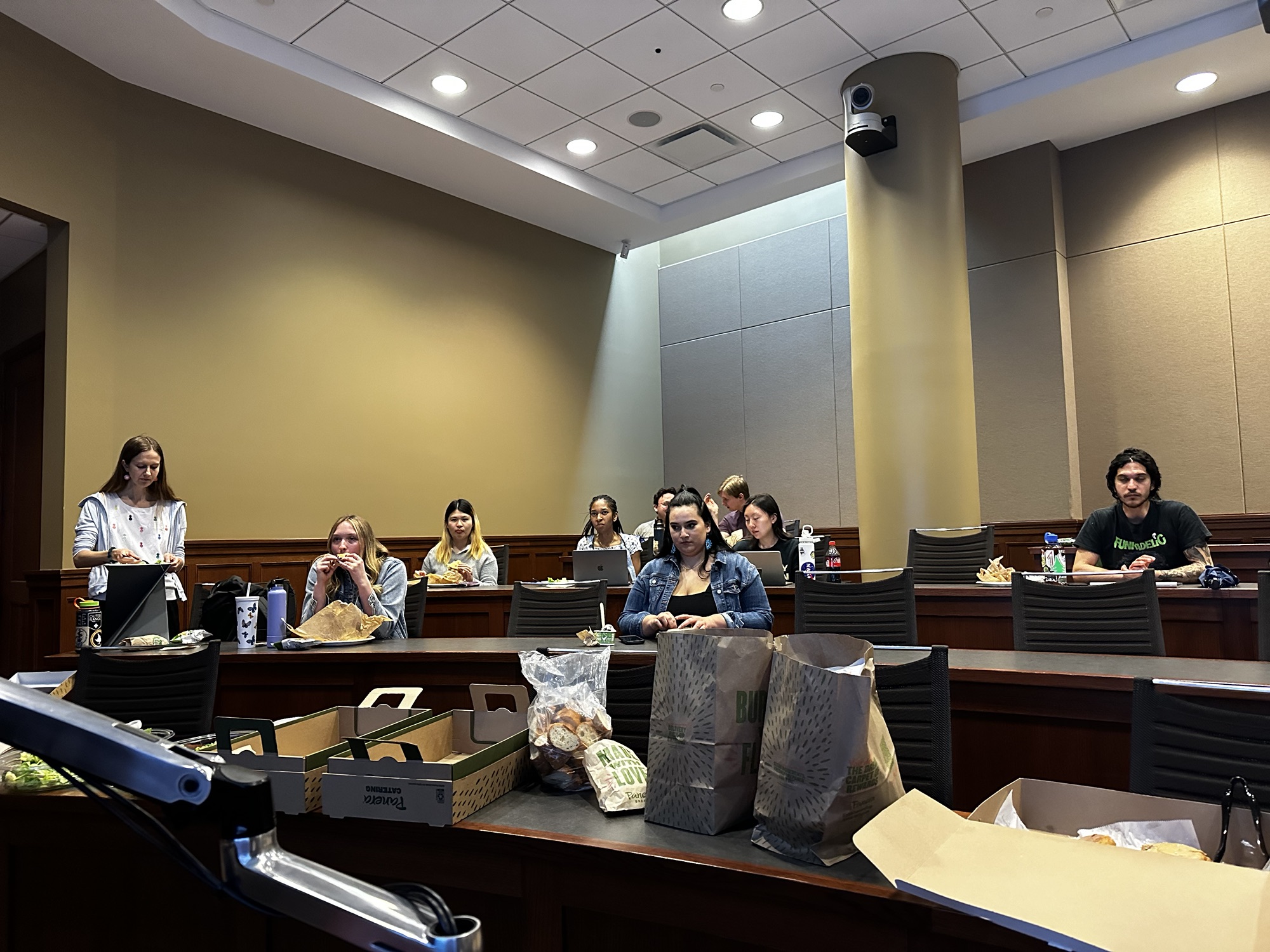
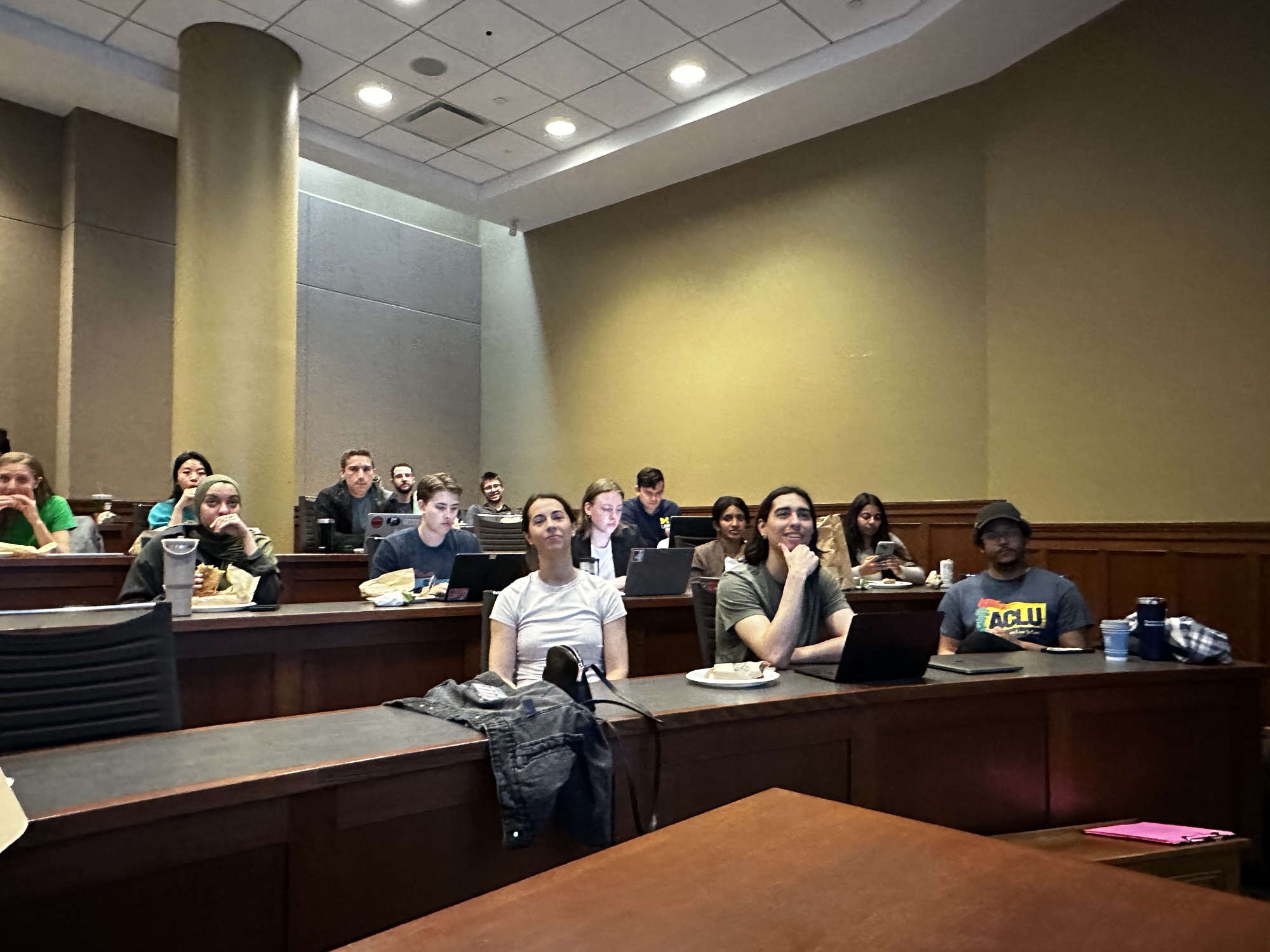
Today, Katherine Johnson and Jalen Rose (of MJLR) and Caleb Hawpetoss (UM NALSA) convened a panel discussion about two Indianlaw articles recently published by the Journal. I brought donuts.
Alexis Studler (+Fletcher obnoxiously inserting self)Alexandra Fay (more MF, too, still in the way)Kaighn Smith (+MF yet again)







 Turtle Talk
You must be logged in to post a comment.