Turtle Talk Poll/Survey: What Should Indian Law Students Be Researching and Writing About? (Now with Results)

Please see below for the write-in answers. Keeping it open but this is probably the end of the meat of the polling.

Every year, American Indian law profs are asked by law students to advise on law school paper topics or law journal note topics. Law profs are well suited to advising students on putting together papers of publishable quality, and perhaps even getting them published. Many people don’t know it, but law students often write about the cutting edge issues long before law profs do.

I am of the view that Indian law practitioners are the people law students should be asking — they’re the ones in the field. A lot of law profs serve as tribal court judges, so we see snippets of the action on the ground but we tend to recommend that a law student write another case note or a case-cruncher. The people who work in-house for tribal governments, federal and state government attorneys, and outside counsel know what the kind of scholarship is actually useful in Indian affairs.

If you think of something else, add it, or post a comment, or both.

Of course, the information could be valuable to law profs as well.

UPDATE (9:17 AM Eastern, Oct. 17, 2014):

The wordpress poll doesn’t work all that well. “Other” answers already include the following:

outer space law and colonization 2
Application of federal laws 1
tribal citizenship/disenrollment remedies 1
land into trust 1
educational effect of the misuse of tribal imagery in elementary/high school. 1
General corporate and business law 1
Tribal Gaming/IGRA 1
indian education–history of related laws 1
Economic Bias in Tribal Law Academic Scholarship 1
tribal criminal jd (including right to counsel, lack of, habeas, etc) 1
Tribal preference and Peabody Coal 1
voting rights, particularly real evidence of barriers 1
Tribal health care programs 1
historical conventions 1
Shared jurisdiction within the boundaries 1
USDA RD Housing administered by TDHEs 1
All of the above! 1
intra-tribal disputes 1
all topics 1
Peacemaking courts becoming mainstream! 1
Native Veterans Tax issue 1
Public Domain Indian allotments-jurisdiction 1
State – Tribal Tax Issues 1
financial regulatory structure of tribal governments and enterprises 1
Alaska trust lands/criminal jdx 1
nagpra 1
BLM oversight of tribal lands and mischaracterization as public lands 1
$99 Million in Attorney Fees for Harper & Gingold 1
Indian water negotiations and settlements 1
environmental law 1
Indian Civil Rights violations 1
Practical effect of cross-deputization of tribal law enforcement 1
tribal election disputes 1
reciprocal domestication of tribal court orders 1
2014 Farm Bill and Tribal Food Sovereignty 1

Sarah Krakoff on the Neurotic Structure of American Indian Law

Sarah Krakoff has published “Law, Violence, and the Neurotic Structure of American Indian Law” in the Wake Forest Law Review (PDF).

An excerpt:

What I want to explore in this Essay is whether there is something about the persistence of American Indian communities and their ability to make their own laws and meanings—their ability to be “jurisgenerative” in the way that only local communities can, according to Cover—that nags at the federal judiciary, that taunts them to try repeatedly to cabin this ungovernable “other.” After more than two and a half centuries of legal (and legalized) violence, American Indian tribes still persist, and they do so in a way that protects an ineffable and unconquerable indigeneity. I wonder whether the disproportionate number of federal judicial decisions (and in particular Supreme Court decisions) devoted to defining, diminishing, cabining, and parsing tribes and their rights and powers is as much a reflection of law’s impotence (the limits of its violence) to erase tribes as it is of its power to destroy. Does judicial anxiety about these limits drive the Court to try, over and over, to extend its interpretive stance into communities decidedly unlikely to act in concert with the Court’s commands? This Essay will probe that question.

Kate Fort on Observing ICWA Cases in State Courts

Our own Kate Fort has posted her paper, “Observing Change: The Indian Child Welfare Act and State Courts,” published in the New York State Bar Association Family Law Review earlier this year. It is available on SSRN.

Here is her abstract:

ICWA is one of the foundational laws of federal Indian law, but it usually arises in the broader public consciousness when there is a voluntary adoption subject to the law. Recently, the law was subject to Supreme Court review in Adoptive Couple v. Baby Girl. A heart-wrenching case, but ICWA is far more regularly applied in abuse and neglect cases. Any involuntary removal of an American Indian child, as defined by the Act, requires the application of ICWA. While cases of voluntary adoptions designed to thwart the requirements of ICWA require constant vigilance from states and tribes, the law provides broader protections for those families in the state child welfare system.

This article posits one way to both collect data about abuse and neglect compliance within the framework of ICWA, and increase that compliance through collaborative change to the systems. QUICWA, a project by the Minneapolis American Indian Center, consists of a group of interested stakeholders who have created a checklist to measure what happens in each individual hearing where the court must apply ICWA. While other groups, such as the National Council of Juvenile and Family Court Judges, use a different checklist format, the goal of the projects are similar — to find ways to increase compliance with ICWA. Funded in collaboration with Casey Family Programs, law schools and social work programs in key states have started observing ICWA hearings using the QUICWA checklist. In Michigan, the Michigan State University College of Law has observed ICWA hearings in three counties, using law students as observers. Though family law is driven by narrative, collecting data is vital to identify patterns surrounding fairness and due process in the individual stories.

Wenona Singel’s “The First Federalists”

Wenona Singel has published “The First Federalists” in the Drake Law Review.

Here is the abstract:

One aspect of federalism’s values that scholars and the courts have largely ignored is their relevance to tribal governance. As sovereigns within the United States that govern with a measure of de jure autonomy, Indian tribes are important agents of self-rule within the United States’ federal system. The tribal exercise of sovereignty, while not part of the constitutional design of federalism in the United States, is nevertheless an example of the principles of federalism in operation.

However, Indian tribes do not receive any accommodation on account of their ability to promote the values of federalism. On the contrary, in dicta that often overshadow the judiciary’s formalist doctrinal analyses, courts regularly portray tribal governance as dangerously foreign, destabilizing, and undemocratic. From a federalism standpoint, this criticism is perplexing because diversity, pluralism, innovation, and experimentation are core values that our judiciary and legal profession expressly endorse. The judiciary’s dismissive characterization of tribal governance and its segregation of tribes from discussions of federalism’s values are also striking, given that federalism existed within tribal governing structures long before it was adopted within the U.S. Constitution. Tribes are the nation’s first federalists, and they continue to engage in federalism as members of the U.S. federal system.

By focusing on the intersection of tribal governance, federalism’s values, and the judiciary’s role in determining the proper allocation of federal, state, and tribal authority, this Article reveals that federalism is not a neutral norm that is equally applied to subnational sovereigns who engage in the act of governance. Despite federalism’s theoretical support of diversity, pluralism, innovation, and experimentation, in reality, federalism is applied within a bounded and highly policed realm. For those sovereigns within federalism’s protected space, diversity and innovation are theoretically promoted. For those sovereigns who exhibit federalism yet who are not part of federalism’s constitutional design, governance reflecting authentic cultural diversity is confined and limited to an increasingly narrow sphere. This Article discusses this dynamic and calls for an engagement of federalism’s values in judicial review of tribal jurisdictional disputes. This recommendation, if followed, will serve the nation and tribal communities by empowering rather than thwarting the exercise of effective governance.

New Scholarship on Impacts of Excepting Alaska Natives from Federal Indian Law

Here is Samuel Gottstein’s “An Era Of Continued Neglect: Assessing the Impact of Congressional Exemptions for Alaska Natives,” published in the Boston College Law Review.

The abstract:

Although Native Americans in the contiguous United States have benefited from recent congressional reforms, Alaska Native communities were largely ignored. Despite the widely acknowledged crisis of sexual assault and domestic violence in rural Alaska Native communities, Congress has explicitly exempted Alaska from legislation that would otherwise give people in these communities the ability to protect themselves. Although public outcry has prompted pending legislation in Congress to repeal some of these exemptions, such as the Alaska Safe Families and Villages Act, even that legislation does not go far enough to achieve a permanent and effective solution to what is a life-or-death problem for many Alaska Natives. This Note argues that Congress and the State of Alaska should expand Alaska Native tribal sovereignty to give Alaska Native communities the ability to stem the tide of this epidemic.

Michigan Journal of Race & Law Reunion This FRIDAY

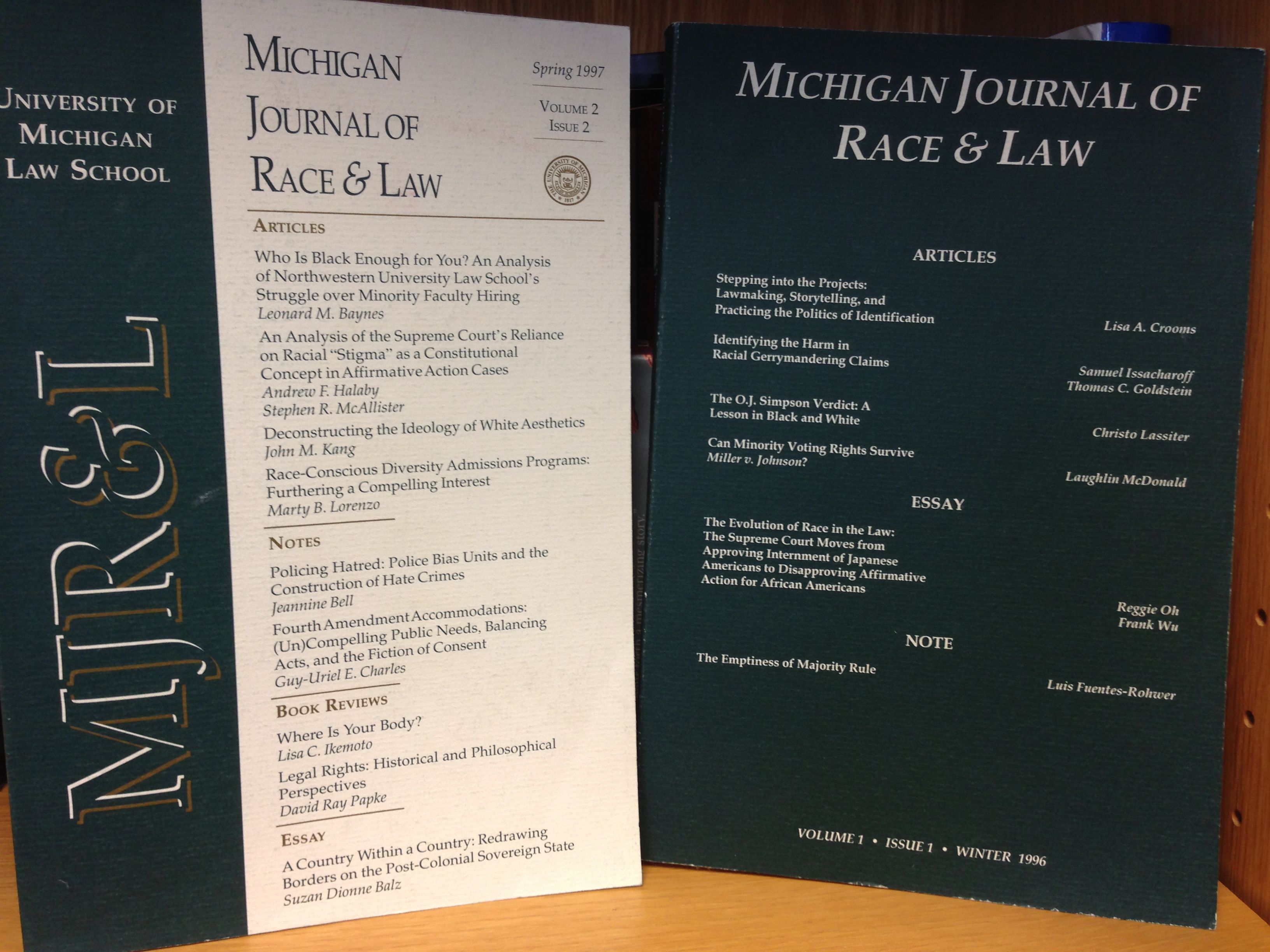
I hope to have more pics to include later in the week but here’s a taste — copies of two of the first four issues of the Journal:

MJRL

Agenda here. My panel:

Panel I: Beginnings
9:00-10:15 A.M.

Moderator: Matthew Fletcher, ’97, Professor of Law and Director if the Indigenous Law & Policy Center, Michigan State University College of Law

Todd Aagaard, ’97, Associate Professor of Law, Villanova University School of Law

Emily M.S. Houh, ’96, Gustavus Henry Wald Professor of the Law of Contracts, University of Cincinnati College of Law

Travis Richardson, ’96, Richardson & Mackoff

Hardy Vieux, ’97, Martin & Gitner PLLC

New Scholarship on “the Unparalleled Rights Enjoyed by American Indians Born in Canada to Freely Access the United States”

The Seattle Journal of Environmental Law has published “Canadian Indians, Inuit, Métis, and Métis: An Exploration of the Unparalleled Rights Enjoyed by American Indians Born in Canada to Freely Access the United States.”

Here is the abstract:

This article expands on an earlier work published in October 2013, jointly by Bender’s Immigration Bulletin and Western Washington University’s Border Policy Research Institute.

Certain American Indians born in Canada enjoy access to the United States unrestricted by the Immigration and Nationality Act, a right stemming from the Jay Treaty of 1794. An examination of this right, reflected by codification as § 289 of the INA, reveals qualifying ABCs are entitled to privileges unparalleled by all but United States citizens to enter and remain in the U.S. “for the purpose of employment, study, retirement, investing, and/or immigration” or any other reason.

Elizabeth Kronk Warner on Lessons from the Tribal Environmental Laboratory

Elizabeth Kronk Warner has posted “Justice Brandeis and Indian Country: Lessons from the Tribal Environmental Laboratory” on SSRN. Here is the abstract:

Justice Brandeis first famously wrote of a system of federalism where states would serve as laboratories of regulatory experimentation, allowing other states and the federal government to benefit from successful regulatory experiments. Although likely beyond the contemplation of Brandeis, tribes, as separate sovereigns existing within the United States, are well-placed to experiment in new and interesting ways. In particular, given their unique connection to the land and the intensified threat of some modern environmental challenges, many tribes are already engaged in regulatory innovation related to environmental law. This is the first scholarly work to fully develop the idea of tribes as “laboratories” for examining environmental law, demonstrating that tribal experimentation can generate the same benefits typically ascribed to the system of federalism. This is also the first article to examine how tribes are already innovating in areas of environmental law outside of tribal codes. The article begins with an examination of federalism and the benefits, such as states as laboratories, typically attributed to the system of federalism. Having provided an introduction, the article then explains how federalism itself is not required to achieve the benefits associated with it, arguing that tribal regulatory experimentation can yield similar results. Next, the article establishes the modern-day need for environmental regulatory experimentation given the lack of innovation occurring at the federal level. And, finally, the article takes a deep look into forms of tribal environmental law related to the regulation of environmental pollution and climate change other than code provisions. Such an examination is particularly helpful given the potential for governments to use such legal tools to fill existing regulatory gaps and the ease with which innovations in this field can be diffused amongst other governments. Having considered these other forms of tribal environmental laws, the article then develops some initial thoughts of how tribes, the states and the federal government may benefit from innovations occurring within the tribal environmental laboratory. Tribal environmental law is particularly exciting given its ability to transcend federal and state environmental law. This section of the article then ends with a call for additional tribal environmental innovation within this area. Ultimately, the article concludes that, by enacting environmental laws to meet their unique tribal needs, many tribes are creating and innovating in the field under their unique powers as separate sovereigns within the United States.

Carrie Menkel-Meadow on the Canadian Indian Residential Schools Settlement

Carrie Menkel-Meadow has posted “Unsettling the Lawyers: Other Forms of Justice in Indigenous Claims of Expropriation, Abuse, and Injustice” on SSRN. It is published in the University of Toronto Law Journal in a symposium on the Indian Residential Schools Settlement. When we have the other papers, we will post.

Here is her abstract:

This article considers, from the experience of the Indian Residential Schools Settlement, the limitations of the current formal justice system and the common ways that lawyers and parties act within it. Looking at the combinations of lawsuits, settlement negotiations, structured compensation schemes, truth and reconciliation processes, and memorial and education programs now provided for in the IRSS, the article suggests that we may need ‘process pluralism’ and different orientations to deal with modern mass harms: now recognized harms (like loss of culture, family, language, as well as physical, mental, and social injury) that the formal legal system has not yet developed the capacity to address. Placing the IRSS in a larger international context, the article suggests that some legal and social recognition of ‘new’ human harms and injuries has necessitated the development of different legal and quasi-legal processes. Whether called ‘restorative,’ ‘transitional,’ or ‘alternative’ justice, new forms of dealing with wrongs, harms, and conflicts will require redesigning legal processes and institutions; legal professional education; and social, cultural, and philosophical orientations to human injuries and ‘redress.’ Not all who are injured (both individually and in groups) want or require the same ‘remedies,’ and our conventional and historical common law and adversarial system must be adapted to the diverse needs of those who are injured by past and unconscionable wrongs, especially when inflicted by major governmental, religious, and civil society institutions and practices.

Colorado Law Symposium on Bay Mills Decision

Wenona Singel and I are delighted and honored to speak at Colorado’s symposium on Michigan v. Bay Mills Indian Community. Thanks to Rick Collins, Sarah Krakoff, Carla Fredericks, Kristen Carpenter, and the rest of the great people at CU.

In honor of the Michigan-centric character if this symposium, it snowed in Boulder.

IMG_2175.JPG

I am honored to share the stage with Kathryn Tierney, the general counsel for the Bay Mills Indian Community. She is a legend, going back to her work on the LCO treaty rights cases in Wisconsin, the LeBlanc matter in Michigan, and United States v. Michigan. Wenona and I know her from the more calmer days of negotiating the Michigan tax agreements a decade ago.

I’ll be patching together a short talk about lessons we can learn from the decision from the successful strategic moves made by Bay Mills.

Continue reading