Kirsten Carlson on The Supreme Court of Canada and Aboriginal and Treaty Rights

Kirsten Matoy Carlson has posted her paper, “Political Failure, Judicial Opportunity: The Supreme Court of Canada and Aboriginal and Treaty Rights,” just published in the American Review of Canadian Studies, on SSRN.

Here is the abstract:

What role do courts play in public policymaking? Fifty years ago, Robert Dahl found that courts largely defer to the political process in public policymaking. Accepted by the majority of scholars today, Dahl’s view suggests skepticism that courts play a significant role in the policymaking process. The few scholars, who concede that courts play a role in policymaking, often see that role as less direct or as in response to public opinion. Using the development of Aboriginal and treaty rights policy in Canada as a case study, I find that the Supreme Court of Canada succeeded in revitalizing the making of Aboriginal and treaty rights policy in the 1990s even without the support of politicians or the public. In 1990, the Court irrevocably altered Aboriginal and treaty rights policy by establishing Aboriginal and treaty rights in section 35(1) of the Constitution and curtailing Parliament’s ability to extinguish these rights. Most notably, the Court reinvigorated the policymaking process by encouraging politicians to revisit Aboriginal and treaty rights policies. When they failed, the Court re-entered the policymaking arena by recognizing and protecting a wide range of Aboriginal and treaty rights from governmental incursion over the next six years. The Court’s emergence as a significant and influential policymaker was the product of historical and institutional forces. While legal mobilization, growing public support, and the judicialization of politics contributed to the development of the Court’s role, I use interviews with political and legal players as well as the Court’s own language to show how the failure of the political process influenced the Court to reinvigorate Aboriginal and treaty rights policymaking. My emphasis on political failure illuminates a more complex relationship between courts, the political process, and policymaking. It also highlights how courts can play an influential role in public policy making.


Grant Christensen on Cultural Property as a Form of Collateral in a Secured Transaction Under the Model Tribal Secured Transactions Act

Grant Christensen has posted his paper, “Selling Stories or You Can’t Own This: Cultural Property as a Form of Collateral in a Secured Transaction Under the Model Tribal Secured Transactions Act,” on SSRN.

Here is the abstract:

The Model Tribal Secured Transactions Act was recently proposed by the National Conference of Commissioners on Uniform State Laws. This article takes the position that the model act, if adopted, will encourage economic development in Indian Country by creating a set of uniform rules which both non-Indians and Indians can utilize to promote lending. Critically – before it is widely adopted, this article implores the NCCUSL to consider including in the model act – language that would protect tribal cultural property; and in the absence of such language, encourages tribes to modify the act to accomplish this protection. The stakes include the potential loss of priceless real and personal, tangible and intangible, cultural property which itself form the linchpin of both tribal identity and cultural expression for many indigenous communities in the United States and beyond.

Electoral Tribunal de Mexico

I’m presenting on Native voting and political rights before the Mexican electoral tribunal. My paper is here.

The Tribunal building

IMG_7398.JPG

IMG_7372.JPG

Anthropology museum

IMG_7306.JPG

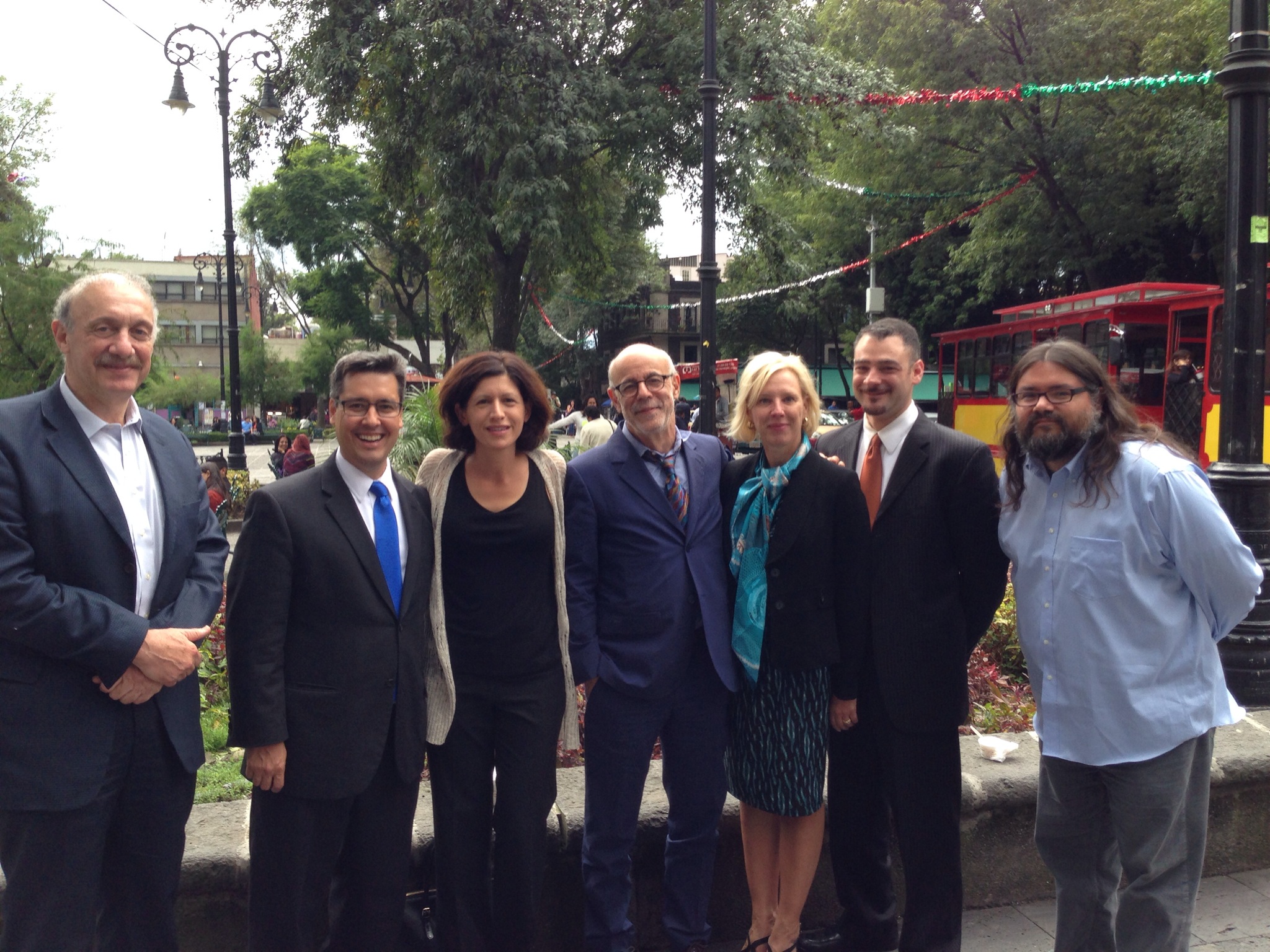
The other American presenters

IMG_7386.JPG

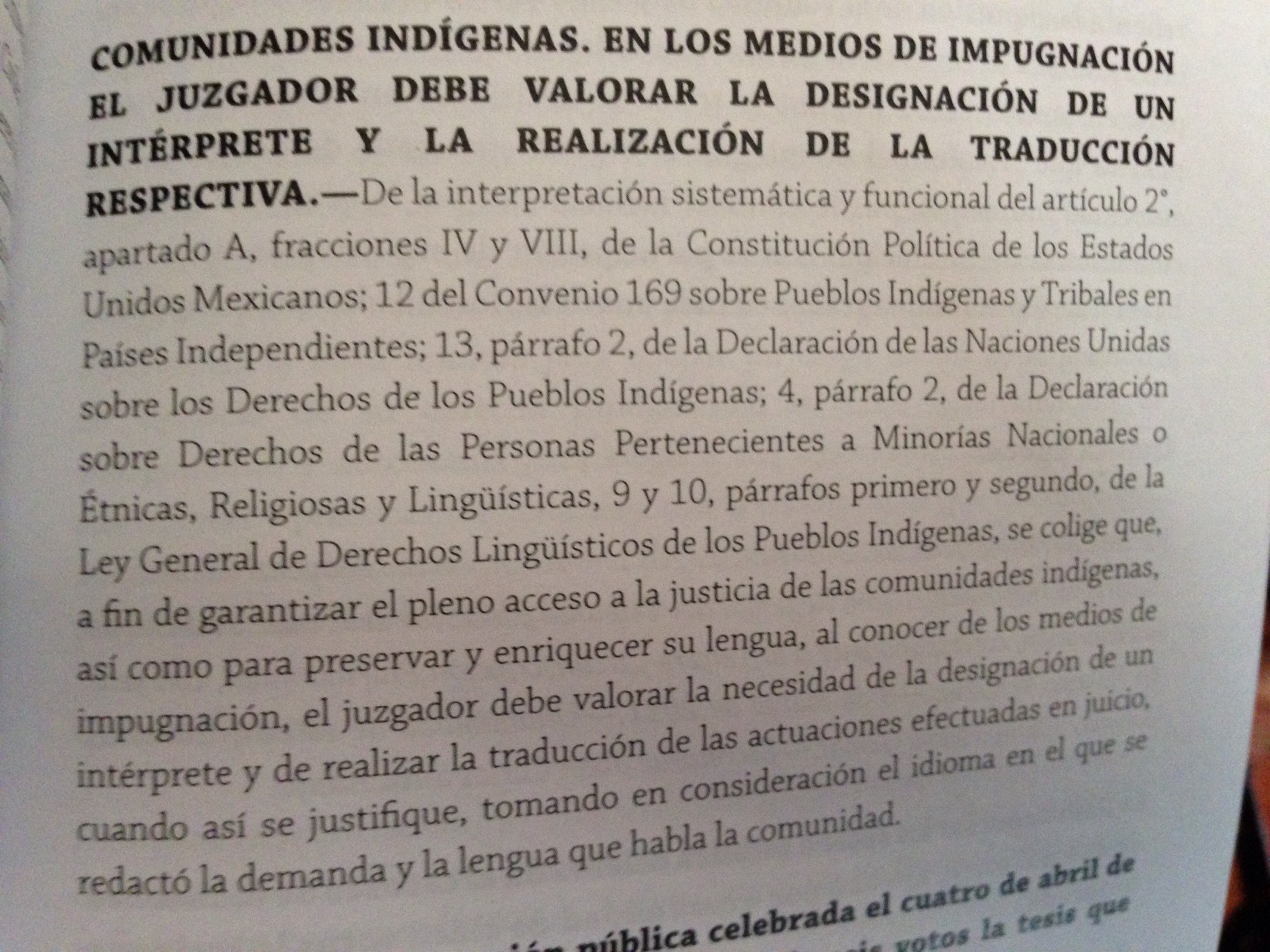
I can’t read it very well but it seems as though the tribunal is using UNDRIP to interpret and apply Indigenous law in tribal elections.

IMG_7362.JPG

Call for Papers – Indigenous Environmental Rights and Tribal Environmental Regulation

William Mitchell Law Review, Vol. 41, Issue 2 (Spring 2015)

The William Mitchell Law Review is dedicating an issue to environmental justice issues, with a focus on indigenous rights to land and natural resources. The issue will be published in March 2015. Confirmed article topics so far cover tribal groundwater rights, EPA jurisdiction over off-reservation Indian lands, and mechanisms for tribal adaptation to climate change. The law review invites submissions that would support this overall theme of indigenous environmental justice and tribal environmental regulation.

Founded in 1974, the William Mitchell Law Review publishes timely articles of regional, national and international interest for legal practitioners, scholars, and lawmakers. Judges throughout the United States regularly cite the Law Review in their opinions. Academic journals, textbooks, and treatises frequently cite the Law Review as well. Due to the rising prominence of William Mitchell’s Indian law program, the Law Review is increasingly becoming a resource for articles relevant to Indian country.

Submissions may take the form of short commentaries or full-length law review articles. If you are interested in submitting an article, please email your submission to melissa.lorentz@wmitchell.edu by Friday, September 12th.

American Indian Law Journal (Seattle Law) Call for Papers

The American Indian Law Journal, published by the Seattle University School of Law, is currently accepting submissions for potential publication in the spring issue.  The American Indian Law Journal serves as a vital online resource providing high quality articles on issues relevant to Indian law practitioners and scholars across the country. The deadline for submissions for the spring issue is December 15, 2014. The editing process for publication begins soon after this date.

The American Indian Law Journal accepts articles and abstracts for consideration from students, practitioners, and law school faculty members.  For more information or to submit an article, please contact Jillian Held, Content Editor, at heldj@seattleu.edu.

New Scholarship from Circe Strum on the Cherokee Freedmen

Here.

Abstract:

Despite a treaty in 1866 between the Cherokee Nation and the federal government granting them full tribal citizenship, Cherokee Freedmen—the descendants of African American slaves to the Cherokee, as well as of children born from unions between African Americans and Cherokee tribal members—continue to be one of the most marginalized communities within Indian Country. Any time Freedmen have sought the full rights and benefits given other Cherokee citizens, they have encountered intense opposition, including a 2007 vote that effectively ousted them from the tribe. The debates surrounding this recent decision provide an excellent case study for exploring the intersections of race and sovereignty. In this article, I use the most recent Cherokee Freedmen controversy to examine how racial discourse both empowers and diminishes tribal sovereignty, and what happens in settler-colonial contexts when the exercise of tribal rights comes into conflict with civil rights. I also explore how settler colonialism as an analytic can obscure the racialized power dynamics that undermine Freedmen claims to an indigenous identity and tribal citizenship.

New Papers on Tribal Federalism, Native Voting Rights, and Bay Mills

Please take a look:

Tribal Disruption and Federalism
This paper is prepared for the 2014 Honorable James R. Browning Symposium hosted by the Montana Law Review (2015 Forthcoming)
Matthew L. M. Fletcher
Michigan State University College of Law
Abstract:

The very presence of Indian nations within the borders of the United States and its territories has always been, from the Founding, disruptive. Indian nations are disruptive, but as I will argue, they are disruptive in the best possible manner. This paper will describe several ongoing tribal-state disputes throughout the nation, acknowledging that the tribal claims are disruptive, but that tribal disruption is not inherently harmful.

Native Voting Rights
This short paper is prepared for the University of Texas/Mexican Electoral Tribunal Workshop (September 5-6, 2014).
Matthew L. M. Fletcher
Michigan State University College of Law
Abstract:

American Indians’ status as citizens of federal, state, and tribal nations has been riddled with ambiguity since the Founding of the American Republic. This short paper surveys the history and law of Native political rights in the American constitutional structure before concluding with a discussion about special problems in tribal elections.

Rights Without Remedies
Matthew L. M. Fletcher
Michigan State University College of Law
Abstract:

In Michigan v. Bay Mills Indian Community, the Supreme Court issued a critically important decision on tribal sovereign immunity denying Michigan a forum to enforce its alleged rights under the Indian Gaming Regulatory Act and under state law. The decision reminds me of Oklahoma Tax Commission v. Citizen Potawatomi Nation, where the Court held that Oklahoma could tax tribal smokeshops, but could not sue the tribe to force remittance of the tax revenue. And so for the second time in recent decades, the Court issued a decision that a state had a right under federal Indian law that was unenforceable against an Indian tribe due to sovereign immunity – in other words, a right without a remedy.

The Supreme Court’s primary reasoning in the Bay Mills matter directly focuses the resolution of these kinds of disputes on Congress. Bay Mills did not simply reaffirm tribal immunity – the Court strongly reaffirmed something known as the clear statement rule. The reaffirmation of the clear statement rule could impact many areas of tribal governance beyond tribal sovereign immunity, including labor relations, treaty rights, tribal court jurisdiction, and of course Indian taxation. This paper parses out where the clear statement rule can by utilized by tribal interests for maximum effect, and where reliance upon the rule could generate signals to Congress.

I conclude by identifying the logical outcome of reliance upon the clear statement rule – Congressional reconsideration of tribal immunities. Indian country’s focus on litigation may be forced to give way to the legislative arena. There, tribal interests may be confronted with the rhetoric of rights without remedies.

New Scholarship on Court Power and Aboriginal and Treaty Rights in Canada

The American Review of Canadian Studies has published Political Failure, Judicial Opportunity: The Supreme Court of Canada and Aboriginal and Treaty Rights, available at http://www.tandfonline.com/doi/full/10.1080/02722011.2014.941153#.U_3lbygdVUQ.  

Here is the abstract:  What role do courts play in public policymaking? This article finds that the Supreme Court of Canada revitalized the making of Aboriginal and treaty rights policy from 1990 to 2007. It offers an explanation of the Court’s engagement in this area and suggests that the standard Charter narrative about court power does not explain fully the role of the Court in Aboriginal and treaty rights policymaking. The account highlights how politics affect the Court and how the Court affects politics. The Court emerged as a significant and influential player in policymaking as the political process failed to accommodate Aboriginal and treaty rights, Aboriginal peoples mobilized legally, and the institutional power of the Court grew. The article’s emphasis on political failure provides a more nuanced view of the Court and how it exercises power vis-à-vis political elites and interest groups.

An earlier version of the article is available on SSRN at http://papers.ssrn.com/sol3/papers.cfm?abstract_id=2484744.

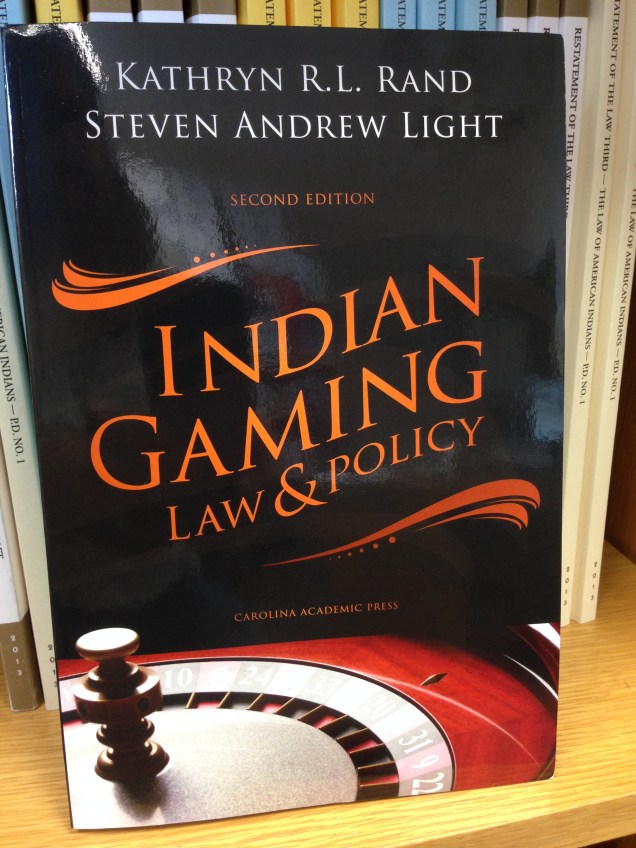
Second Edition of Indian Gaming Law and Policy by Rand & Light

Here:

R&L

Top 15 or so American Indian Law Articles by SSRN Download from 2014

We did this for 2013 last December, and in 2012. We are trying again by popular demand. And because MSU soon will begin hosting the SSRN Indigenous Nations & Peoples Law eJournal.

1. Human Rights to Culture, Family, and Self-Determination: The Case of Adoptive Couple v. Baby Girl
Forthcoming in STEFAN KIRCHNER AND JOAN POLICASTRI, EDS., INDIGENOUS RIGHTS IN INTERNATIONAL LAW.
Kristen A. Carpenter and Lorie Graham
University of Colorado Law School and Suffolk University Law School
Date Posted: February 28, 2014
Working Paper Series
231 downloads

2. Constitutionalism, Federal Common Law, and the Inherent Powers of Indian Tribes
Forthcoming, American Indian Law Review, University of Utah College of Law Research Paper No. 76
Alexander Tallchief Skibine
University of Utah – S.J. Quinney College of Law
Date Posted: April 17, 2014
Last Revised: April 29, 2014
Accepted Paper Series
213 downloads

3. Native American Lands and the Supreme Court
Journal of Supreme Court History, 38: 369-385, 2013
Angela Riley
University of California, Los Angeles (UCLA)
Date Posted: June 19, 2014
Accepted Paper Series
196 downloads

4. Mapping Intergenerational Memories (Part I): Proving the Contemporary Truth of the Indigenous Past
Arizona Legal Studies Discussion Paper No. 14-01
Robert Hershey , Jennifer McCormack and Gillian E. Newell
University of Arizona – James E. Rogers College of Law , University of Arizona – Department of Geography and Regional Development and Independent
Date Posted: January 12, 2014
Working Paper Series
163 downloads

5. Constitutional Concern, Membership, and Race
Florida International Law Review, 2014, Forthcoming , U of Colorado Law Legal Studies Research Paper No. 14-3
Sarah Krakoff
University of Colorado Law School
Date Posted: April 04, 2014
Accepted Paper Series
126 downloads

6. No Sticks in My Bundle: Rethinking the Indian Land Tenure Problem
Kansas Law Review, Forthcoming
Jessica A. Shoemaker
University of Nebraska – College of Law
Date Posted: May 01, 2014
Accepted Paper Series
107 downloads

7. In Search of a Civil Solution: Tribal Authority to Regulate Nonmember Conduct in Indian Country
Tulsa Law Review, September 2014, Forthcoming
Philip H. Tinker
Kanji & Katzen, PLLC
Date Posted: February 22, 2014
Accepted Paper Series
82 downloads

8. Consumer Credit on American Indian Reservations
Valentina P. Dimitrova-Grajzl , Peter Grajzl , A. Joseph Guse and Richard M. Todd
Virginia Military Institute , Washington and Lee University – Department of Economics , Washington and Lee University – Williams School of Commerce, Economics, and Politics and Federal Reserve Bank of Minneapolis
Date Posted: March 14, 2014
Last Revised: May 28, 2014
Working Paper Series
81 downloads

9. Tribes as Innovative Environmental ‘Laboratories’
Elizabeth Ann Kronk Warner
University of Kansas – School of Law
Date Posted: February 14, 2014
Last Revised: February 22, 2014
Working Paper Series
80 downloads

10. Balancing between Two Worlds: A Dakota Woman’s Reflections on Being a Law Professor
Berkeley Journal of Gender, Law & Justice, Vol. 29, No. 2, 2014
Angelique Townsend EagleWoman
University of Idaho – College of Law
Date Posted: June 15, 2014
Accepted Paper Series
72 downloads

11. Finance and Foreclosure in the Colonial Present
Radical History Review, Issue 118 (Winter 2014)
Alyosha Goldstein
University of New Mexico
Date Posted: January 30, 2014
Accepted Paper Series
71 downloads

12. Rising Waters, Rising Threats: The Human Trafficking of Indigenous Women in the Circumpolar Region of the United States and Canada
MSU Legal Studies Research Paper No. 12-01
Victoria Sweet
Michigan State University College of Law
Date Posted: February 22, 2014
Accepted Paper Series
73 downloads

13. Tribal Laws & Same-Sex Marriage: Theory, Process, and Content
Ann E. Tweedy
Hamline University School of Law
Date Posted: January 12, 2014
Last Revised: July 18, 2014
Working Paper Series
59 downloads

14. What Does Indigenous Participatory Democracy Look Like? Kahnawà:Ke’s Community Decision Making Process
Review of Constitutional Studies, Vol. 18, No. 1, 2013
Kahente Horn-Miller
Mohawk Council of Kahnawake
Date Posted: May 17, 2014
Accepted Paper Series
57 downloads

15t. In the Name of the Child: Race, Gender, and Economics in Adoptive Couple v. Baby Girl
Florida Law Review, Forthcoming
Bethany Berger
University of Connecticut School of Law
Date Posted: March 30, 2014
Last Revised: May 29, 2014
Accepted Paper Series
50 downloads

15t. Essay: Tribal Trustees in Climate Crisis
American Indian Law Journal, Vol. II, Issue II, Spring 2014, Forthcoming
Mary C. Wood
University of Oregon – School of Law
Date Posted: April 05, 2014
Working Paper Series
50 downloads

15t. International and Domestic Law Dimensions of Climate Justice for Arctic Indigenous Peoples
Ottawa Law Review, Vol. 43, No. 113, 2013
Elizabeth Ann Kronk Warner and Randall S. Abate
University of Kansas – School of Law and Florida A&M University – College of Law
Date Posted: February 03, 2014
Accepted Paper Series
50 downloads

18 (honorable mention). Tribal Rights of Action
Columbia Human Rights Law Review, Vol. 45, No. 2, 2014
Seth Davis
University of California, Irvine School of Law
Date Posted: April 04, 2014
Accepted Paper Series
47 downloads

This one is not yet available for download but I’m sure it would have made the list:

Beyond the Indian Commerce Clause
Yale Law Journal, Forthcoming
Gregory Ablavsky
University of Pennsylvania Law School
Date Posted: August 14, 2014
Accepted Paper Series

We skipped out on articles about Indigenous peoples outside of the US, so here is a sampling of articles focusing on more international questions: Continue reading