Kristen Carpenter and Lorie Graham on Human Rights and Adoptive Couple v. Baby Girl

Kristen Carpenter and Lorie Graham have posted a very compelling and powerful paper about the Supreme Court’s decision in Adoptive Couple v. Baby Girl. It is required reading for anyone interested in the case, and is destined to be the definitive paper on the international human rights aspects of the case.

The article is titled Human Rights to Culture, Family, and Self-Determination: The Case of Adoptive Couple v. Baby Girl. Here is the abstract:

The well-being of indigenous children is a subject of major concern for indigenous peoples and human rights advocates alike. In 2013, the U.S. Supreme Court decided in Adoptive Couple v. Baby Girl that the Indian Child Welfare Act did not prevent the adoption of a Cherokee child by a non-Indian couple. This occurred over the objections of her Cherokee biological father, extended family, and Tribal Nation. After the decision, Baby Girl’s father and the adoptive couple contested the matter in a number of proceedings, none of which considered the child’s best interests as an Indian child. The tribally-appointed attorney for Baby Girl, as well as the National Indian Child Welfare Association and National Congress for American Indians, began examining additional venues for advocacy. Believing that the human rights of Baby Girl, much like those of other similarly situated indigenous children, were being violated in contravention of the United Nations Declaration on Indigenous Peoples Rights, and other instruments of international law, they asked us to bring the matter to the attention of the United Nations Special Rapporteur for Indigenous Peoples Rights (“UNSR”). We prepared a “statement of information” to alert the UNSR of the human rights violations occurring in the case. With the permission of the attorneys and organizations involved, this chapter introduces the Baby Girl case, contextualizes the claims in international human rights law, and then reproduces the statement of information, and portions of the UNSR’s subsequent public statement. It concludes with an update on the Baby Girl case and broader discussion about the potential for using international law and legal forums to protect the human rights of indigenous children.
Kirsten Carlson Awarded National Science Foundation to Study Congress and Indian Law Legislation

Here.

Amazing news for Professor Carlson! Her project is titled, “Legal Mobilization, Rights Claims, and Federal Indian Policy Reforms.”

Duke Law Journal Publishes “The Savage Constitution”

Gregory Ablavsky has published “The Savage Constitution” (PDF) in the Duke Law Journal.

Here’s the abstract:

Conventional histories of the Constitution largely omit Natives. This Article challenges this absence and argues that Indian affairs played a key role in the Constitution’s creation, drafting, and ratification. It traces two constitutional narratives about Indians: a Madisonian and a Hamiltonian perspective. Both views arose from the failure of Indian policy under the Articles of Confederation, when explicit national authority could not constrain states, squatters, or Native nations. Nationalists agreed that this failure underscored the need for a stronger federal state, but disagreed about the explanation. Madisonians blamed interference with federal treaties, whereas the Hamiltonians argued the federal military was too weak to overawe the “savages.”

Phil Tinker on Tribal Authority to Regulate Nonmember Conduct in Indian Country

Phil Tinker has posted his paper, “In Search of a Civil Solution: Tribal Authority to Regulate Nonmember Conduct in Indian Country,” forthcoming in the September 2014 issue of the Tulsa Law Review.

Here is the abstract:

Violence in Indian Country is epidemic. Tribal governments, which ostensibly have primary responsibility for keeping the peace within their territory, are hampered by restrictive federal laws that prohibit Tribes from exercising criminal authority over non-Indians. This is so even where those non-Indian lawbreakers live on the reservation and commit acts of violence against tribal members. Instead, the federal government is responsible for investigating and prosecuting most on-reservation crime. This irrational system is the product an archaic federal policies dating back to the 19th century that have never been adequate to protect Indian communities.

ILPC Victoria Sweet on The Human Trafficking of Indigenous Women in the Circumpolar Region of the United States and Canada

Our own Victoria Sweet has posted her newest paper, “Rising Waters, Rising Threats: The Human Trafficking of Indigenous Women in the Circumpolar Region of the United States and Canada.”

Here is the abstract:

Among indigenous people around the world, human trafficking is taking a tremendous toll. While trafficking is not an exclusively indigenous issue, disproportionately large numbers of indigenous people, particularly women, are modern trafficking victims. In Canada, several groups concerned about human trafficking have conducted studies primarily focused on the sex trade because many sex workers are actually trafficking victims under both domestic and international legal standards. These studies found that First Nations women and youth represent between 70 and 90% of the visible sex trade in areas where the Aboriginal population is less than 10%. Very few comparable studies have been conducted in the United States, but studies in both Minnesota and Alaska found similar statistics among U.S. indigenous women.

With the current interest in resource extraction, and other opportunities in the warming Arctic, people from outside regions are traveling north in growing numbers. This rise in outside interactions increases the risk that the indigenous women may be trafficked. Recent crime reports from areas that have had an influx of outsiders such as Williston, North Dakota, U.S. and Fort McMurray, Alberta, Canada, both part of the new oil boom, demonstrate the potential risks that any group faces when people with no community accountability enter an area. The combination of development in rural locations, the demographic shift of outsiders moving to the north, and the lack of close monitoring in this circumpolar area is a potential recipe for disaster for indigenous women in the region. This paper suggests that in order to protect indigenous women, countries and indigenous nations must acknowledge this risk and plan for ways to mitigate risk factors.

New Scholarship on Tribal Constitutional Amendment and Reform

Jason Hipp has published “Rethinking Rewriting: Tribal Constitutional Amendment and Reform,” in the Columbia Journal of Race and Law. This paper won the 12th Annual NNALSA Indian Law Writing Competition. Here is the abstract:

This Essay examines the recent wave of American Indian tribal constitutional change through the framework of subnational constitutional theory. When tribes rewrite their constitutions, they not only address internal tribal questions and communicate tribal values, but also engage with other subnational entities, i.e. states, and the federal government. This Essay applies that framework to a study of tribal constitutional amendment and reform procedures. Focusing on the processes of constitutional change produces insight into tribes’ status as “domestic dependent sovereigns” in the contemporary era of self-determination, a status reflected in the opportunities, and limitations, inherent in tribal constitutions. In so doing, this Essay aims to highlight an aspect of tribal constitution writing that enables successful reform and communicates the significance and goals of constitutionalism within the tribal context.

ILPC Book Talk — Recognition, Sovereignty Struggles & Indigenous Rights in the United States

Amy Den Ouden, Kathleen Brown-Perez, Jean O’Brien, Ruth Torres

20140220-141303.jpg

New Scholarship on the “Bad Men” Clause in the Sherman Treaties

James D. Leach has published “Bad Men Among the Whites” Claims After Richard v. United States” in the New Mexico Law Review.

An excerpt:

This article contends that Richard provides Indians with exactly what they bargained for and received when their tribes negotiated and signed treaties with the United States. The government is unlikely to return the parties to their pre-agreement status by returning to Indians the lands they gave up in treaties. The right of Indians to receive what the government promised them in exchange for large amounts of tribal land would seem to be beyond moral or legal dispute. But as we will see, even these seemingly self-evident principles are now disputed.

Our post on the Richard case is here.

Howard Brown and Ray Austin Update Article on Navajo Preference in Employment Act

Howard L. Brown and the Honorable Raymond D. Austin have published “The Navajo Preference in Employment Act: A Review and Update of Cases and Rules, 2010–2012” in the New Mexico Law Review. 

The original article from 2010 is here.

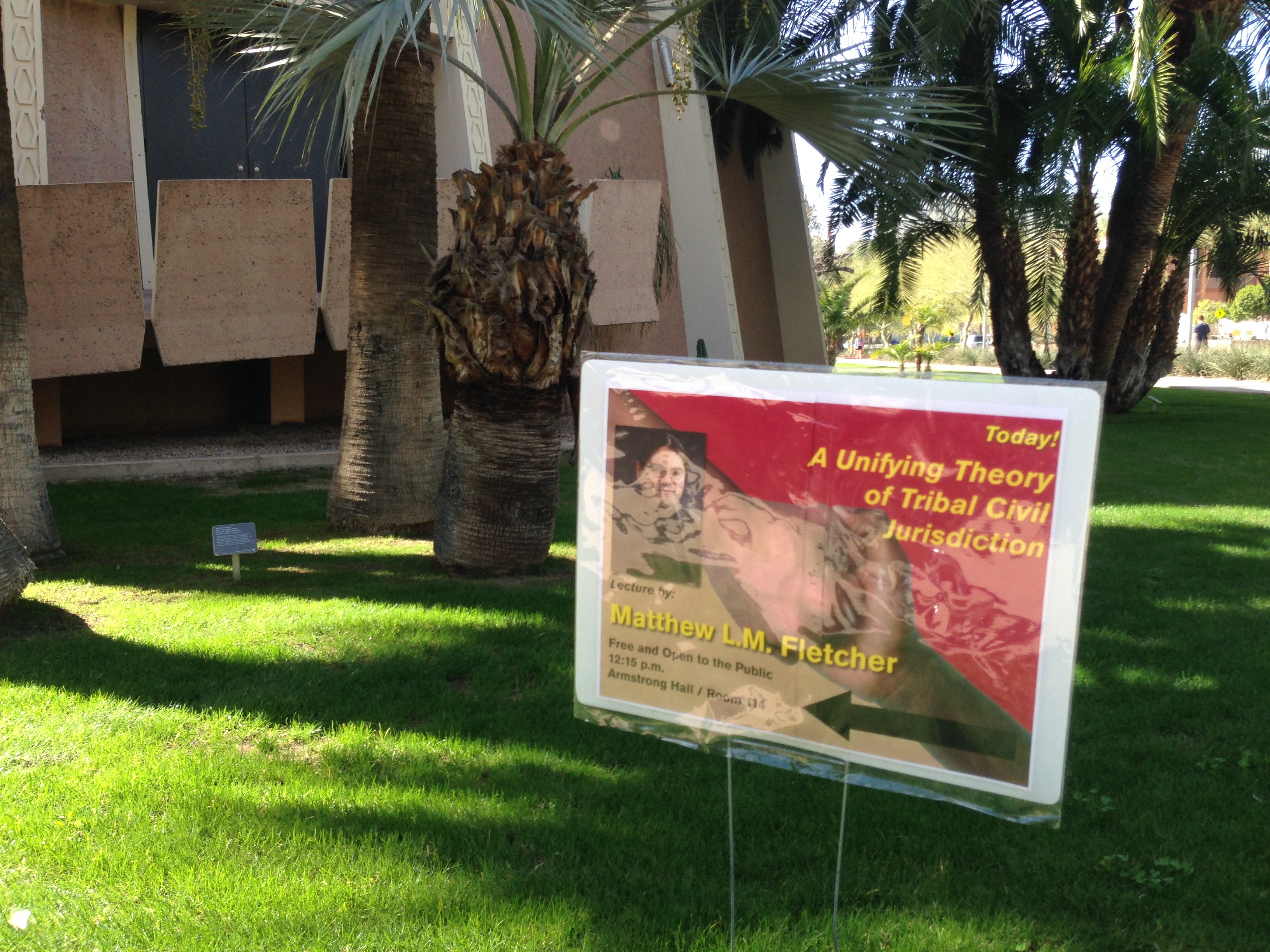
Fletcher Talk on Tribal Civil Jurisdiction at Arizona State

Here is a link to the audio: http://media.law.asu.edu/Law/2014/Spring/ILP/Tribal_Civil_Jurisdiction_02_13_14.mp3. Paper here.

Poster

Great crowd. Miigwetch for attending.

crowd