New Scholarship on Tribal Gaming Revenue Allocation Plans

Thaddieus W. Conner and William A. Taggart have published “Indian Gaming and Tribal Revenue Allocation Plans: Socio-economic determinants of policy adoption” in the Social Science Journal. Here is the abstract:

As the Indian gaming industry has experienced unprecedented growth over the past two decades, tribes have pursued different paths regarding the utilization of gaming revenues within parameters established by the Indian Gaming Regulatory Act. Since 1993, more than 100 tribes have received approval through the Department of the Interior to distribute revenues directly to tribal members through per capita payments governed by a Tribal Revenue Allocation Plan (RAP). This paper improves our understanding of nations with payment plans by exploring whether socio-economic tribal features are associated with the successful adoption of a RAP. We find that tribes who gained approval of a RAP in the 1990s have higher per capita incomes, while also having smaller populations and lower levels of educational attainment. Population is the strongest predictor of RAP adoptions in both the 1990s and 2000s, with the impact of other tribal features being less meaningful in explaining adoption in the second decade.

Email me if you want a pdf.

New Scholarship on the “American Indian Child Welfare Crisis of the 1960s and 1970s”

Margaret D. Jacobs has published “Remembering the ‘Forgotten Child’: The American Indian Child Welfare Crisis of the 1960s and 1970s” in the American Indian Quarterly. Email me for a pdf.

Here is an excerpt:

On Christmas Day 1975, Marcia Marie Summers was born to Charlene Summers, a member and resident of the Standing Rock Sioux Nation in North Dakota. A few months later, a white couple from Indiana approached the young mother and offered to care for her infant while Summers attended school. (Just two months before, the couple had filed an adoption petition in the Standing Rock Tribal Court for another Indian child, but the court had denied their request.) Assuming she was making a temporary arrangement, Summers agreed and signed a document giving the Indiana couple power of attorney over Marcia Marie in parent-child-related actions. Immediately, the couple departed with the baby from the reservation and returned to Indiana. Summers realized that the couple intended to permanently adopt her daughter, so she asked the Standing Rock Tribal Court to intervene. When the couple ignored the tribal court’s order to return the child to her mother, Summers and tribal authorities requested the help of the Association on American Indian Affairs ( AAIA). Their attorney filed a writ of habeas corpus on Summers’s behalf in the Washington County, Indiana, Circuit Court, and the judge ordered Marcia Marie returned to her mother, noting the tribe’s exclusive jurisdiction in the case.

Like Summers, in the 1960s and 1970s, thousands of other American Indian parents, grandparents, and caretakers suffered the removal of their children and their placement in non-Indian foster or adoptive homes. Unlike Summers, however, many Indian families struggled for years to regain their children, and some were never able to effect their return. By the late 1960s, many Indian tribes had become deeply troubled by this practice. In 1968, having endured an inordinate number of such cases, the Devils Lake (now Spirit Lake) Sioux Tribe of North Dakota requested that the AAIA conduct an investigation into the practice. The AAIA found that of 1,100 Devils Lake Sioux Indians under twenty-one years of age living on the Fort Totten reservation, 275, or 25 percent, had been separated from their families. Suspecting that this practice devastated other Indian communities as well, the AAIA engaged in a painstaking process to amass similar data from state social services agencies and private placement agencies across the nation. They discovered that in most states with large American Indian populations, 25 to 35 percent of Indian children had been separated from their families and placed in foster or adoptive homes or in institutions at a per capita rate far higher than that of non-Indian children.

How did it come to pass that the fostering and adoption of Indian children outside their families and communities had reached these crisis proportions by the late 1960s? State welfare authorities and Bureau of Indian Affairs ( BIA) officials alleged a dramatic rise in unmarried Indian mothers with unwanted children and claimed that many Indian individuals and families lacked the resources and skills to properly care for their own children. Claiming to be concerned with the best interests of the Indian child, the BIA promoted the increased fostering and adoption of Indian children in non-Indian families. Indian families and their advocates charged instead that many social workers were using ethnocentric and middle-class criteria to unnecessarily remove Indian children from their families and communities. Through creating their own child welfare organizations and legal codes, as well as working for the Indian Child Welfare Act ( ICWA), Indian activists and their allies sought to bring Indian child welfare under the control of Indian nations.
New Oregon Law Review Article on (Tribal) Criminal Jurisdiction and the Nation-State

David Wolitz has published “Criminal Jurisdiction and the Nation-State: Toward Bounded Pluralism” in the Oregon Law Review.

An excerpt:

In this Part, I argue that criminal jurisdiction on tribal lands already reflects major elements of the Bounded Pluralism approach I support, but that criminal justice in Indian Country could be improved if tribes had greater functional jurisdiction and if the federal government had greater supervisory authority to set fundamental-rights constraints on that jurisdiction.

New Scholarship: “Re-Thinking Colonialism to Prepare for the Impacts of Rapid Environmental Change”

Nicholas James Reo and Angela K. Parker have published “Re-Thinking Colonialism to Prepare for the Impacts of Rapid Environmental Change” in Climatic Change. Highly recommended.

Here is the abstract:

This essay demonstrates how key concepts from ecology can be applied within historical analyses in order to gain insights regarding contemporary environmental change. We employ a coupled human and natural systems conceptual framework in a nascent historical analysis of rapid societal and environmental change in colonial New England, where European colonization led to stark and rapid transformations. Introduced diseases reduced indigenous communities to a fraction of their pre-contact levels. European agriculture and associated pest species, deforestation and overharvest of ecologically influential species were among key aspects of the rapid changes in colonial New England. Cross-continental biotic introductions initiated reinforcing feedback loops that accelerated the transition of human and natural systems into novel states. Integrating colonial history and ecology can help identify important interactions between human and natural systems useful for contemporary societies adjusting to environmental change.

Continue reading

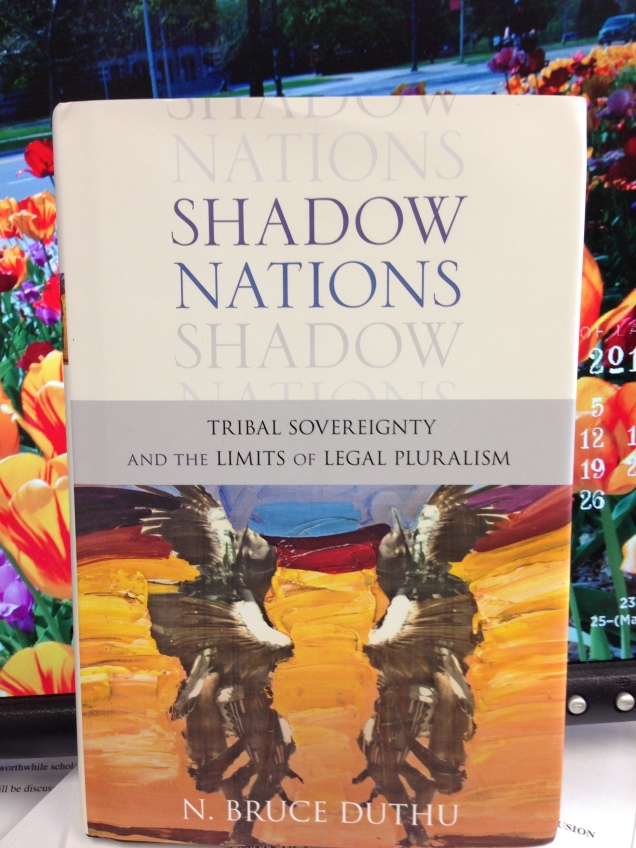
In the Mail — Bruce Duthu’s New Book

Chi-miigwetch Bruce! And congrats!

Duthu

On Being (Mis)Cited by the Supreme Court

From the NY Times.

Nor was Justice Kennedy’s brief quotation from “Actual Innocence” especially punctilious. Here is how the justice rendered it, including his brackets and ellipses: “[P]rompt [DNA] testing … would speed up apprehension of criminals before they commit additional crimes, and prevent the grotesque detention of … innocent people.”

Those first three dots covered a lot of ground. They took the place of more than six sentences and suggested a different point than the one the authors were making. The original passage concerned evidence collected at crime scenes, not from people who might be connected to it.

“What we were saying had nothing to do with post-arrest testing of suspects,” said Jim Dwyer, a co-author of the book who is now a columnist for The New York Times. “We were arguing that all evidence should be tested, whether or not a suspect had been charged.”

Mr. Neufeld agreed. “The ‘prompt testing’ is referring to something completely different than the latter phrase,” he said. “Barry, Jim and I never endorsed arrestee databases.”

The omission of two words with the second set of dots is easier to understand. The authors had written that testing could prevent “the grotesque detention of thousands of innocent people.” Justice Kennedy apparently did not want to endorse the possibility that the criminal justice system had such widespread shortcomings. (The Innocence Project, which is affiliated with the Benjamin N. Cardozo School of Law in New York, says that more than 300 prisoners have been exonerated using DNA.)

Breann Swann Nuʻuhiwa on Good Native Hawaiian Governance

Breann Swann Nuʻuhiwa has published “Government of the People, by the People, for the People:  Cultural Sovereignty, Civil Rights, and Good Native Hawaiian Governance” in the Asian-Pacific Law and Policy Journal.

Here is an excerpt:

Yet “civil rights,” as they are understood and articulated by the federal government, are not necessarily congruous with core Native Hawaiian beliefs about leadership, relationships, and responsibility. Furthermore, as history demonstrates, the wholesale  appropriation of American rights principles by the Native Hawaiian people can hinder Native Hawaiian sovereignty and privilege non-community members over community members. Accordingly, the founders of the reorganized Native Hawaiian government must take special care to balance external expectations with Native Hawaiian beliefs and  values in order to develop an approach to civil rights that maximizes Native Hawaiian  sovereignty. This article seeks to provide information and analysis that may be of use to the Native Hawaiian convention participants as they design a civil rights approach.

New Practitioner Paper on the Tenth Amendment Implications of IGRA’s Class II and Class III Distinction

Jacob Berman of the California AG’s office has published Such Gaming Causes Trouble: Constitutional and Statutory Confusion with the Indian Gaming Regulatory Act in the Seton Hall Journal of Sports and Entertainment Law.

There is no abstract but this paragraph from the conclusion establishes the premise:

Since its passage, the Indian Gaming Regulatory Act has proved wildly successful at improving Indian tribes’ economic status, but the Second and Tenth Circuits have deviated  from Congress’ original intent. The IGRA was intended to put Indian tribes and state governments on an equal footing, not to give tribal governments undue leverage over state governments. This principle of tribal-state equality has been ignored by the Second and Tenth Circuits, which instead decided to force states to choose between no Class III gambling and all Class III gambling, treating state lotteries, race tracks, and off-track betting as functionally equivalent to craps, roulette and slot machines. Not only does this approach go against Congress’ intent in passing the IGRA, but it also goes against the Tenth Amendment’s anti-coercion doctrine, which prohibits the federal government from enlisting state legislatures and to enforce federal policies. The Eleventh Amendment option, created in Seminole, presents no viable alternative for a state seeking to maintain any form of regulated Class III gaming under the class-based test.

Not supportive of tribal prerogatives, and basically reads Cabazon Band of the equation. The language in red above, in my view, is just flat wrong on a number of levels. Oh well.

New Scholarship on ANILCA Compliance

Miranda Strong has published “Alaska National Interest Lands Conservation Act Compliance & Nonsubsistence Areas: How Can Alaska Thaw Out Rural & Alaska Native Subsistence Rights?” in the Alaska Law Review.

Here is the abstract:

The Alaska Constitution prevents the Alaska National Interest Lands Conservation Act’s (ANILCA) rural subsistence priority from being enforced. The Federal Government currently manages subsistence on federal lands in Alaska and Alaska can only resume management if it becomes ANILCA compliant. The current federal management system does not sufficiently protect rural and Alaska Natives’ subsistence rights. Alaska’s Legislature must overcome the rural-urban divide to amend its constitution to become ANILCA compliant again by providing a modified rural priority that includes urban Alaska Natives. The Alaska Legislature should repeal the nonsubsistence zones statute because it denies federally defined rural areas the state’s subsistence priority.

New Student Scholarship on Appropriation of Native Culture

Brian Sheets has published “Papers or Plastic: The Difficulty in Protecting Native Spiritual Identity” in the Lewis & Clark Law Review (also SSRN).

Here is the abstract:

Sellers of Native ceremonies offer the opportunity to non-Natives to participate in ceremonial traditions with roots in Native spiritual communities—for a price. These “plastic shamans” have appropriated some Native ceremonies, sometimes with fatal results. Commodifying these spiritual practices removes important communal identities from their sources and furthers the stereotype that Native communities and their cultural practices are relics of the past—a concept reinforced through divorcing cultural practices from vibrant, modern Native societies struggling to maintain an identity. In response to ceremonial appropriation by plastic shamans, some Native spiritual communities have sued operators of botched ceremonies, and have further advocated for legal protection of Native ceremonies in Western legal concepts. However, Western law misses the mark. While spiritual identity is offered protection through exemptions to generally applicable laws, the Western requirement of a bright-line object to represent spiritual identity does not allow for the protection of an intangible ceremony from appropriation. Furthermore, Western concepts of intellectual property are market based, and directly conflict with the intent to protect Native ceremonies from being commodified. These conflicting values demonstrate the tension in protecting spiritual identity. And when Native cultural composition, transformative ceremonial practice, and distributions of ceremonies between Native groups are taken into account, the difficulty becomes even more apparent.

This Comment explores the approach of current Western laws seeking to protect cultural heritage, and then applies one Native proposal through a First Amendment analysis to  demonstrate the difficulty of protecting Native spiritual identity in Western law. Some of the current means of protecting and preserving Native spiritual identity make  appropriation even easier through documentation requirements. While there is a compelling reason to protect Native ceremonies from appropriation, Western courts are limited in their ability to favor one group’s religious practices over another. This Comment concludes that while difficult to protect in law, public awareness is the most likely cure to prevent shopping for spirituality—enlightenment and selfactualization cannot be bought off-the-shelf with the clerk asking at checkout “paper, or plastic?”