Student Scholarship on Cross-Border Affirmative Action

Here:

An Indian by Any Other Name: Cross-Border Affirmative Action
Forthcoming, 92 N.Y.U. L. REV. (2017)
Raymond J. Fadel
New York University (NYU), School of Law, Students
Date Posted: December 08, 2016

Univ. of Washington NALSA Stop DAPL Project

Call for Submissions:Dear Turtle Talk Community, 

The University of Washington Native American Law Student Association (NALSA) is asking for photos (digital or print) documenting the myriad of ways & moments during which native people gathered in direct action opposing the DAPL protest. As law students, we hope one day to advance causes for Indian Country in the courtroom, but today we want to celebrate and feature the strength and character shown at the “Stop DAPL” encampment through a photography exhibition. 

On the first floor of our Law building, there exists a common space that rotates art each 3 to 6 months. The NALSA of the University of Washington will select 7 to 10 of the submissions for display (printing them if not already printed) to recognize the ongoing effort to protect Native American sacred space. The print will be in this art space for the next 3 to 6 months with acknowledgement to the photographer.

Once the “Stop DAPL” encampment exhibition is complete, NALSA will return the printed piece to the contributor as a token of our appreciation. Or in the alternative, the contributor could donate it to our student Association for auction at our annual dinner in Feb. 2017.

With heartfelt thanks,

University of Washington Native Law Students.

Contact, Tony Aronica, aronicat@uw.edu

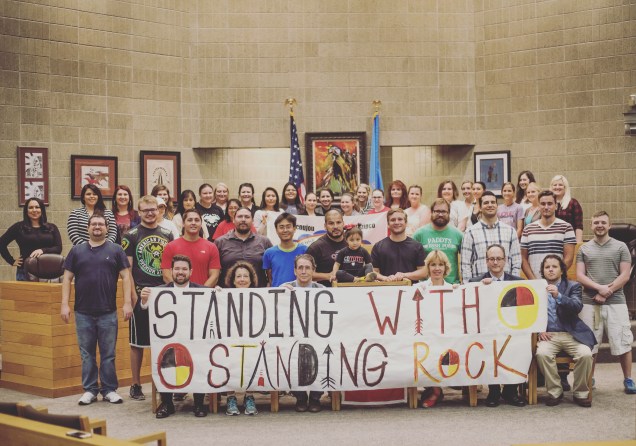
South Dakota NALSA: “Standing with Standing Rock”

Here:

Standing with Standing Rock.jpg

Reminder: Apply to Clerk at NARF by September 2, 2016

Founded in 1970, the Native American Rights Fund (“NARF”) is the oldest and largest nonprofit law firm dedicated to asserting and defending the rights of Indian tribes, organizations, and individuals nationwide. NARF’s practice is concentrated in five key areas: the preservation of tribal existence; the protection of tribal natural resources; the promotion of Native American human rights; the accountability of governments to Native Americans; and the development of Indian law and educating the public about Indian rights, laws, and issues.

NARF is currently seeking candidates for its Summer 2017 Clerkships! Each year, NARF conducts a nation-wide search for law students to participate in its Law Clerk Program. Positions are available in all three of NARF’s offices: Anchorage, AK; Boulder, CO; and Washington, D.C.

Here is the advertisement. The deadline to apply is September 2, 2016.

Save the Date: Apply to Clerk at NARF by September 2, 2016

Founded in 1970, the Native American Rights Fund (“NARF”) is the oldest and largest nonprofit law firm dedicated to asserting and defending the rights of Indian tribes, organizations, and individuals nationwide. NARF’s practice is concentrated in five key areas: the preservation of tribal existence; the protection of tribal natural resources; the promotion of Native American human rights; the accountability of governments to Native Americans; and the development of Indian law and educating the public about Indian rights, laws, and issues.

Summer Clerkships
NARF is currently seeking candidates for its Summer 2017 Clerkships! Each year, NARF conducts a nation-wide search for law students to participate in its Law Clerk Program. Positions are available in all three of NARF’s offices: Anchorage, AK; Boulder, CO; and Washington, D.C.

Here is the advertisement. The deadline to apply is September 2, 2016.

New Volume of UCLA Law School’s Indigenous Peoples’ Journal of Law, Culture & Resistance

Here:

Contents

Distant Thunder
Walden, Dawn Nichols

What Then Remains of the Sovereignty of the Indians? The Significance of Social Closure and Ambivalence in Dollar General v. Mississippi Choctaw
Beardall, Theresa Rocha; Escobar, Raquel

Gallery
Church, Kelly

Creating a Culture of Traffic Safety on Reservation Roads: Tribal Law & Order Codes and Data-Driven Planning
Hill, Margo L.; Myers, Christine S.

Crickets
Locklear, Lydia

Call for 2016 DC Interns for NABA-DC Mentorship and Brownbag Lunch Program

Do you know a student that will be in D.C. to intern or clerk at an organization or firm that works in Indian law and policy? If so, please encourage them to sign up for the NABA-DC Brown Bag Series and Mentorship Program!


Interns sign up here: http://goo.gl/forms/EGUKmk6Zte


If you are an attorney and would like to sign up as a mentor, click here: http://goo.gl/forms/1c0r6VP8Ld


Brownbag Program: Every year, the Native American Bar Association of Washington, D.C. (NABA-DC) organizes events for summer interns working in the field of Indian law and policy. Events include brownbags lunches at government agencies, law firms, and non-profit organizations, as well as happy hours and a summer picnic. The Brownbags are a wonderful opportunity for interns to network with fellow interns and potential employers.


If you have any questions about the Brownbag lunch series please contact nabadcbrownbag@gmail.com.


Mentorship Program: NABA-DC also coordinates a Mentorship Program each summer to give legal interns working in Indian law a personal networking experience.  Interns are matched with professionals working in Washington D.C., with efforts made to find mentors who are working in the same fields the interns wish to enter, enriching the interns’ educational experience in D.C. and connecting practitioners with the next generation of Native leaders.


If you have any questions about the NABA-DC mentorship program, please contact nabadcmentorship@gmail.com.
New Student Scholarship on Indian Sports Mascots and Nicknames

The BYU Education and Law Journal has published “Between a Tomahawk and a Hard Place: Indian mascots and the NCAA” by Stephanie Jade Bollinger. [pdf]

An excerpt::

Thus, a reviewing court should find that agreements between Native American tribes and Universities granting approval for the use of Indian names as mascots should be void as against public policy. If the approval is found to be void, the NCAA would have a harder time basing approval as the primary factor for exemptions from its own mascot policy at championship games. Without the mascot exemption, more universities may decide to eliminate their use of Indian mascots and, in doing so, discontinue the harmful effects from their use of Indian mascots.

New Student Scholarship on Tribal Internet Gaming

The Jurimetrics Journal at ASU Law has published “A New Formula for Tribal Internet Gaming” by Racheal White Hawk. [pdf]

The abstract:

Tribal gaming is an industry that generates more than $27 billion a year. It comprises forty percent of all gaming in the United States, and has provided more than 628,000 jobs for Native and local communities. While tribal brick-and-mortar casinos contribute numerous economic, cultural, and social benefits to Native communities, Internet gaming profits are a potential boon. Internet gaming is well positioned for rapid growth because tens of millions of Americans use computers, cell phones, and tablets for shopping, games, and entertainment. Furthermore, with the advent of increasingly accurate geolocation technology, filtering, and blocking systems, the age and location of gamblers can be monitored, thus facilitating legal Internet gaming within state borders. Moreover, the potential for tax and licensing revenue from Internet gaming is immense, and states may enter into revenue-sharing agreements with tribes while offering exclusivity for tribal operators. For instance, in California, tribes contributed $467 million to state revenue in 2012 from brick and mortar casinos. States such as Delaware and New Jersey have legalized intrastate Internet gaming to reap tax revenue. California, however, has not yet legalized intrastate Internet gaming. Rather than wait for states to legalize intrastate Internet gaming, some tribes are launching their own online poker and bingo rooms to accept bets from players not located on Indian lands, asserting that doing so is legal under the Indian Gaming Regulatory Act (IGRA). However, some states disagree that it is legal under IGRA. To prevent impending expensive and time-consuming litigation and to support tribal economic development, Congress should reform the current regulatory patchwork of federal Internet gaming legislation by legalizing interstate Internet gaming, allowing states to opt out of the federal interstate Internet gaming scheme, and adding a new category specifically for Internet gaming to IGRA.

NNALSA 2016 Writing Competition Results

Congrats to Katie Jones!!!!

2016-NNALSA-Writing-Competition-Winners