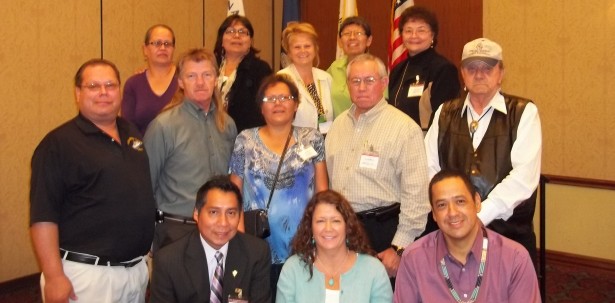
Congratulations to (Justice) Andrew Adams III

On January 28, 2012, the Muscogee (Creek) National Council held its Legislative branches Quarterly Session. An account of the meeting can be found on the Tribal Town Radio Blog. At the meeting, Andrew Adams III, a citizen of the Muscogee (Creek) Nation, was confirmed as a Supreme Court Justice. Andrew’s other contributions to the legal field can be found here. He’s also a Turtle Talk contributor.

Congratulations to Andrew and his family!

Ninth Circuit Denies En Banc Petition in Miranda v. Anchondo (BIA & Pascua Yaqui)

Here are the materials (the order denying review is here):

Miranda En Banc Petition

Combined Opposition to En Banc Petition

The panel materials and opinion are here.


Update in Columbe v. Rosebud Sioux Tribal Court (Suit re Tribal Court Jurisdiction over Nonmember)

Here are the materials in the denial of Columbe’s motions for reconsideration and to hold a trial for a permanent injunction (prior post here, with opinion dismissing plaintiff’s claims):

Columbe Motion for Reconsideration

RST Opposition to Motion for Reconsideration

Columbe Motion for Permanent Injunction

RST Opposition to Motion for Permanent Injunction

DCT Order Denying Motion for Reconsideration

Earliest post here.

Tulalip Tribes Justice System Case Study

Important scholarship. [Will be replaced soon.]

Updated version:

Justice in Indian Country- A Case Study of the Tulalip Tribes

Gila River Advertises Appeals Judge Opening

Here is the position description.

Tenth Circuit Briefs in Appeal of Nambé Pueblo Tribal Court Sentence of Nine Years (without Counsel)

Here are the opening briefs in Romero v. Goodrich:

Romero Opening Brief

Nambe Pueblo Brief

Here are the lower court materials.

Federal Court Holds Salt River Tribal Court Has No Jurisdiction over Frito-Lay in Dispute with Tribal Member

Here are the materials in Frito-Lay v. Stover (D. Ariz.):

DCT Decision in Frito-Lay v Stover

Frito-Lay Motion for Summary J

Stover Opposition to Frito-Lay Motio

Frito-Lay Reply

Stover Motion to Dismiss

Tribal Motion to Dismiss

Navajo Nation SCT Decides Case Involving Challenge to Contempt Order for Violating PPO

Here:

Victor Bowman v. Delores Greyeyes.  Opinion.  Bowman files a petition asking the Court to reconsider its Dec. 14, 2011 summary denial of his application for a writ of habeas corpus.  Reconsideration petitions for special actions may not be filed without leave of the Court. The Court treats the petition as a motion for leave but states that, in future, petitions for leave must first be filed pursuant to N.R.C.A.P. Rule 19(d), and must contain sufficient detail for the Court to rule on the request.  In this case, the Court denies the motion as Bowman offers no new argument. (January 24, 2012).

New Student Scholarship on Federal Court Jurisdiction over Tribal Banishments

Mary Swift has published “Banishing Habeas Jurisdiction: Why Federal Courts Lack Jurisdiction to Hear Tribal Banishment Actions” in the Washington Law Review. The article is available on SSRN here.

Here is the abstract:

The Indian Civil Rights Act (ICRA or ‘the Act’) of 1968 grants members of federally recognized Indian tribes individual civil rights similar to those enumerated in the federal Bill of Rights and Fourteenth Amendment. However, the Act provides only one explicit federal remedy for violations of the rights secured therein: the writ of habeas corpus. The U.S. Supreme Court has refused to read an implied cause of action into the Act. Some federal courts assert habeas jurisdiction to review tribal banishment actions alleged to violate ICRA, but not over disenrollment actions. Tribal banishment means an individual tribal member is cast out from tribal lands and often removed from tribal membership rolls. Tribal disenrollment means an individual tribal member is removed from tribal membership rolls and often denied access to some or all tribal facilities. This Comment argues that federal courts should not assert habeas jurisdiction over tribal banishment actions because: exercising habeas jurisdiction over tribal banishment actions contravenes federal Indian law canons of construction; expansive habeas jurisdiction disturbs the careful balance struck by Congress and the Court between individual rights and tribal sovereignty; declining jurisdiction protects tribes’ sovereign authority to determine their own membership; and the line between banishment and disenrollment is arbitrary because tribes have authority to exclude nonmembers from tribal lands. Though it may leave a few individual tribal members without a remedy to challenge tribal banishment alleged to violate ICRA, such a uniform rule best protects tribal sovereignty, preserves congressional intent, and promotes robust tribal court systems.

South Dakota SCT Remands American Indian Probate Case to Allow Newly-Enrolled Heir to Reopen BIA Probate Decision

Here is the opinion in In re Estate of Flaws.

An excerpt:

Based upon the plain language of SDCL 29A-2-114 and the foregoing authorities, we hold that the trial court did not err in determining that the methods and time limits in the statute for establishing paternity are exclusive. A question remains, however, as to whether Yvette failed to comply with any of them. The trial court found that Yvette had petitioned the Department of the Interior, Bureau of Indian Affairs, Office of Hearings and Appeals to reopen Donald’s probate to include her as an heir. For that reason, the court initially took this matter under advisement to see if Yvette’s petition would be granted. The court subsequently determined it could take more than a year to have Yvette’s petition heard. For that reason, the court issued its decision and this appeal followed. The day after the filing of Yvette’s appellant’s brief, however, the Bureau of Indian Affairs tribunal issued an order directing any parties opposed to naming Yvette as an heir to Donald’s estate to show cause for their objections within thirty days. Thus, Yvette’s efforts to reopen Donald’s probate may still prove successful, permitting her to comply with SDCL 29A-2-114(c) to establish Donald’s paternity. In the interests of justice, therefore, we remand this matter to the trial court to wait for a reasonable time for the Bureau of Indian Affairs’ decision and to proceed accordingly.