Federal Court Challenge to Yankton Tribal Election Dismissed

Here is the opinion in Kirbie-Orozco v. Yankton Sioux Tribal Election Board (D. S.D.) (Kirbie-Orozco v Yankton). Here you are:

In each case, a court has an obligation to determine its jurisdiction. The court finds that it possesses no subject matter jurisdiction over this intra-tribal matter. In re Sac & Fox Tribe of Mississippi in Iowa / Meskwaki Casino Litigation, 340 F.3d 749, 763-64 (8th Cir.2003); Runs After v. United States, 766 F.2d 347, 352 (8th Cir.1985); see also Cohen’s Handbook of Federal Indian Law § 406[1][b][ii] (Nell Jessup Newton, ed.) 2005.

Pokagon Band Election Results

From Indianz:

The Pokagon Band of Potawatomi Indians of Michigan has a new chairman and vice chairman.

Matt Wesaw replaces John Miller as chairman. Wesaw most recently served as vice chairman and served as chairman in the 1990s.

Butch Starrett was elected vice chairman. He replaces Wesaw in the post.

The tribe held its election last Saturday, July 11.

Get the Story:

Pokagon Band elects Matt Wesaw (The Dowagiac News 7/17)

In Honor of Frank Ettawageshik

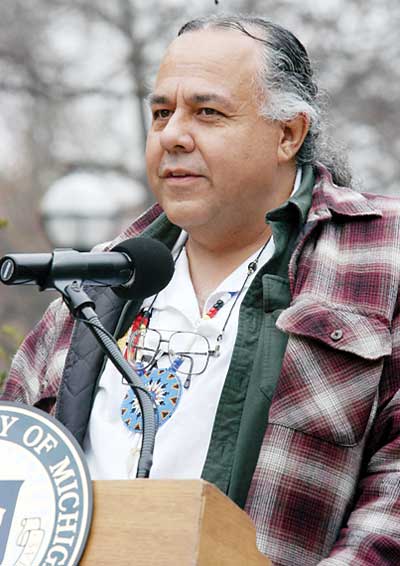
Little Traverse Bay Bands of Odawa Indians chairman Frank Ettawageshik recently lost his bid for re-election as chairman. We wish to honor Frank’s service not only to the Little Traverse Odawak but also to all of the tribes of Michigan.

Michigan Daily
Michigan Daily

Frank has been an enlightened and thoughtful ambassador for the Michigan Anishinaabek, serving as a leader on numerous tough issues such as the Great Lakes Compact, for which he won the 2007 Great Lakes Guardian of the Year award from Clean Water Action Michigan. He has testified before Congress on this issue (more testimony and still more).

He has appeared on CNN to talk about Congressional apologies to American Indians.

And at home, Frank’s administration renegotiated LTBB’s gaming compact and developed and built the Odawa Casino. He has worked on intergovernmental relations and economic development with the State of Michigan.

Frank is an amazing speaker and storyteller, as well as a leader, and he is to be honored.

Miigwetch, Frank.

NYTs: Navajo Nation to Vote on Structure of Government

From the NYTs (Navajo Supreme Court opinion):

FLAGSTAFF, Ariz. (AP) — Navajo voters have never had much of a say in how their modern government was shaped. But that may soon change, after a tribal judge cleared the way for a special election on a restructuring that could alter the balance of power on the sprawling reservation.

The government structure was forced upon Navajo voters 86 years ago and was reorganized under three branches without their consent.

Maybe Navajos “will have a greater sense of ownership in the government than they now have,” said Dale Mason, who teaches Navajo government at the University of New Mexico, Gallup.

In 1923, the federal government created the Tribal Council to sign off on oil and gas leases. Before that, Navajos largely governed themselves. Small bands were led by headmen, or naataanii, who came together only in times of crisis to solve problems that extended beyond their communities.

Even if such a meeting, called a naachid, resulted in a decision to act, no Navajo was bound to comply.

With the discovery of oil on the reservation in 1922, the federal government needed an entity to deal with for leasing matters. It appointed three Navajos to a business council, but soon realized that the group needed to be more representative and expanded it to include delegates from across the reservation.

Continue reading

Sault Tribe to Vote on Chairman/CEO Separation

From AIPBlog:

Tonight the Sault Ste. Marie Tribe of Chippewa Indians voted to have a referendum to change the Tribes Constitutional By-Laws and Separate the Chairman/CEO position into two distinct positions: one elected and one otherwise.

AIPBlog followers realize I have advocated this type of separation and cited several academic studies which indicate more positive outcomes from separating politics and business in Tribes. It is a pleasure as a member of the Sault Tribe to see some action in this direction.

LTBB Primary Election Results

From Indianz:

Members of the Little Traverse Bay Bands of Odawa Indians of Michigan voted in a primary election on May 11. Incumbent chairman Frank Ettawageshik and incumbent vice chairman Bill Denemy received the most votes. They will face Ken Harrington and Dexter McNamara in the June 29 general election. Tribal members also narrowed the field for five council seats.

Get the Story:
Twelve candidates move on in the tribe’s election process (The Petoskey News-Review 5/15)

API v. Sac & Fox — Cross-Motions Pending

The case is ATTORNEY’S PROCESS AND INVESTIGATION SERVICES, INC. v. SAC & FOX TRIBE OF THE MISSISSIPPI IN IOWA.

After having been reopened (see our post here), post-tribal remedies exhaustion, the tribe filed a motion to dismiss, and the plaintiffs filed a motion for summary judgment. Both are pending after the court’s order to allow amendment of some of the pleadings.

DCT Order on Motion to Amend

Sac & Fox Motion to Dismiss

API Resistance to Motion to Dismiss

Sac & Fox Reply

API Motion for Summary Judgment

Sac & Fox Resistance to Motion for Summary J

Attorney’s Process and Investigation Services v. Sac and Fox Tribe — Case Reopened

This case arises out of alleged tortious nonmember conduct during the leadership dispute at Meskawki a few years back. In 2005, the Northern District of Iowa applied the tribal court exhaustion doctrine as justification for staying the case (nov-2005-dct-order). The tribal court’s processes have run (motion-to-reopen-case [includes tribal court decision]), and now the case has been reopened (dct-order-reopening-case).

This will be a very interesting application of the Montana test, if the court reaches the merits.

Indian Law-Related Panels at AALS

Thursday, January 8, 2009, 8:30-10:15

Section on Indian Nations and Indigenous Peoples
Columbia 3, North Tower/Lobby Level, San Diego Marriott Hotel & Marina

New Directions for International Law and Indigenous Peoples

(Program to be published in Idaho Law Review)

The United Nations’ adoption of the “Declaration on the Rights of Indigenous Peoples” in September 2007 marked an historic moment for the world’s 300 million indigenous peoples. The Declaration is the first time that the United Nations has formally recognized indigenous peoples’ rights to self-determination and control over their lands and natural resources. This year’s program will address the following issues related to the Declaration: How can the Declaration be used to improve the lives of indigenous peoples; What national laws and policies violate the Declaration, and what are the most effective remedial measures to address these violations?; and, How will the Declaration influence Congress, the administration and the courts?

Business Meeting at Program Conclusion.

Robert T. Coulter – Speaker
Angelique A. Eaglewoman – Speaker
G. W. Rice – Speaker
Wenona T. Singel – Moderator

Continue reading

Derek Bailey Profiled by Record-Eagle

From the Traverse City Record-Eagle:

PESHAWBESTOWN — Derek Bailey wakes up with a sense of privilege, a feeling he’s had each morning since taking office as chairman of the Grand Traverse Band of Ottawa and Chippewa Indians.

“I hold that thought throughout the day,” he said.

Bailey, 36, became the band’s youngest tribal chairman this month, following a nearly seven-month election odyssey rife with disputes and litigation.

Continue reading