ABA SEER Indigenous Law Committee Student Writing Competition

The ABA Section on Environment, Energy, and Resources (SEER) has launched its 2024 law student writing competitions, and the Indigenous Law Committee is thrilled to be participating again this year. Please share this exciting opportunity with any law students who may be interested in submitting a piece on Indigenous law and the environment!

Prize: $1,000 cash

Length: 20 page max

Entries due: May 31, 2024

Submit to: Kevin.Gordon@americanbar.org with the subject line: “SEER Law Student Writing Competition: Indigenous Law.”

Full competition rules here [updated link].

Tohono O’Odham and San Carlos Apache Sue Bureau of Land Management over Power Line Approval

Here is the complaint in Tohono O’Odham Nation v. Department of the Interior (D. Ariz.):

New Issue of UCLA Indigenous Journal of Law, Culture & Resistance — Vol. 8

Articles

Decolonization of Language Policy in Arctic Canada – Letter to the Editor

Colonialism in northern Canada is not a historical artefact because the bureaucratic structure of colonial government persists. If parts of southern Canada are discussing post-colonial frameworks, then we must consider that the northernmost Territory of Nunavut (“our land”) is in a syn-colonial condition and the present trend is for it to continue. Canada endorsed the United Nations Declaration on the Rights of Indigenous People in 2016 and enacted it in 2021. If Canada is truly committed to a philosophy of reconciliation and decolonization, then it will make policy changes in the north that follow a guiding principle of self-determination for indigenous people. The simplest changes would be 1) to deliver more Inuktut instruction in schools and 2) to add knowledge… 

Revitalizing Stewardship and Use of Tribal Traditional Territories: Options for Improving California Policy and Law in State-Managed Lands and Waters

California dispossessed Indian tribes of millions of acres in the decades following the State’s founding. Loss of tribal land and waters largely cut off Indian tribes from ancestral territories on which they depend for food, culture and identity. Tribal arguments for rights to these areas outside their reservations have some support in the law, but solutions are better produced in a collaborative process between sovereign Indian tribes and State resource agencies. Recent changes in State policy that seek to remedy historic injustices and respect tribal sovereignty provide opportunities for joint efforts. The authors propose seven options for discussion among Indian tribes and State agencies. The goal is to catalyze a process by which the tribes and agencies may… 

Eagle Permits, RFRA, and American Indian Religious Freedom: Legal Avenues for First Amendment Protection

Built on a colonial discourse of justifiable Christian conquest, United States federal Indian law and policies have specifically targeted American Indian religious practices as a way to assimilate American Indians into the dominant colonizing culture and to undermine tribal sovereignty. Federal policies throughout colonization and into the present have drastically swung between denying American Indian religious practice and allowing for it under federal control, creating a confusing string of conflicting precedent. Although the worst of these practices has largely been abandoned, the paternalism of the United States government continues today with the creation and oversight of a permit system, which regulates the use and possession of bald and golden… 

E PULE KĀKOU! (LET US PRAY!): Constitutionality and Practicability of Public School Sponsored Native Hawaiian Prayers

This article argues that the state of Hawai’i should encourage and provide legislative protection for practicing pule in K-12 public schools on a regular basis for cultural and educational purposes. The Hawai’i state constitution should have specific provisions regarding the time, venue, and practitioners of pule. Hawai’i state laws should provide greater protection of Native Hawaiian religious rights than federal laws. Part II introduces the educational and cultural values of pule, its connection with ‘Ōlelo Hawai’i(Native Hawaiian language) from the past to present, and pule practices as educational programs at public schools can contribute to the Third Hawaiian Renaissance. Part III reviews the current Hawai’i state law protection of pule in public schools under… 

The United Nations Declaration on the Rights of Indigenous Peoples in Defense of the Indian Child Welfare Act

The Indian Child Welfare Act (ICWA) is a law that was passed to address the removal crisis of American Indians from their community to non-Indian families. The removal crisis is a result of centuries of detrimental federal government policies such as assimilation laws and boarding schools and campaigns to “adopt out” Indian children. ICWA has been challenged over the years in court but has prevailed. Although child removal has decreased slightly since its adoption, the data on removal are still shocking and must be addressed. The most recent development in the fight over ICWA is Brackeen v. Bernhardt where a non-Indian adoptive couple is suing over ICWA’s constitutionality under the equal protection clause and Tenth Amendment. Because of the confusion between…

Fletcher on the Sovereignty Problem in Federal Indian Law

Check out “The Sovereignty Problem in Federal Indian Law” on SSRN.

Here is the abstract:

There is a sovereignty problem in federal Indian law, namely, that the federal government’s sovereign defenses prevent tribal nations and individual Indian people from realizing justice in the courts. Often, compelling tribal and Indian claims go nowhere as the judiciary defers to the interests of the United States, even where Congress has expressly stated its support for tribal interests. Conversely, tribal judiciaries allow claims to proceed to the merits, invoking customary and traditional law to hold tribal governments accountable.
Sovereignty theory helps to explain why justice can be done in one court system but not another. But federal, state, and tribal courts are all American courts than can and should learn from one another. This paper is an effort to show that federal sovereign defenses are not inevitable, nor are they even necessary.

Data good.

Fort Peck Tribes Expand its Criminal Jurisdiction over Non-Indians

The Fort Peck Tribes Expand Criminal Jurisdiction Over Non-Indians

On August 17th, 2023, the Fort Peck Tribal Executive Board expanded its special jurisdiction over non-Indians under the Violence Against Women Reauthorization Act of 2022 (VAWA).


What is VAWA?

Originally passed in 1994, VAWA is the first Federal Legislation acknowledging domestic violence as crime and provides resources to encourage Community Coordinated Responses to prevent violence against Women. Subject for renewal every five years, VAWA has been reauthorized in 2000, 2005, 2013, and in 2022. Each reauthorization builds upon existing protections for victims of domestic violence and will be subject to another reauthorization in 2027. *

Continue reading

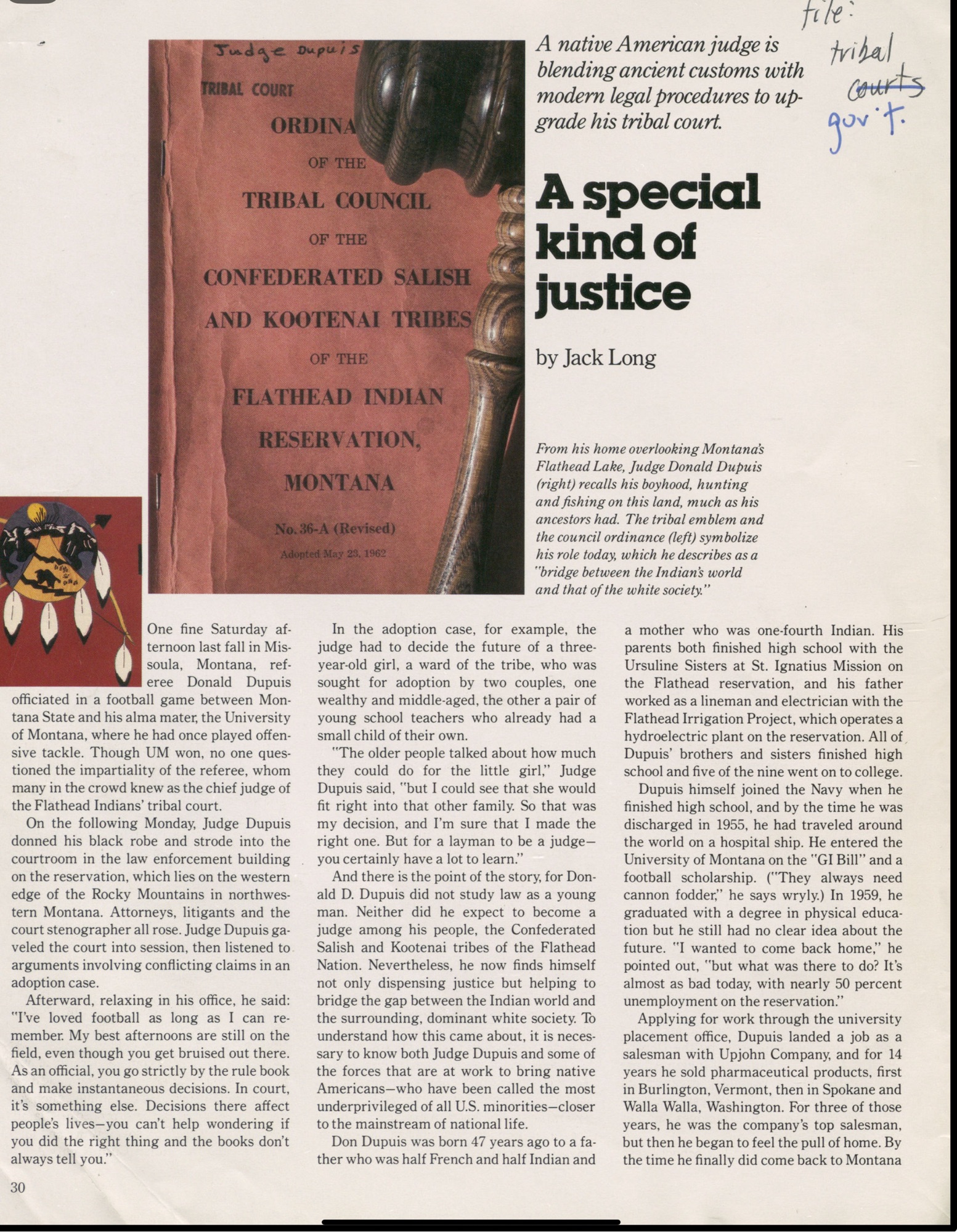
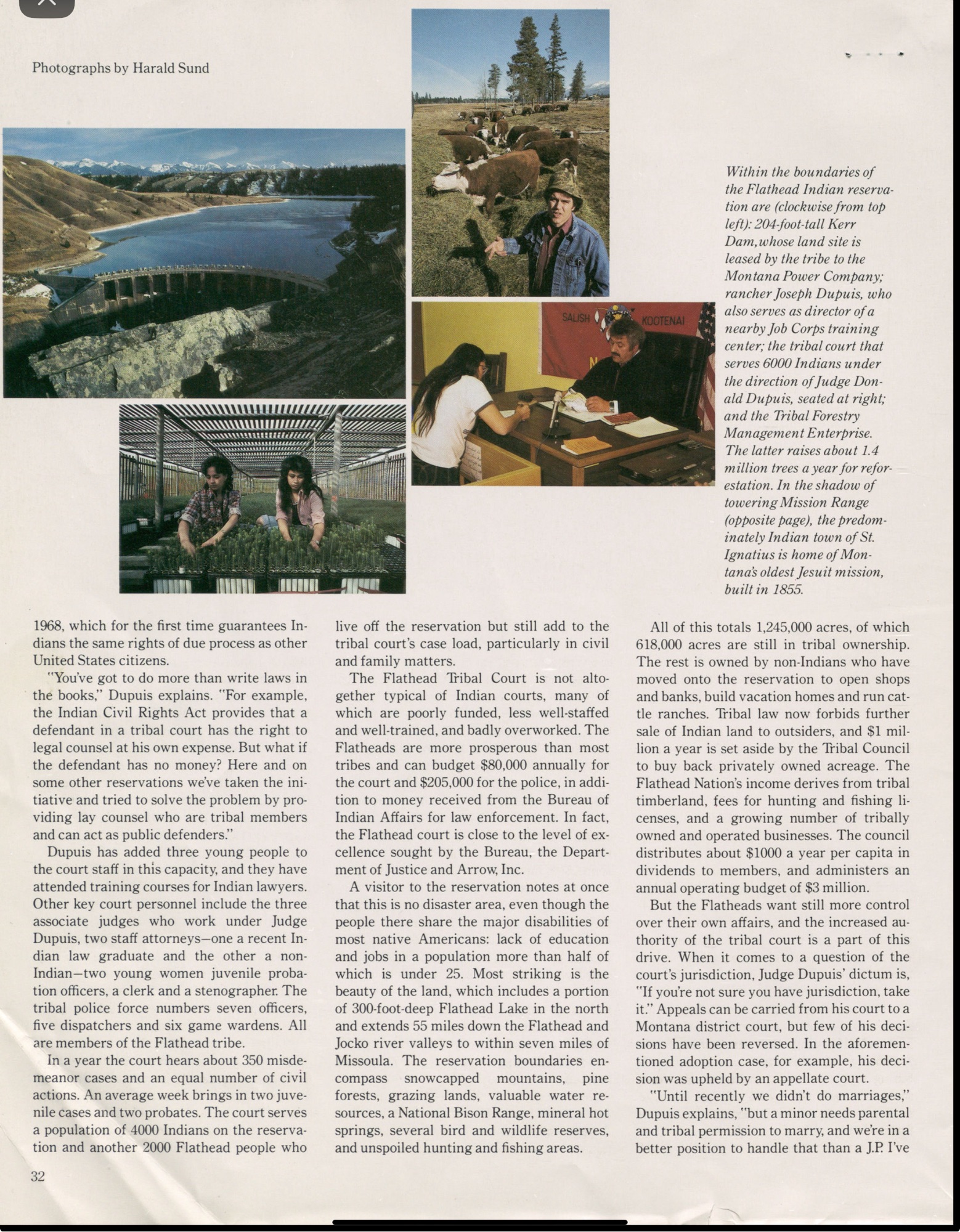
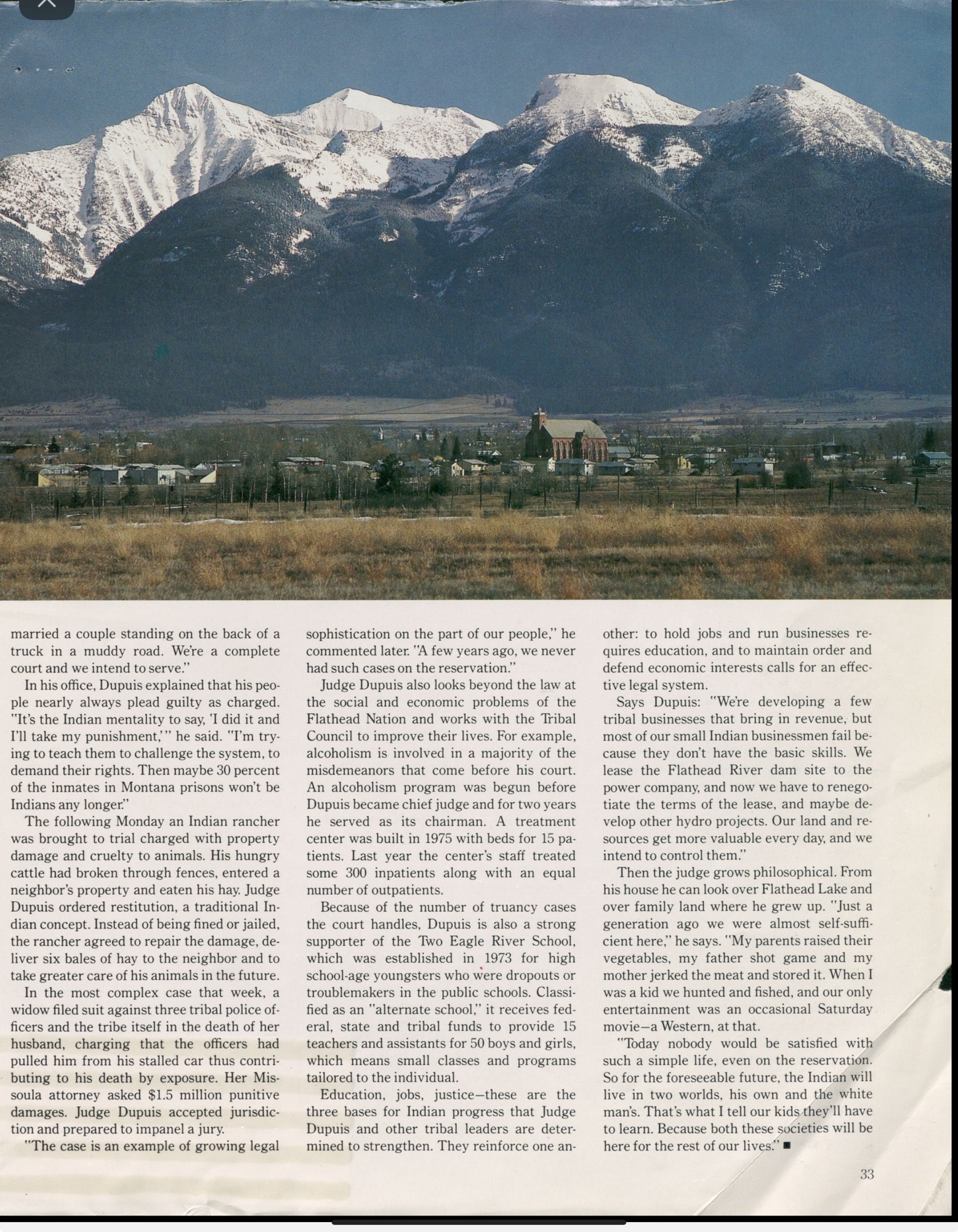
Blast from the Past — Profile of Flathead Tribal Judge Donald Dupuis [1980]

Here, published in the Exxon shareholder magazine The Lamp (!):

Comment on the U.S. Forest Service’s Proposed Rule, “Land Uses; Special Uses; Carbon Capture and Storage Exemption,” 88 Federal Register 75530 (Nov. 3, 2023)

Here:

Chief Justice Position for Blackfeet Tribe Appellate Court

 Position Announcment Chief Justice

This is an active appellate court with many interesting and sometimes complex cases. 

The Blackfeet Tribe is actively seeking applications for a Chief Justice for the Court of Appeals. The Chief Justice is responsible for overseeing the judicial component of the Blackfeet Court of Appeals in accordance with the Blackfeet Constitution and By-Laws, 1934, Blackfeet laws, judicial oath of office, terms of appointment and the Blackfeet Rules of Court. The Chief Justice is also responsible for ensuring that Court of Appeals grants and contacts are adhered to. Will preside over all cases within the Blackfeet Court of Appeals. Must have a Juris Doctorate from an ABA accredited law school and be at least thirty (35) years of age at time of appointment.

For application materials, including job description and qualification requirements, please contact the Blackfeet Tribe Personnel Department at (406) 338-7307 or email mbird@blackfeetnation.com or laugare@blackfeetnation.com.

Winnebago Tribe of Nebraska Sues Army over Children’s Remains at Carlisle Indian School Grounds

Here is the complaint in Winnebago Tribe of Nebraska v. United States Department of the Army (E.D.Va.):