
Michigan Journal of Race & Law: Last Lunch of the Semester!

Alexis Studler has published “Reviving Indian Country: Expanding Alaska Native Villages’ Tribal Land Bases Through Fee-to-Trust Acquisitions” in the Michigan Journal of Race & Law.
Here is the abstract:
For the last fifty years, the possibility of fee-to-trust acquisitions in Alaska has been precarious at best. This is largely due to the Alaska Native Claims Settlement Act of 1971 (ANCSA), which eschewed the traditional reservation system in favor of corporate land ownership and management. Despite its silence on trust acquisitions, ANCSA was and still is cited as the primary prohibition to trust acquisitions in Alaska. Essentially, ANCSA both reduced Indian Country in Alaska and prohibited any opportunities to create it, leaving Alaska Native Villages without the significant territorial jurisdiction afforded to Lower 48 tribes. However, recent policy changes from the Department of Interior reaffirmed the eligibility of trust acquisitions post-ANCSA and a proposed rule from the Bureau of Indian Affairs signals a favorable presumption of approval for Alaska Native fee-to-trust applications. This Note reviews the history and controversy of trust acquisitions in Alaska, and more importantly, it demonstrates the methods in which Alaska Native Villages may still acquire fee land for trust acquisitions after ANCSA.

M. Henry Ishtani and Alexandra Fay have published “Revising the Indian Plenary Power Doctrine” in the Michigan Journal of Race & Law.
Here is the abstract:
The federal Indian law doctrine of Congressional plenary power is long overdue for an overhaul. Since its troubling nineteenth-century origins in Kagama v. United States (1886), plenary power has justified invasive Congressional interventions and undermined Tribal sovereignty. The doctrine’s legal basis remains a constitutional conundrum. This Article considers the Court’s recent engagement with plenary power in Haaland v. Brackeen (2023). It argues that the Brackeen opinions may signal judidal readiness to reevaluate the doctrine. The Article takes ahold of Justice Gorsuch’s critical assessment and runs with it, ultimately proposing a method for cleaning up this destructive and constitutionally dubious line of caselaw.
Here are the materials in Sierra Club v. Dept. of Transportation:

Bethany R. Berger has published “Intertribal: The Unheralded Element in Indigenous Wildlife Sovereignty” in the Harvard Environmental Law Review.
Here is the abstract:
Intertribal organizations are a powerful and unheralded element behind recent gains in Indigenous wildlife sovereignty. Key to winning and implementing judicial and political victories, they have also helped tribal nations become powerful voices in wildlife and habitat conservation. Through case studies of these organizations and their impact, this Article shows why intertribal wildlife organizations are necessary and influential, and how the intertribal form reflects a distinct relational approach to wildlife governance. As the first article focused on the intertribal form, moreover, the Article also identifies an unexamined actor in tribal sovereignty and legal change.
Highly recommended!

Alejandro E. Camacho, Elizabeth Ann Kronk Warner, Jason McLachlan, and Nathan Kroeze have posted “Adapting Conservation Governance Under Climate Change: Lessons from Indian Country,” forthcoming in the Virginia Law Review, on SSRN.
Here is the abstract:
Anthropogenic climate change is increasingly causing disruptions to ecological communities upon which Natives have relied for millennia, raising existential threats not only to ecosystems but to Native communities. Yet no analysis has carefully explored how climate change is affecting the governance of tribal ecological lands. This Article closes this scholarly and policy gap, examining the current legal adaptive capacity to manage the effects of ecological change on tribal lands.
The Article first considers interventions to date, finding them to be lacking in even assessing—let alone addressing—climate risks to tribal ecosystem governance. It then carefully explores how climate change raises distinctive risks and advantages to tribal governance as compared to federal and state approaches. Relying in part on the review of publicly available tribal plans, the paper details how tribal adaptation planning to date has fared.
In particular, the Article delves into the substantive, procedural, and structural aspects of tribal governance, focusing on climate change and ecological adaptation. Substantively, tribal governance often tends to be considerably less wedded to conservation goals and strategies that rely on “natural” preservation, and many tribes focus less on maximizing yield in favor of more flexible objectives that may be more congruent with adaptation. Procedurally, like other authorities, many tribal governments could better integrate adaptive management and meaningful public participation into adaptation processes, yet some tribes serve as exemplars for doing so (as well as for integrating traditional ecological knowledge with Western science). Structurally, tribal ecological land governance should continue to tap the advantages of decentralized tribal authority but complementing it through more robust (1) federal roles in funding and information dissemination, and (2) intergovernmental coordination, assuming other governments will respect tribal sovereignty. The Article concludes by identifying areas in which tribal management might serve as valuable exemplars for adaptation governance more generally, as well as areas for which additional work would be helpful.

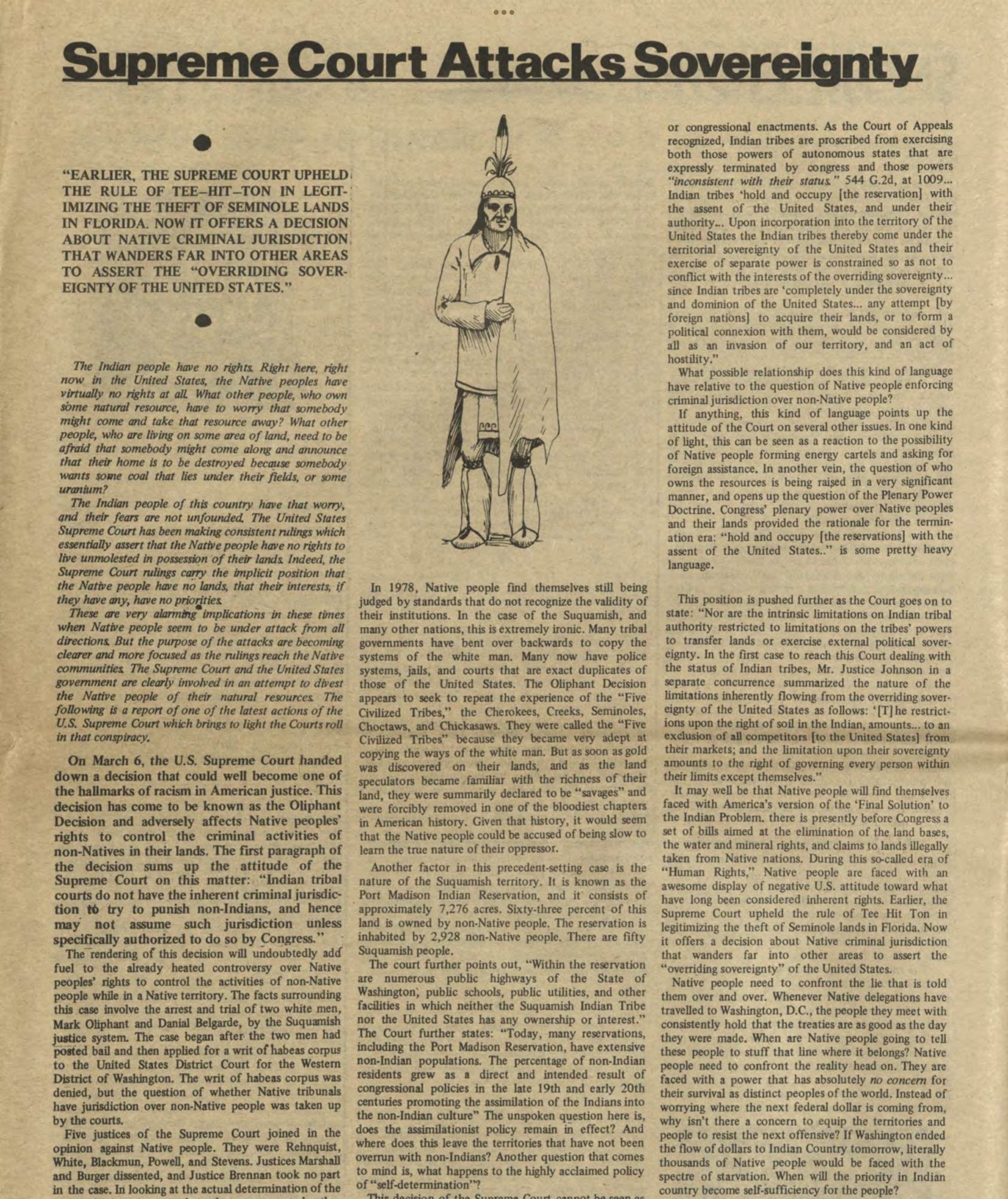
Grand Christensen has posted “Tribal Courts are Courts of General Jurisdiction,” forthcoming in the Florida Law Review, on SSRN. Here is the abstract:
Twenty years ago the Supreme Court misread its precedents and took a short cut to do what was “simpler” instead of what was right. It determined that tribal courts are not courts of general jurisdiction without examining the origins of tribal judicial power. Writing for the majority in Nevada v. Hicks, Justice Scalia concluded that in order to find that tribal courts were able to interpret federal law the Court would have to “attribute to tribal courts jurisdiction that is not apparent.” But power often exists even if it is not apparent at first glance. Unwilling to do even a cursory examination to determine whether tribal courts might nonetheless possess general jurisdiction, the Court decided that it would be “surely [ ] simpler… to conclude that tribal courts cannot entertain” claims arising under federal law. This article objects to the legal principle that tribes cannot exercise their inherent sovereign powers because it would “simpler” for the Supreme Court.
In Hicks, the Court abdicated its responsibility by not engaging in an analysis of the origins of the judicial power exercised by tribal courts. Under the principles of inherent sovereignty it is the tribal sovereign and not the Supreme Court that controls the jurisdiction of tribal courts. If a tribal government vests in its judicial department the authority to interpret federal law, then the tribal court maintains that power until withdrawn by the tribal sovereign. This article further argues that the Court in Hicks exceeded its Article III exercise of the judicial power to attempt to limit – against the will of the tribal sovereign – the general jurisdiction of tribal courts. It concludes by encouraging tribal governments to decide for themselves whether they want their courts to interpret federal law. If the tribal sovereign assigns that power to its courts, then tribal courts should begin affirmatively exercising general jurisdiction despite the Hicks precedent.



 Turtle Talk
You must be logged in to post a comment.