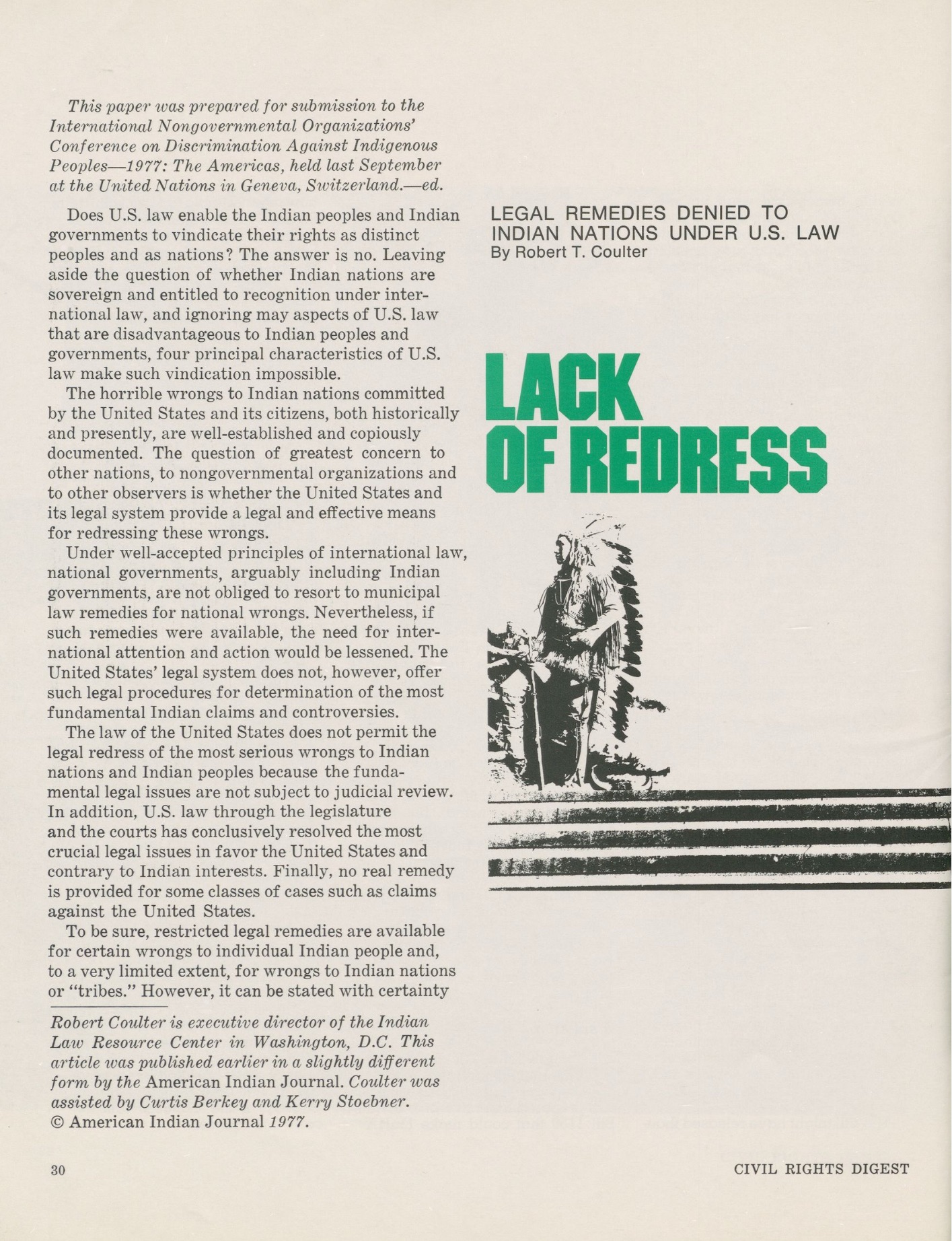
The inherent Tribal sovereignty of Native nations predates the formation of the United States and is reflected in the constitutional vision of tripartite sovereignty. Yet their sovereignty is oft diminished explicitly by federal law or implicitly by federal courts. This implicit divestiture is often the result of the federal judiciary’s inconsistent interpretations of Indigenous Peoples law. This Article argues that a more principled and coherent approach for federal judges would be to consistently make use of the corpus juris, or whole body of law, including the in pari materia or affiliated statutes canon. The Article posits that the corpus juris of inherent Tribal sovereignty requires understanding whether any federal laws have explicitly abrogated or diminished a specific Native nation’s rights to traditional self-governance and understanding traditional Tribal law. The corpus juris inherent Tribal sovereignty approach illustrates how, where the Supreme Court has utilized the in pari materia canon, the consistency and coherence of Indigenous Peoples law increases. Through an analysis of select cases, involving Native nation traditional land and ways of life, I illustrate how Alaska Native nations have been particularly impacted by the explicit and implicit diminishment of traditional ways of life. However, through traditionally informed governance systems, Alaska Native nations continue to assert their inherent Tribal sovereignty, especially when faced with Alaska’s “sole state sovereignty” arguments in federal courts. The Article utilizes the corpus juris of inherent Tribal sovereignty argument and the constitutional vision of tripartite sovereignty to illustrate how the State of Alaska’s “sole state sovereignty” arguments must fail when utilizing this more coherent approach.
We are back from break and catching up on job postings so please accept our apologies if you sent a job posting and it hasn’t been posted.
If you have a new announcement, please share it with us by uploading the information requested on this Google Form. If you have any questions, please email the MSU College of Law Indigenous Law & Policy Center at indigenous@law.msu.edu.
Legal Summer Intern
Waseyabek, Grand Rapids, MI
Waseyabek LLC’s Legal Department is seeking a motivated and detail-oriented Summer Legal Intern to support a broad range of legal functions. This role provides hands-on experience in a dynamic, mission-driven organization working at the intersection of tribal sovereignty, business development, and corporate law.
Must be enrolled in an accredited law school and have successfully completed at least one year of coursework
Strong research, writing, and analytical skills
Ability to handle confidential information with professionalism and discretion
Excellent attention to detail and organizational skills
Interest in corporate, regulatory, and/or tribal law is a plus
Law Student Volunteer – Office of Tribal Justice, Summer 2026,
Office of Tribal Justice, U.S. DOJ, Washington, D.C.
The internship is designed to give students the opportunity to gain first-hand experience working on challenging projects and cases principally involving issues of federal Indian law. Interns work closely with attorneys in the Office of Tribal Justice (OTJ) on a wide range of Indian law issues and projects. Work may include legal research, drafting legal memoranda and briefs, participating in public policy development, reviewing proposed legislation, and responding to citizen correspondence. Also, interns may have the opportunity to attend Congressional hearings, oral arguments before the Supreme Court, and high-level meetings with OTJ attorneys. All full-time, rising second- or third-year law students. Law school graduation terminates eligibility except for graduate law students who are enrolled at least half-time and not practicing law. Students should be able to demonstrate excellent academic credentials, good writing skills, knowledge of federal Indian law, and familiarity with tribes and tribal matters. Academic credit for work experience possible. Open until January 16, 2026 https://www.justice.gov/legal-careers/job/law-student-volunteer-summer-2026-3
The Blackfeet Tribe is seeking an entry level associate attorney to join the Blackfeet Legal Department in Browning, Montana. Selected candidates will conduct research, draft legal documents, contribute to case preparation, and participate in civil litigation in Federal, State, and Tribal courts. We seek a candidate with strong legal writing, analytical, and communication skills, coupled with a commitment to ethical standards. If you are prepared to make a significant contribution to our Department and strive for legal excellence, we encourage you to submit your application and be part of our dedicated team.
Interested candidates please email a cover letter, resume and a list of references to: tgilham@blackfeetnation.com
Juris doctorate; Admission to State Bar(s)
Salary Negotiable Open until February 15 2026
Court Administrator Officer
Wilton Rancheria, Elk Grove, CA
The Court Administrative Officer serves as the chief administration personnel for the Wilton Rancheria Tribal Court. The incumbent is responsible for ensuring the effective and efficient administration and operation of the Judicial Branch, encompassing the Tribal Court, Traditional Court, and Appellate Court. The Court Administrative Officer provides leadership in strategic planning, personnel supervision, and the administrative management of Court resources. Minimum Qualifications:
Bachelor’s degree in Political Science, Business Administration, Public Administration, or a related field. Minimum of three (3) years in court administration, governmental operations, or legal administration (e.g., court administrator, court clerk, government director, attorney, or paralegal). Minimum of two (2) years in a supervisory or management role with increasing responsibility. Must successfully pass a background investigation and maintain strict confidentiality under Tribal and federal law. Must pass pre-employment and random drug testing. Must possess a valid California Driver’s License (or obtain within a reasonable time), have a safe driving record, and be insurable under the Tribe’s vehicle policy. Must be able to travel occasionally for training and conferences.
Hiring Preference Policy:
Among qualified applicants, preference is given to Wilton Rancheria Tribal Members, then to spouses of Wilton Rancheria Tribal Members, and to other Native Americans. All applicants claiming preference must submit verification of their Native American heritage.
Wilton Rancheria is seeking a qualified individual to serve as Chief Judge for its Tribal Court. This role involves presiding over all cases brought before the court, issuing orders, judgments, warrants, and subpoenas, and ensuring fairness and impartiality in decision-making. The Chief Judge will also participate in administrative matters, including presenting a court budget to the Tribal Council and maintaining court rules in coordination with the council for efficient administration of justice.
Eligibility requirements for the Chief Judge position include being admitted to practice law before the highest court of any state, being at least 35 years old, having no felony convictions or recent misdemeanors involving moral turpitude, and possessing familiarity with federal Indian law. Proposals will be evaluated based on general experience, specific expertise with tribal law and governance, judicial philosophy, references, and Native American preference in accordance with the Tribe’s policy.
Applicants must submit a cover letter, responses to all requested information, and disclose any potential conflicts of interest.
The Directing Attorney/Senior Directing Attorney provides vision and strategic leadership for the Alaska Native Justice Center’s comprehensive legal services. This position oversees and manages ANJC’s internal legal practice procedures, supervises legal staff, manages program budgets, and ensures effective service delivery across all programs. Working in partnership with our people, the Directing Attorney develops opportunities that fulfill our endless potential by leading a team that represents Alaska Tribes in child welfare matters, provides technical assistance to tribal justice systems, and delivers civil legal services to Alaska Native and American Indian victims of violence. The role requires exceptional legal expertise, strategic thinking, and dedication to advancing justice for Alaska Native communities.
Duties and Responsibilities:
• Ensure the quantity and quality of legal work and effective, efficient, high-quality representation of clients across all ANJC services.
• Oversee administration, compliance, and fiscal management of grant-funded initiatives, including budgets, contracts, audits, financial reporting, and evaluations.
• Lead and supervise attorneys, paralegals, and support staff, providing mentoring, guidance, and professional development opportunities.
• Collaborate with the COO and staff for legal work management, including assistance and administration of legal work management and database systems.
• Develop and maintain effective partnerships with Tribes, Tribal Organizations, Alaska Native organizations, and funding sources to advance ANJC’s mission.
• Serve as a strategic contributor and active member of the CITC Leadership Council (CLC), representing ANJC in organizational planning and decision-making.
• Prepare and present strategic information, reports, and recommendations to senior leadership and the Board of Directors.
• Represent ANJC in local, state, and national forums on public safety, justice, and Alaska Native legal issues.
• Design and ensure delivery of community education presentations and outreach initiatives to increase awareness of ANJC services statewide.
• Implement strategies that advance ANJC’s public policy objectives, including researching proposed legislation and regulations and drafting consultation comments.
• Oversee applicant and client services tracking procedures, reporting, and data maintenance to ensure compliance with grant requirements.
• Manage day-to-day office operations and improve administrative systems, policies, and processes to enhance organizational effectiveness.
• Carry an appropriately sized caseload concomitant with other duties and responsibilities as assigned by the COO.
• Travel to rural and urban areas as required to support client services and community partnerships.
• Perform all related duties as needed and assigned.
Directing Attorney
Seven (7) years of experience in the practice of law, including experience and knowledge in Alaska Native legal issues, Indian Child Welfare Act and Child in Need of Aid.
Three (3) years of experience as a manager overseeing social service, legal or related programs, including budget management, grant administration and development of staff.
Senior Directing Attorney
Ten (10) years of experience in the practice of law, including experience and knowledge in Alaska Native legal issues, Indian Child Welfare Act and Child in Need of Aid.
Five (5) years of experience as a manager overseeing social service, legal or related programs, including budget management, grant administration and development of staff.
Preferred Qualifications: Previous experience with legislative process.
Experience in ANCSA/Indian law, P.L. 93-638 and P.L. 102-477.
Columbia River Inter-Tribal Fish Commission, Portland, Oregon
• Serve as CRITFC’s principal legal counsel on treaty rights, tribal sovereignty, environmental and natural resource law, and organizational compliance.
• Lead a team of attorneys and legal staff, overseeing litigation support, policy development, and intergovernmental negotiations.
• Build partnerships with tribal governments, federal and state agencies, and regional stakeholders to advance CRITFC’s mission and protect tribal treaty rights.
• Guide CRITFC’s legal and policy strategies while supporting organizational systems, risk management, and compliance efforts.
• Juris Doctorate from an accredited law school, active bar membership in WA, OR, or ID (or ability to obtain within one year). Special consideration will be given to practice in other states accompanied by the ability to acquire a license to practice in any of the three states listed.
• Certificate, special training, and/or experience in Expertise in Indian law, tribal sovereignty, environmental and natural resource law, and federal litigation procedures.
• Experience working with Native American Tribes in any capacity.
• Minimum of 10 years’ experience as a practicing attorney.
• Minimum 5 years’ experience in a supervisory position.
Washington DC Regional, Earthjustice, Washington DC
Conduct and supervise advocacy before federal agencies and courts as warranted.
Manage new and existing cases from start to finish.
Act as lead counsel in ongoing and potential litigation to secure and strengthen national greenhouse gas emissions standards for major industries.
Juris Doctorate (JD) degree from an ABA accredited law school. Six+ years of litigation and legal advocacy experience, working both independently and in a coalition setting. Admitted or eligible to waive in for admission to the District of Columbia Bar.
Salary $161,400 – 206,200. For this position, we seek a candidate available as soon as possible. Preference will be given to applications received by January 16, 2026. https://app.jobvite.com/j?aj=oS91yfwk&s=Turtle_Talk
American Indian Law Center Albuquerque, NM (hybrid)
The American Indian Law Center (AILC) is seeking a mission-driven, highly organized Assistant Director to lead the Pre-Law Summer Institute for American Indians and Alaska Natives (PLSI) and its year-round programs supporting Native pre-law and law students. This is a visible, influential role for someone who thrives in education and program management, enjoys building relationships, and can keep many moving parts running smoothly. While AILC is housed at and partners with UNM Law School, AILC is a separate non-profit, and is not part of UNM.
What you will do:
· Lead day-to-day operations for PLSI and related programs, including bar prep initiatives, clerkship programs, and academic/professional development offerings.
· Lead pathway outreach to pre-Law students in order to recruit and prepare them for Law School and applications.
· Plan and deliver key program cycles: recruitment, application review, admissions, registration, orientation, daily class schedules, and end-of-program wrap-up.
· Build and maintain strong relationships with alumni, tribal colleges and universities, tribal education” “· Bachelor’s degree required
· Experience working with Tribes or Natives, 1 yr preferred
· Recruitment and/or outreach, 1 yr preferred
· Grants management and reporting, 1 yr preferred
· Public speaking, 1 yr preferred
· Microsoft Office 365 (Outlook, Word, Excel, PowerPoint) environment including formatting and production of word processing documents, spreadsheets, and reports.
· Ability to use tools and applications for communication, gathering and organizing data, tracking progress, promoting programs, reporting, and video conferencing.
· Experience developing social media content (Planable, Mailchimp, Survey Monkey, Doodle, Word Press)
· Ability to travel out of state 4-5 trips per year for 3-4 days per trip to do outreach, presentations, and tabling
· Reliable transportation required
· US driver’s license required
· We are funded by the Bureau of Indian Education, and our grants require Indian Preference in hiring.
Benefits:
· 403b with 2% contribution
· Employer paid life insurance
· 64 hours of NM Healthy Workplaces Act paid sick leave per year
· One week of PTO per year
· Seven holidays (MLK, Juneteenth, July 4, Labor Day, Thanksgiving and Day after Thanksgiving)
· Approximately two weeks off, paid, over winter break, which follows or exceeds UNM Law School’s closure (Dec 20, 2025-Jan 4, 2026)
Attorney provides direct representation and advice to various government departments; manages a case load at all stages of litigation involving extensive courtroom work primarily in child welfare matters in both Tribal and State court; prepares legal opinions, memoranda and other legal documents; performs legal research and general contract review; and assists in statutory review and drafting.
•Graduate of an American Bar Association approved law school with a J.D. degree.
•Member in good standing with the State Bar of Minnesota, if presently licensed within the jurisdiction.
•Must possess a license to practice law in the State of Minnesota, and therefore must present either the above-referenced Certificate of Good Standing or a copy of a completed and pending Application for Admission to the Bar of Minnesota.
•Knowledge or experience in American Indian law and court systems preferred but will train.
•Legal and native cultural principles or practices and knowledge or experience in child protection matters a plus.
•Experience in conducting hearings, preparing opinions and briefs, and preparing cases for trial a plus.
•Ability to communicate effectively and persuade or lead others.
•Personal computer skills in a Windows environment.
•Must have a valid driver’s license and be insurable under the Band’s Auto Insurance Policy.
•Must pass a pre-employment drug & alcohol test and background check.
Represents the Fort McDowell Yavapai Nation in all criminal, juvenile, dependency and/or comparable actions; Represents the Fort McDowell Yavapai Nation in all appeals of all criminal and juvenile actions; Reviews reports and complaints to determine if court action should be filed; Prosecutes violations of tribal laws and ordinances and negotiates plea agreements; Researches and prepares legal pleadings, argues motions and appeals and formulates trial strategies; Researches technical and scientific aspects of evidence; Interviews and prepares witnesses to testify at trial; Contacts defense attorneys or unrepresented defendants regarding pending cases and collects and provides discovery to the defense Responds to police and other enforcement personnel requests for information as requested; Advises police or other enforcement personnel on legal matters and procedures; Provides legal assistance to prosecuting staff and other tribal attorneys as requested; Monitors court scheduling of cases and maintains case logs and prosecution statistics; Provides limited assistance to the general public by answering limited questions; Researches existing laws/ordinances;
A law degree from an accredited law school and Membership in the State Bar of Arizona;
Three years of responsible experience in criminal prosecution or defense of criminal cases including jury trials;
Tribal experience desirable;
Juvenile court experience desired
Drug court experience desired
Current Arizona driver’s license and ability to meet insurance standards,
Fort McDowell Yavapai Nation, Fort McDowell, Arizona
Hears and determines all types of cases filed in the Tribal Court, including but not limited to: criminal, traffic, civil (e.g. domestic relations, probate, repossession, breach of contract, personal injury), juvenile, and children cases (e.g. neglect, dependency, incorrigibility, truancy) as directed by the Chief Judge. Conducts legal research and issues orders in connection with cases heard in a timely matter. Presides over jury trials; Issues search and seizure warrants, arrest warrants, and orders of protection where appropriate. Assists in the development of court rules of procedure in all areas listed above. Performs other duties as assigned by the Chief Judge.
1) Must be At least thirty (30) years of age
2) Must be a law school graduate OR possess a minimum of three years experience as a judge, practicing attorney or advocate and have a high school diploma or GED Certification
3) Juris Doctorate preferred
4) Must submit to and pass a FBI criminal history background check
5) Must successfully pass a pre-employment drug screen
6) Must have a current AZ driver’s license and meet FMYN insurance standards
The Reservation Attorney shall provide legal counsel to the Tulalip Tribes government in all judicial and administrative forums and in the Tribes’ governmental and business relations with outside entities. This position will focus on the area of child welfare, and will appear in Tulalip and State Courts on behalf of the Tulalip Tribes in child welfare proceedings. One (1) year of experience practicing law or equivalent experience advocating for or providing counsel to Indian tribes or tribal communities.
Under the supervision of the Senior General Counsel, provide general legal advice to the Tribe and its sub-entities in a broad variety of areas including but not limited to contracts, employment, Indian gaming, taxation, jurisdiction, environmental regulation, cultural resource preservation, child welfare, and Tribal Code development. Juris Doctorate from an ABA accredited law school; At least three (3) years’ experience as a practicing attorney, preferably five (5) years and with a tribal government or entity that represents tribal interests; Must be able to provide at least one writing sample; Advanced proficiency in Microsoft Office (Word, PowerPoint, Excel, & Outlook) and Adobe Acrobat; Ability to follow direction and to work collaboratively with groups or individuals; Licensed to practice law in the State of New Mexico; or must be licensed in another state and become licensed in the State of New Mexico following the next available bar exam; or by reciprocity no later than six months after date of hire; if not licensed in any state, then must become licensed in the State of New Mexico following the next available bar exam; Familiarity with federal Indian law; Must be able to pass background check to meet the employment eligibility requirements as they pertain to the position; If terminated from any previous position held as an attorney then the applicant must demonstrate that such termination was made without cause or that the reasons for termination would not adversely impact the duties and responsibilities herein; Licensed to practice law in the State of New Mexico; Must possess valid State driver’s license and meet Tribal insurance standards; Must successfully pass a pre-employment drug/alcohol screen and background investigation. Salary: $76,731- $115,128 an. Open until filled https://mescaleroapachetribe.com/careers/
Other positions currently posted at Mescalero Apache Tribe:
1.Serves as the Division Head for the Division of Intergovernmental Affairs, supervises Division staff, and develops and administers the Division’s budget.
2.Conducts technical, historical, political, and legal research on topics and issues relevant to treaty hunting, fishing, and gathering rights, and in particular Indian law and environmental law.
3.Coordinates with other GLIFWC staff, GLIFWC’s Board of Commissioners, and GLIFWC Committees on legal and policy activities related to treaty hunting, fishing, and gathering rights that affect the Commission and its member tribes. Assists in the development of policy positions, the preparation of comments, drafting regulatory changes, and in consultations with other governments.
4.Acts as a primary point-of-contact for meetings of the Voigt Intertribal Task Force, including the development of agendas and timely preparation of meeting materials.
5.Assists and advises the Commission and other Commission Divisions regarding legal or policy matters, including the development of agreements with outside consultants, and the development and administration of the Commission’s P.L. 93-638 contract and other contracts or grants.
6.Assists the Commission in matters affecting the Commission’s federal funding, including the coordination of appropriations priorities and the preparation of Congressional testimony.
7.Draft and review legal documents including resolutions, contracts, Memoranda of Understanding, and GLIFWC policies.
8.Assists member tribes regarding negotiations or litigation relevant to treaty hunting, fishing, and gathering rights.
QUALIFICATIONS:
Juris Doctor (JD) degree and membership in good standing in a State Bar required.
High degree of skill in oral and written communication required.
No less than 5 years of work or other relevant experience with Indian tribes and the operation of tribal government required.
Background in political science, public policy, biological or environmental science desirable.
Capability to work with a variety of professional and non-professional individuals.
Indian preference will be applied consistent with GLIFWC policies and the federal Indian Self Determination and Education Assistance Act (PL 93-638).
Salary: $84,546-$95,818 Open until January 2, 2026 or until filled.
APPLICATION PROCEDURE:
Interested employees must submit a completed GLIFWC primary application for employment, a letter of interest, and a resume or CV (including three professional references) to be considered for the position. Applications are available at https://glifwc.org/about-us/careers. Completed applications & materials should be returned (in email, mail, or in person) to:
Ashley Poch, Human Resources Director
Great Lakes Indian Fish & Wildlife Commission
P.O. Box 9, 72682 Maple Street Odanah, WI 54861 hr@glifwc.org
Law Fellow
Alaska Native Justice Center Anchorage, AK
2026 Native Law Fellow. Anchorage, Alaska. Our mission is justice for Alaska Native People. This fellowship begins late summer or early fall 2025 and seeks to encourage recent law graduates to work in the field of Native law. Fellows will have opportunities to pursue a wide variety of projects. We support and partner with Alaska Tribes to enhance their Tribal Justice Systems and represent Alaska Tribes in State Child of Need Aid cases where the Indian Child Welfare Act applies. Alaska Native/American Indian applicants, as defined in P.L. 93-638 Indian Self-Determination Act, who are recent law school graduates or are 3L students are encouraged to apply here. This position is open until filled, but we strongly encourage interested applicants to apply by January 31, 2026.
Minimum Qualifications:
Continued employment is contingent upon completion of satisfactory state and federal fingerprint criminal background check.
Applicants must be eligible per the Cook Inlet Tribal Council’s P.L. 102-477 Plan, meaning they must be a member of a federally-recognized tribe and/or have a Certificate of Degree of Indian BloodApp (CDIB) (regardless of blood quantum), or tribal enrollment card noting they are Alaska Native/American Indian and/or show eligibility for Indian Health Service (IHS). Additionally, they must reside in the Cook Inlet Region during the fellowship. This is an in-person position in our Anchorage office.
Juris Doctor degree from an accredited law school.
Preferred Qualifications:
Active member of the Alaska Bar Association.
Experience and knowledge in Alaska Native legal issues, Indian Child Welfare Act, Child in Need of Aid proceedings, ANCSA, and federal Indian law.
Knowledge of tribal, state, and federal relations and jurisdictional issues.
Experience working directly with Alaska Native Tribes and communities.
The Protective Services Attorney provides legal support and Community representation in child welfare, juvenile offenders, adult in need of care matters, mental health code commitments and Indian Child Welfare Act litigation on behalf of and representing the Gila River Indian Community (Community) and Tribal Social Services (TSS).
Juris Doctorate Degree from an ABA accredited law school and licensed to practice law in Arizona or eligible for admission in Arizona through reciprocity and one-year experience as a licensed attorney.
Experience specializing in child welfare proceedings preferred.
Experience with Indian Child Welfare Act and Federal Indian Law is preferred.
Wilton Rancheria, California (Tribe) seeks a qualified individual to serve as the Chief Judge for the Wilton Rancheria Tribal Court. The Chief Judge will:
1. Preside over and decide all cases properly brought before the Court.
2. Have the power to conduct hearings and otherwise undertake all duties and exercise all authority of a judicial officer under the law.
3. Enter all appropriate orders and judgments.
4. Issue all appropriate warrants and subpoenas.
5. Maintain integrity, fairness, and impartiality in decision-making.
6. Participate in administrative matters to support the Wilton Rancheria judicial branch.
In addition to the duties of a judge, the Chief Judge shall also have the following administrative duties:
1. Present a budget for the Wilton Rancheria Courts to the Chairperson and Tribal Council for approval pursuant to the Budget and Audit Act.
2. Be responsible for creating and maintaining the rules of the Court in coordination with the Tribal Council, not in conflict with the Wilton Rancheria Code, for the orderly and efficient administration of justice.
3. Provide feedback regarding the Court Administrative Officer, the Clerk, deputy clerks, bailiff(s), and any other court personnel required to efficiently administer and operate the Tribal Court.
This RFP is open until the deadline below. All proposals should be made in accordance with the following instructions:
A. A cover letter signed by the applicant.
B. Responses to the information requested in this RFP; and
C. Disclosure of any past or present assignments, relationships, or other employment that the applicant has or has had that may create a conflict of interest or an appearance of a conflict of interest in serving the Tribe. This includes, but is not limited to, disclosing any relationship, personal or professional, with any past or present elected official, officer, judge, employee, contractor, or citizen of Wilton Rancheria.
D. All proposals must be delivered by electronic mail, mail delivery, or in person on or before 5:00 p.m., January 9, 2026, to:
To be eligible to serve as Chief Judge, a person must:
A. Be admitted to practice law before the highest court of any state;
B. Be at least thirty-five (35) years of age;
C. Never have been convicted of a felony, or been convicted, within the ten (10) years preceding his appointment, of a misdemeanor involving moral turpitude, corruption or dishonesty;
Confederated Tribes and Bands of the Yakama Nation, Toppenish, WA
The Chief Judge shall hear and determine all matters fully and regularly filed in the Yakama Tribal Court. The Chief Judge shall have the power to:
• Issue any written order, decree, judgment and legal memorandum necessary and proper to the complete exercise of their powers;
• To issue subpoenas to compel witnesses or documents, or both, on the motion of any party on their own in the proceeding before him/her and may hold in contempt any party or person for failure to comply with such subpoena after being properly notified and without legal justification for failing to do so;
• To administer oaths to persons in proceedings before him/her and where necessary and proper, to carry out judicial duties;
• To administer fines, penalties, dismissals, forfeitures, costs, restitution, hold in contempt, defer prosecution, impose, suspend, or defer jail time;
• To hold arraignments, preliminary hearings, pre-trials, trials, jury trials, post trials, sentencing and may sit on the Yakama Nation Court of Appeals where it does not conflict with trial duties and was not an appeal that he/she sat on at trial level;
• To follow the federal rules of evidence;
• To use the federal rules of Criminal and Civil Procedures as guidelines when Tribal Law or custom does not apply.
A combination of extensive education, supervision, and legal professional experience.
Required to pass pre-employment drug test.
Required to pass pre-employment background check.
Membership or an enrollment in the Yakama Nation or in any Indian Nation within the United States.
The attorney works under the direct supervision of the President of the Bay Mills Indian Community and the President of Bay Mills Community College, and provides strategic legal advice as counsel for and on behalf of the Bay Mills Indian Community, and all its governmental and commercial entities to advance compliance with applicable laws, to appear as such before all federal, state and tribal courts, tribunals, departments, agencies and committees of Congress and the State legislatures, including services in connection with tribal claims against the United States; provided, that monetary recovery claims against the United States are not covered by the attorney contract.
1. Juris Doctor Degree from an ABA accredited law school required.
2. Member of the Michigan State Bar and licensed to practice law in the state of Michigan required.
3. No less than 3 years’ experience in federal Indian law, tribal consultation, child welfare law, Indian Child Welfare Act, labor and employment law, gaming and tax law, and comprehensive understanding of tribal sovereignty and tribal jurisdictional matters.
4. Outstanding writing, researching, and communication skills required.
5. Must have an excellent past work record.
6. Must have a valid driver’s license with good driving record and be insurable to drive. Must be able to travel when required.
7. Must have high integrity and honesty standards. The incumbent must be free of any criminal record in tribal, state or federal jurisdictions.
8. To perform this position successfully, an individual must be able to satisfactorily perform each function listed under the essential functions and physical demands categories of this position description.
The University of Oklahoma (OU) College of Law seeks outstanding applicants, entry-level, for a Visiting Assistant Professorship (VAP) starting in the 2026-27 academic year. The VAP is appointed to a one-year term with the possibility of an additional one-year renewal. The program is designed for promising scholars whose area of research focuses on Native American law and Indigenous issues and who plan to pursue a career in law teaching. This is a full-time position, and the VAP will be expected to be in residence at OU and participate broadly in the intellectual life of the law school, develop a scholarly agenda, publish at least one law-review article, and make substantial headway on one work in progress.
The VAP will teach one course per semester and receive mentoring in their teaching and scholarly work from an advisory faculty team, the Associate Dean for Academic Affairs, and the Associate Dean for Faculty Development and Research. One course will focus on a substantive area of law related to Indian Country, and the other course will be either a first-year doctrinal course or upper level required course. The VAP will also receive financial support for their scholarship, including access to research assistants, coverage of professional travel, and access to faculty development activities. ” Applicants must demonstrate potential for scholarly achievement and classroom teaching. Applicants must have a JD from an ABA-accredited law school, outstanding academic credentials, and significant law-related practice and/or clerkship experience. OU Law welcomes outstanding applicants in all areas, with particular interest in curricular needs in Religion, Culture and Indian Law, Economic Development in Indian Country, Indian Child Welfare Act, Public Health in Indian Country, Criminal Law in Indian Country, Water law in Indian Country, Criminal Justice in Indian Country, or other specific areas of legal interest related to Indian Country. Salary TBD; Open Until filled. https://apply.interfolio.com/175894
Research Associate
Environmental Law Institute, Washington, DC
ELI is offering a two-year opportunity to join the Institute as a Research Associate. Research Associates at the Environmental Law Institute help grow dynamic initiatives in the environmental law and policy research space. The Research Associate position is an entry-level position that begins in Summer 2026 and ends in Summer 2028. Superior academic research, writing, and interpersonal communication skills.
A strong desire to gain knowledge in the environmental field.
An undergraduate background in environmental or related issues is preferred.
Foreign language skills can be helpful but are not required.
Director, Division of Intergovernmental Affairs (DIA)
Great Lakes Indian Fish & Wildlife Commission (GLIFWC), Odanah, WI
The position leads the Division of Intergovernmental Affairs by managing staff, budgets, and major policy initiatives; conducts in-depth legal, political, and historical research related to treaty-reserved hunting, fishing, and gathering rights; coordinates with GLIFWC leadership, committees, and member tribes to develop policies, review legal documents, and support negotiations or litigation; and represents GLIFWC in key intergovernmental and funding processes, including preparing meeting materials, managing agreements and grants, and assisting with federal appropriations and Congressional testimony.
1. Juris Doctor (JD) degree and membership in good standing in a State Bar required.
2. High degree of skill in oral and written communication required.
3. No less than 5 years of work or other relevant experience with Indian tribes and the operation of tribal government required.
4. Background in political science, public policy, biological or environmental science desirable.
5.Capability to work with a variety of professional and non-professional individuals
Job Purpose or Objective(s): Responsible for representing the Choctaw Nation of Oklahoma in criminal actions in the Choctaw Nation District Court. You will report to the Lead Tribal Prosecutor.
1. Represent the Choctaw Nation in all criminal cases within the jurisdiction of the Choctaw Nation of Oklahoma.
2. Facilitate communication with professionals in the legal community, law enforcement, and federal, state, and local officials to prosecute criminal actions within the jurisdiction of the Choctaw Nation of Oklahoma.
3. Maintain good inter-departmental relations and communication with the judicial department, law enforcement, state offices, and other legal departments.
4. Help draft legislation affecting criminal laws, to be considered by the Tribal Council, as directed by the Senior Executive Officer.
5. Confer with the Lead Prosecutor and other prosecutors regarding the prosecution of cases in the Choctaw Nation District Court.
6. Assist Choctaw Nation Lighthorse Police.
7. Perform other tasks as may be assigned.
Job Requirements:
Juris Doctorate from accredited law school
Licensed to practice law by a State within the United States
Experience with criminal, juvenile, and deprived case procedures.
Five [5] years of experience as a prosecuting attorney and tribal attorney general position


 Turtle Talk
You must be logged in to post a comment.