Ezra Rosser has published “Medicaid Waivers and Political Preferences for Indians” in the Harvard Law Review Blog.
Kirsten Carlson on the Rise of Lobbying by Tribal Interests from 1978 to 2012
Kirsten Matoy Carlson has posted “Lobbying Against the Odds,” forthcoming in the Harvard Journal on Legislation. Here is the abstract:
Conventional narratives maintain that groups that lack political power litigate because they cannot attain their goals politically. Yet lobbying by American Indians has increased over 600 percent since the late 1970s. And they are not alone. Other politically marginalized groups have also intensified their lobbying efforts over the past five decades. This raises an important question that scholars have yet to adequately answer: Why do some groups use legislative strategies to achieve their goals? This Article challenges the prevailing wisdom and demonstrates that groups sometimes lobby even when the odds are stacked against them. It considers the existing sociolegal framework for understanding why groups litigate, and suggests modifications based on insights from interest group studies, to provide a more complete explanation of when and why groups engage in various advocacy strategies. This modified sociolegal approach produces significant insights into how legal and political actors influence and are influenced by the institutions they turn to, but also enables us to see similar—and divergent—patterns across contexts. The Article presents original quantitative data to document the dramatic rise in American Indian lobbying from 1978 to 2012. Then it uses the modified sociolegal approach to explain how the relationships among courts, the political process, and groups facilitated American Indian legislative advocacy. It concludes by discussing the implications of the approach for studies of legal mobilization, interest groups, and federal Indian law.
Recommended!
Washington COA Decides Puyallup Tribe Of Indians v. Wash. State Shorelines Hearings Bd.
Here:
Norton Sound Health Corp. Sues IHS
Here is the complaint in North Sound Health Corp. v. Azar (D.D.C.):
New Volume of American Indian Law Journal (Vol. 6, Issue 2)
Here:
Volume 6, Issue 2 (2018)
Articles
I See You – A Story from the Haudenosaunee
Simone Anter J.D.
Indian Child Welfare Act Annual Case Law Update and Commentary
Kathryn Fort and Adrian T. Smith
August 2016 – August 2017 Case Law on American Indians
Thomas P. Schlosser
CDIB: The Role of the Certificate of Degree of Indian Blood in Defining Native American Legal Identity
Paul Spruhan
Justice McKeig is one of this year’s Hamline College commencement speakers
Here.
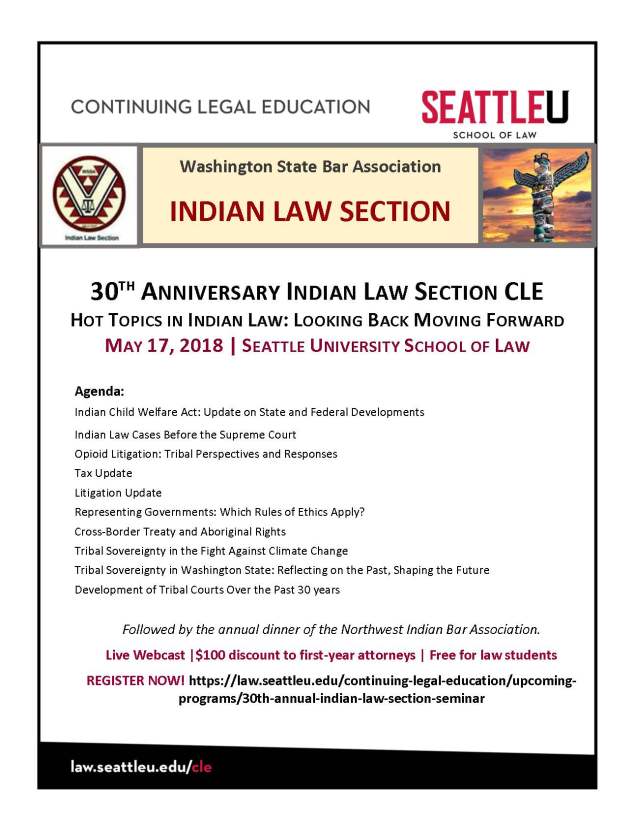
Washington State Bar Indian Law Section CLE
Consultation Webinar Announcement
Defending Tribal Sovereignty: The Ongoing Battle Over “Meaningful Consultation” and Self-Governance Over Natural and Cultural Resources
May 23, 2018
12:00 PM – 1:30 PM EST
Non-CLE Webinar
(direct link: https://shop.americanbar.org/ebus/ABAEventsCalendar/EventDetails.aspx?productId=326797486)
The Dakota Access Pipeline, Bears Ears National Monument, de-listing of the gray wolf and the Greater Yellowstone Ecosystem Grizzly Bear, and the Bureau of Land Management’s rule regulating hydraulic fracturing on Federal and Indian land. These high-profile courtroom dramas are about more than the protection and use of natural resources: they encapsulate the ongoing struggle between tribes and federal agencies over the government’s obligation as trustee to engage in “meaningful consultation” about actions impacting Indian Country. These developments are just the latest in a centuries-long debate about the meaning of tribal sovereignty, and they offer an indigenous perspective into the promise of true environmental justice.
2017 ICWA Case Law Update and Commentary
Addie Smith and I put this together:
Indian Child Welfare Act Annual Case Law Update and Commentary
This article provides a comprehensive catalog of published ICWA jurisprudence from across all fifty states in 2017. Designed as a quick reference for the ICWA practitioner, this article summarizes key case decisions that have interpreted the law in meaningful, significant, or surprising ways. It also tracks current attempts by ICWA’s opponents to overturn the law. By providing an overview of last year’s ICWA cases, this article is meant to keep practitioners up-to-date so they can be effective in the juvenile courtroom without sorting through and reading the dozens of cases published across all fifty jurisdictions.
“If You Find Doughnuts and 900 Pounds of Bacon in the Woods of Michigan, Don’t Touch It”
From VICE, here.
 Turtle Talk
You must be logged in to post a comment.