¶28 In this case, CPS Lebrun’s testimony that an unidentified person orally confirmed that “they are not eligible, just they can only be descendent members” does not satisfy the Department’s ICWA burden. As a direct result of the Department’s failure to satisfy this burden—and likely assuming the Department had, prior to filing its Notice of No ICWA Involvement, followed up with formal inquiry with the Blackfeet Tribe as CPS Lebrun testified he would—the District Court proceeded to termination without conclusive determination from the Tribe. No documentation or testimony of an authorized tribal representative either dispelled or confirmed the District Court’s and Department’s belief that the children were not Indian children as defined by ICWA. Under the circumstances of this case, we hold the District Court erred by proceeding to terminate Mother’s rights to D.E. and A.E. without a conclusive tribal determination of their tribal membership status and eligibility.¶29 Accordingly, we hold the District Court abused its discretion in terminating Mother’s parental rights without a conclusive tribal determination of tribal membership status and enrollment eligibility. We reverse and remand for an appropriate threshold determination of whether D.E. and A.E. are Indian children based on a conclusive tribal determination of tribal membership and eligibility in the Blackfeet Tribe. Further, if D.E. and A.E. are conclusively identified as Indian children subject to the requirements of ICWA, the District Court shall hold further proceedings as may be necessary to meet the evidentiary burdens of ICWA.
North Carolina “Reason to Know” ICWA Notice Case
Here.
*Whether the evidence presented at the adjudication hearing should have caused the trial court to have reason to know an “Indian child” may be involved and trigger the notice requirement is the issue before us. The federal regulations implementing ICWA and promulgated in 2016, clearly the states court has reason to know an “Indian child” is involved if: “Any participant in the proceeding, officer of the court involved in the proceeding, Indian Tribe, Indian organization, or agency informs the court that it has discovered information indicating that the child is an Indian child.” 25 C.F.R. § 23.107(c)(2) (2018).
The ICWA proscribes that once the court has reason to know the child could be an “Indian child,” but does not have conclusive evidence, the court should confirm and “work with all of the Tribes … to verify whether the child is in fact a member.” 25 C.F.R. § 23.107(b)(1). Federal law provides: “No foster care placement or termination of parental rights proceeding shall be held until at least ten days after receipt of notice by the parent or Indian custodian and the tribe or the Secretary[.]” 25 U.S.C. § 1912(a). Further, a court must “[t]reat the child as an Indian child, unless and until it is determined on the record that the child does not meet the definition of an ‘Indian child.’ ” 25 C.F.R. § 23.107(b)(2).
Other jurisdictions have recognized that “Indian child” status of the juvenile can only be decided by the tribe itself; therefore, only a suggestion that the child may be of Indian heritage is enough to invoke the notice requirements of the ICWA. In re Antoinette S., 104 Cal. App. 4th 1401, 1408, 129 Cal.Rptr.2d 15, 21 (2002). Additionally, ICWA provides that even after the completion of custody proceedings, if the provisions of ICWA were violated, “any parent or Indian custodian from whose custody such child was removed, and the Indian child’s tribe may petition any court of competent jurisdiction to invalidate such action.” 25 U.S.C. § 1914 (2012).
In In re A.R., the Respondent-father claimed that he had “a family connection to a registered Native American group” which consequently qualified his children for the protections under ICWA. In re A.R., 227 N.C. App. 518, 523, 742 S.E.2d 629, 633 (2013). . . . Further, this Court held that “[t]hough from the record before us we believe it unlikely that [the juveniles] are subject to the ICWA, we prefer to err on the side of caution by remanding for the trial court to … ensure that the ICWA notification requirements, if any, are addressed … since failure to comply could later invalidate the court’s actions.” Id.
In the case of In re C.P., the respondent-mother made the bare assertion that she and her children could possibly be eligible for membership with a band of Potawatomi Indians. In re C.P., 181 N.C. App. at 702, 641 S.E.2d at 16. The trial court required the ICWA notice to be sent. Id. When the time required under ICWA had passed without response from the tribe, the trial court allowed two continuances before determining ICWA did not apply and resumed the proceedings. Id. at 703, 641 S.E.2d at 16-17.
***
Our Court has required social service agencies to send notice to the claimed tribes rather than risk the trial court’s orders being voided in the future, when claims of Indian heritage arise, even where it may be unlikely the juvenile is an Indian child. See In re A.R., 227 N.C. App. at 524, 742 S.E.2d at 634; In re C.P., 181 N.C. App. at 702, 641 S.E.2d at 16.
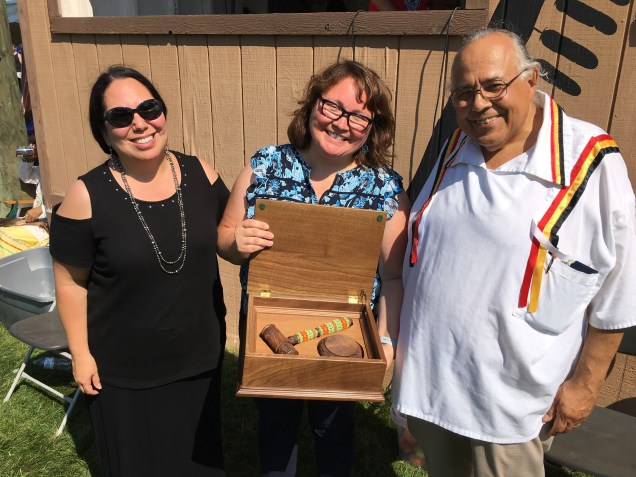
LTBB Honors Former Appellate Justice Wenona Singel

Annoucement: Training with Bois Forte Victim Services
Bois Forte Victim Services is hosting training on VAWA/TLOA, VAWA implementation, utilizing tools provided under VAWA in a P.L. 280 state, and the interplay between domestic violence, substance abuse, and child welfare matters. The speakers are experts in their respective fields. The training is free.
Please click here for the advertisement and registration form. Note that CLE and CEU (for social workers) credits are pending approval.
When: August 29-30, 2018
Where: Fortune Bay Casino and Hotel
Friday Job Annoucements
Job vacancies are posted on Fridays. Any posts received prior to 12pm EST on Friday will appear in that Friday’s announcements. If you would like to submit a post for an Indian law or leadership job, please send a brief description of the job and a PDF job announcement to indigenous@law.msu.edu.
View job postings from August 3, 2018.
Table Mountain Rancheria
In-House Legal Counsel, Friant, CA. Serve as legal advisor to the Tribal Council, tribal government departments and economic enterprises. Perform high level legal research and analysis in numerous areas of law and policy related to Federal Indian and California Law. Provide in-house support and legal advice on Tribal, State, Gaming and Federal laws and regulations. Please see the job description for more information.
Sacks Tierney, P.A.
Litigation Associate, Scottsdale AZ. Seeking a candidate with three to five years of experience. Knowledge of tribal law and water law is strongly preferred. Please direct questions and send resumes to Nicole at Nicole.vick@sackstierney.com.
Shute, Mihaly & Weinberger LLP
2019 Summer Clerkships and Fellowships, San Francisco, CA. Shute, Mihaly & Weinberger LLP is a boutique law firm specializing in government, land use, renewable energy, and environmental law. Summer clerkships are open to students who will have completed their 2L year. The three-year fellowship is open to recent law school graduates. Applications are accepted on a rolling basis, with a deadline of August 15 for the clerkship and Labor Day for the fellowship. Please see the job descriptions for more information.
WildEarth Guardians
(2) Staff Attorneys, Sante Fe, NM. WildEarth Guardians seeks two public interest-focused staff attorneys with a minimum of 5 years experience to join our legal team. Experience with at least some of the laws governing management, land use, and resource protection on public lands is essential. Applications should include, in a single pdf: cover letter; resume; one legal writing sample; and contact information for three professional references. The hiring committee will review applications on a rolling basis, with an ideal start date of no later that September 28. Please see the job description for more information.
Federal Communications Commission
Attorney Advisor (General), Washington, D.C. The position is in the Consumer and Governmental Affairs Bureau, Office of Native Affairs and Policy. Incumbent in this position: Serves as a senior attorney advisor to the Chief and Deputy Chief, on all policy matters. Provides expertise on Tribal issues and ensures that the Commission’s telecommunications regulatory policies with respect to federally-recognized American Indian Tribes, Alaska Native Villages, Hawaiian Home Lands, and other Native Communities are implemented and met. Application closes August 21, 2018. Please see the job description for more information.
Department of the Interior
(2) Attorney Adviser (General), Lakewood, CO. Specific duties will include providing a full array of legal services to the offices and programs of the Office of Natural Resources Revenue (ONRR); Coordinating with colleagues and other offices in the Office of the Solicitor; and reviewing proposed legislation and testimony on proposed legislation related to the ONRR. Application closes August 16, 2018. Please see the job description for more information.
Department of Justice
(2) Trial Attorneys, Denver, CO. The Natural Resources Section seeks to hire and cultivate talented trial attorneys and provides its lawyers with frequent and meaningful court experience in a variety of jurisdictions on a broad range of issues. The ideal candidate should be comfortable in a “first-chair” role in multiple complex cases. The application closes September 4, 2018. Please see the job description for more information.
Trial Attorney, Washington, D.C. The Environment and Natural Resources Division, Indian Resources Section seeks applicants with a demonstrated record of complex case management, initiative and creativity, strong courtroom skills, outstanding legal writing, and a commitment to the highest ethical and professional standards. Experience in water rights litigation and knowledge and experience in Indian, administrative, and constitutional law are highly desirable. Application closes August 30, 2018. Please see the job description for more information and to apply.
(8) Trial Attorneys, Washington D.C. The Natural Resource Division seeks attorneys for cases involving the stewardship of our national parks, forests, rangelands, wildlife refuges, and offshore resources; the Nation’s trust relationship with Native Americans and Tribes; vital federal programs ranging from nuclear materials management to military preparedness to energy policy and resource extraction; and original actions in the U.S. Supreme Court to resolve boundary and water allocation disputes. Applications close September 4, 2018. Please see the job description for more information.
Assistant United States Attorney, Phoenix, AZ. AUSAs represent the interests of the United States of America in the United States District Court of Arizona and the United States Court of Appeals for the Ninth Circuit. AUSAs immediately undertake cases, many high profile, in any of several units within each division. Application closes August 16, 2018. Please see the job description for more information.
Assistant United States Attorney (Criminal), Portland, OR. The qualified applicant would be expected to (a) assist federal law enforcement agents in structuring and implementing criminal investigative plans and strategies; (b) actively participate in grand jury proceedings; and (c) litigate cases of moderate to high complexity from start to finish with limited supervision. Application closes August 20, 2018. Please see the job description for more information.
(2) Assistant United States Attorney (Civil), Portland, OR. Seeking attorneys to fill an Assistant United States Attorney vacancy in the Asset Recovery and Money Laundering Division, Affirmative Civil Enforcement (ACE) unit. Application closes August 20, 2018. Please see the job description for more information.
Assistant United States Attorney (Criminal), Medford, OR. The individual selected for this position will be responsible for the investigation and prosecution of violent crime cases that may include drug crimes; firearms offenses; child exploitation crimes; human trafficking; organized crime; criminal immigration matters; and general crimes. Application closes August 20, 2018. Please see the job description for more information.
Honors Program Entry Level Attorneys, Washington D.C. This job is being filled at many locations nationwide. The Attorney General’s Honors Program is the Department of Justice recruitment program for entry-level attorneys, and attracts applications from law students graduating during the current academic year, and law school graduates serving in judicial clerkships, qualifying full-time fellowships, or attending full-time graduate law programs (LL.M.). Application closes September 4, 2018. Please see the description for more information.
Opinion in the Grayeyes Case
Federal Magistrate Quashes Third Party Subpoena Issued against Tunica Biloxi Tribal Enterprise
Here are the materials in Commonwealth of Pennsylvania v. ThinkFinance (E.D. La.):
High Country News: “The next Supreme Court pick could shape Indian law for decades”
Here.
Commentator in Salt Lake Tribune Calls for Criminal Prosecution of San Juan County Clerk
National Indian Law Library Bulletin (8/8/2018)
Here:
The National Indian Law Library added new content to the Indian Law Bulletins on 8/8/18.
Law Review & Bar Journal Bulletin
http://www.narf.org/nill/bulletins/lawreviews/2018.html
- Dismantling monuments.
- Native American reproductive health law–Reproductive Justice: The politics of healthcare for Native American women. [Book Review]
- Tribal sovereign immunity at the patent and trademark office.
- Standing Rock in the swamp: Oil, the environment, and the United Houma Nation’s struggle for federal recognition.
Federal Courts Bulletin
http://www.narf.org/nill/bulletins/federal/2018.html
Carter v. Tahsuda (Indian Child Welfare Act – Constitutionality)
State of California v. Iipay Nation of Santa Ysabel (Gaming; Unlawful Internet Gambling Enforcement Act)
Northern Natural Gas Company v. 80 Acres of Land in Thurston County (Utilities; Rights-of-Way – Condemnation)
Wilhite v. Awe Kualawaache Care Center (Jurisdiction; Racketeer Influenced and Corrupt Organizations Act)
State Courts Bulletin
http://www.narf.org/nill/bulletins/state/2018.html
State v. George (Jurisdiction)
Cayuga Nation v. Campbell (Official Tribal Government)
News Bulletin
http://www.narf.org/nill/bulletins/news/currentnews.html
In the Land & Water section, we feature an article about a study on the changing scope of Native American groundwater rights.
U.S. Legislation Bulletin
http://www.narf.org/nill/bulletins/legislation/115_uslegislation.html
The following bills were added:
- S.2850: A bill to amend the White Mountain Apache Tribe Water Rights Quantification Act of 2020 to clarify the use of amounts in the WMAT Settlement Fund.
- H.R.6510: To establish, fund, and provide for the use of amounts in a National Park Service and Public Lands Legacy Restoration Fund to address the maintenance backlog of the National Park Service, United States Fish and Wildlife Service, Bureau of Land Management, and Bureau of Indian Education, and for other purposes.
- S.3269: A bill to establish the Department of Veterans Affairs Advisory Committee on Tribal and Indian Affairs, and for other purposes.
- S.3280: A bill to increase intergovernmental coordination to identify and combat human trafficking within Indian lands and of Indians.
- H.R.6545: Violence Against Women Reauthorization Act of 2018. (See Title IX)
- H.Res.1037: Recognizing the 29th anniversary of the Tribal Canoe Journey of the Tribal Nations of the Pacific Northwest and congratulating the Puyallup Tribe of Indians for hosting the 2018 Power Paddle to Puyallup.
- H.R.6647: To amend the Native American Graves Protection and Repatriation Act to move the enforcement office to the Bureau of Indian Affairs, to increase the civil monetary penalties for failure to follow the processes established by that Act, and for other purposes.
 Turtle Talk
You must be logged in to post a comment.